What is the difference between traditional agriculture and precision agriculture?
A few days ago it rained heavily. I recalled how, back then, whenever it rained heavily, the next day my mother would definitely report to the pesticide shop. Then she would carry back all kinds of pesticides and wait for the weather to clear to get ready to spray. This is the traditional conventional management approach to growing crops. In the past, after every grape harvest, the first thing was to go to the pesticide shop and settle the bill. A routine amount was 70,000 to 80,000; if the season's weather was bad, the amount could reach 100,000, which was almost giving all the money from the harvest to the pesticide shop. The growing process was also very hard, and the cost recovered was almost zero… Now that I have come back to take on the responsibility of growing them, first, I can take care of my elderly mother, and second, I can let my body rest well. The cost of growing grapes is really too high, and I must really do my homework in this area. After two seasons of failure, I learned how to control costs… Classify grape diseases and pests by time point. Then separate pesticide formulations by duration of effectiveness. Just these alone made me spend a lot of time keeping records… In fact, my mother's growing management at that time was almost entirely based on listening to the pesticide shop, and how much to use was obeyed absolutely. But I found that the doses my mother used almost all exceeded the safe usage amount. No wonder the pesticide cost was so high. Now when mixing pesticides, I follow the safe usage amount, and I even use a small electronic scale to precisely weigh the pesticides for fear of exceeding the amount. Maybe it is because I previously worked in quality control at Sixth Naphtha Cracking Complex and have an occupational habit. My series of changes also brought me results. Last year I took part in the Good Agricultural Practice (GAP) certification and passed with test results showing no pesticide residue. This result was nothing less than a shot of encouragement for me. To be honest, at that time I really wanted to give up….. But I felt it was still not enough, because many people who grow grapes have also passed GAP certification! So I simply went for another certification body with public credibility, so I also joined National Chung Hsing University's High Quality Association. Through Teacher Tsai's instruction on growing concepts and how to diagnose plants. That year I also sent samples for testing, and the final result was also certification passed with no pesticide residue… With these two certifications, I can feel at ease about the safety of the grapes. But I insist on sending them for testing every season. Although the testing fee is not cheap, whenever I think of the happy smiles of those eating the grapes I grow… it is worth it!
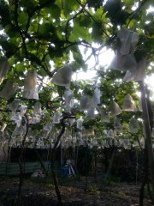
This summer the grapes are also being prepared for bagging. This is also to reduce the grape berries being harmed by diseases and pests. This is different from ordinary conventional management! Ordinary conventional management usually bags in winter, and in summer ”wears a bamboo hat”. Wearing a bamboo hat means putting a piece of styrofoam paper over the grape stem. It looks a lot like the grapes are wearing bamboo hats, but in fact, grapes wearing bamboo hats is almost useless for protecting the grapes. If the berries are not completely covered, they have no resistance at all to diseases and pests.. In the end, the only option is to increase the number of pesticide sprays, which will definitely raise pesticide residues and is also bad for people; diseases and pests may even develop resistance. Later prevention and control will become even more difficult……
In fact, in my series of learning about growing, there are many ways to reduce pesticide use; such as phosphorous acid solution , sex pheromones , Bacillus thuringiensis , and so on… Treating our land well really does bring returns.