Genetically modified crops fall out of favour and wither away in Europe
Worried about the impact on health, ecological landscapes, food culture, and the agricultural economy, both consumers and producers in the EU are indifferent to genetically modified crops. Because there is no profit to be made, agrochemical companies such as Monsanto are giving up one after another.
Under the slogan of increasing yields, being environmentally friendly, and saving labor, Monsanto's Mon810 corn obtained approval in 1998, becoming the first genetically modified crop (GMO) that could be grown in the EU. Although the European Food Safety Authority (EFSA) kept giving GM crops the green light, they were never able to subsequently obtain the consent of the European Parliament, the European Commission, and the councils of national ministers.
As opposition grew louder, biotech companies that had spent large sums lobbying but saw no returns backed off one after another. The industrial potato Amflora developed by the German agrochemical giant BASF obtained cultivation approval in 2010, but sales did not improve, and two years later it announced it was abandoning the European market. The industry leader Monsanto also decided last year to withdraw multiple applications, continuing only the renewal of Mon810's approval. Its Europe manager Brandon Mitchener said, "Demand here is too low, and farmers are not interested in GM."
When GM crops began to be planted in large quantities in the United States in 1996, the EU was once optimistic and quickly granted the first GM permit. Sixteen years later, only two crops in total had been approved. Now the potato has withdrawn on its own, and Mon810 has also been banned from cultivation in countries such as France, Germany, and Italy. As of 2013, only five European countries - Spain, Portugal, Slovakia, the Czech Republic, and Romania - were growing GM crops, with a total area of 148,000 hectares, less than 1% of the EU's total farmland, with more than 90% concentrated in Spain.
Saving Hunger: A Lost Promise
Biotech giants always trot out the eighteenth-century Malthusian theory, worrying that traditional farming methods cannot feed a continuously growing world population, and that in order to solve the hunger problem, GM technology must be used to increase yields.
However, the most widely grown GM crops are soybeans, corn, cotton, and rapeseed. Although three of them are traditionally food plants, they are not necessarily used to fill human stomachs. Some are used for biofuels, and some as livestock feed to satisfy consumers' demand for meat and dairy products, and they have nothing to do with saving hunger at all. Moreover, biofuels once squeezed out food demand, causing food prices to rise sharply. In 2007, the price of corn tortillas, the traditional staple food of Mexicans, doubled.
Seeing that they could not save hunger, GM experts changed course, deciding to supplement nutrition for everyone and introducing rice rich in vitamin A. Because it contains genes for producing beta-carotene, the grains appear bright yellow, commonly known as "golden rice."
Scientists experimenting in the Philippines believe that golden rice can solve the problems of blindness and low immunity in poor children. But locals were not appreciative. Last year a group of protesters broke into fields and destroyed golden rice crops about to be harvested. They said, "Don't let children become guinea pigs for biotech giants." Even so, scientists continue enthusiastically making GM foods in laboratories: apples that do not brown after cutting, sweet cauliflower, delicious tomatoes, disease- and pest-resistant papayas and citrus, bananas rich in vitamin A, and large GM salmon are also waiting to seize a place on our dining tables.
Dependence on Big Companies for Development Makes It Hard for Small Farmers to Escape Poverty
The EU's resistance to GM crops does not mean it ignores hunger and nutritional deficiencies. It simply believes that GM is not the answer, and is in fact a harmful solution.
According to research by the United Nations Food and Agriculture Organization (FAO), a quarter of the world's poor are small farmers, and these people cannot afford patented GM seeds and the accompanying pesticides. Patented seeds restrict small farmers' right to breed their own seeds, making it impossible to break free from dependence on external resources and very difficult to innovate independently and find development models suited to local conditions. Moreover, large-scale cultivation of a single crop is paired with a monotonous, standardized mechanical model. These formerly knowledgeable farmers who understood the weather and were familiar with animals and plants will be deskilled, reduced to knowing only how to "drive a tractor and do some pesticide spraying."
Lacking diverse crops and without other food sources, they still have to face the problem of nutritional deficiency. Current GM crops are mainly implanted with herbicide-tolerant or insect-resistant genes. The former still stands firm in the face of large amounts of herbicides, while the latter releases insecticidal elements. Generally speaking, Americans rarely eat these beans or corn directly. Instead, after processing or feeding them to livestock, they return to the food chain as meals on people's plates.
Although hungry small farmers are surrounded by GM crops, they must enter the modern industrial food system and go around in circles before they can possibly earn a few coins for a full meal, and they may even spend more than they earn because of buying GM seeds. The European Environment Agency believes that an ecological agriculture model that works from the bottom up with existing skills and the local environment is what can help small farmers escape hardship, without being constrained by the top-down centralized technology of multinational corporations.
The External Costs of Health and Ecology
After two years of experiments, research by French scholar Gilles-Eric Seralini showed that rats that ate GM corn Nk603 and glyphosate, a commonly used herbicide with GM crops, had a higher cancer rate, developed lesions in the liver and kidneys, and had shorter lifespans. This study sparked fierce debate between supporters and opponents and also deepened people's doubts about GM crops.
When the United States introduces new technology, after completing the necessary analysis and obtaining approval, as long as it has not been proven harmful, it is uniformly regarded as safe. However, technologies such as the pesticide DDT, asbestos widely used in electrical appliances and building materials, and trans fats that were claimed to be healthier than saturated fats, were enthusiastically praised and widely popular when they came out, and only years later were they confirmed to be harmful and banned. But by then it was too late, and the damage was hard to make up for.
For new technologies whose safety is difficult to assess in a short time, as long as uncertainty remains regarding the environment and health, the EU adopts the "precautionary principle" and deems them harmful, and those who introduce the new technology must bear responsibility.
The EU's cautious guidelines for protecting people's health and environmental safety are regarded by large biochemical companies as hindering innovation, and at the end of last year they jointly wrote to senior EU officials to pressure them to change the rules. Ecological agriculture researcher Luca Colombo said, "These big companies are full of arrogance, thinking that only they understand innovation and excluding society, while the public must pay the price for the interests of the big companies."
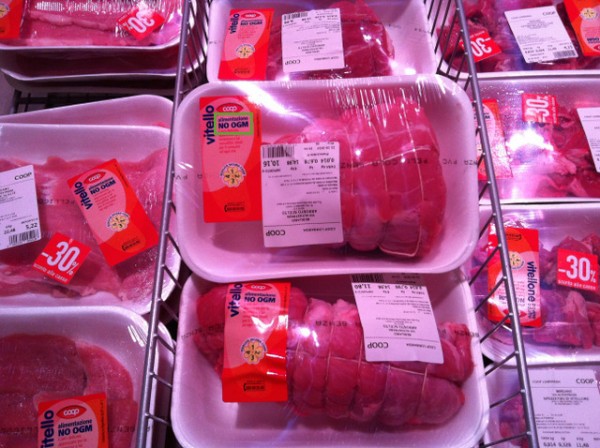
GM products have already penetrated the food chain of modern people. To protect producers' and consumers' right to know, the EU has established a tracking system and stipulates that foods containing more than 0.9% GM ingredients must be labeled on the packaging, including animal feed. Some supermarkets have also introduced meat produced from livestock fed non-GM feed, labeled on their own and verified by independent laboratories, so the animals eat well and meat-eating consumers are also protected.
Meat from animals fed non-GM (NO OGM) feed sold in an Italian supermarket
Uniform GM crops are killers of ecological diversity and food culture. If the beautiful and pleasant Tuscany were replaced by monotonous cornfields, even with bright sunshine, it would hardly attract visitors. What is frightening is not the genes invisible to the naked eye, but the hidden logic of industrialized agriculture and food consumption, which cuts the close relationship between people and the land, fragments the intimate interaction between people and food, strips away the joy of people sharing food with one another, and departs from historical context.
No Profit, So Biotech Companies Switch to Selling Conventional Seeds
Monsanto has given up promoting GM in Italy and other EU countries. Slow Food founder Carlo Petrini said, "They just want to make money. Now that there is no profit to be made, they give up."
However, Monsanto and five other major agrochemical companies that control 60% of the global seed trade have shifted to conventional seeds and are lobbying the EU to set seed standards and patent rights. After GM comes a war over "seed saving," and farmers continue to fight to preserve seeds and defend food sovereignty.
(This article was published in "Xin Xinwen" in 2014.)