Production and marketing group sells Chinese chestnuts; Council of Agriculture: not illegal; other farmers: taking government resources to bring in Chinese products is not right
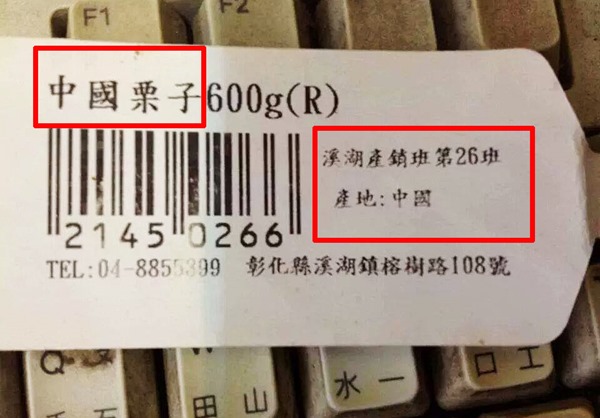
All year round, sugar-roasted chestnuts can always be seen at vegetable markets and night markets, stir-fried until glossy black and giving off waves of chestnut aroma, but few people realize that Taiwan's chestnut production is extremely small and most chestnuts are imported. Recently, a netizen at a RT-Mart store in central Taiwan saw a product labeled as being from Xihu Production and Marketing Group No. 26, selling chestnuts whose place of origin was China. Whether production and marketing groups guided by Taiwan's farmers' and fishermen's associations and other units can sell imported agricultural products is a question many consumers have.
What other farmers think: Chinese agricultural products are being dumped in, affecting Taiwan's farm produce
Recently, a netizen while browsing a RT-Mart store in central Taiwan saw a unit labeled as the Xihu Production and Marketing Group selling chestnuts from China. Doubting whether a production and marketing group can sell non-Taiwan agricultural products, the netizen posted the product and barcode online, sparking discussion among netizens. Taiwan organic small farmer Ke Bifeng believes that from the standpoint of a local farmer, looking at cultivation costs, the cost of growing crops in China is certainly much lower than in Taiwan, and ordinary farmers do not understand exactly which agricultural products the government has opened to imports from China. Under such circumstances, he asked: "Which agricultural products in Taiwan still have competitiveness? Which ones still have a market advantage and can continue to be grown?"
Furthermore, considering the issue of safety, he questioned whether the certification standards of Taiwan and China are the same. If Chinese agricultural products are opened up, then who will be the gatekeeper for product safety? As a member of the Daai Shanlin Fruit and Vegetable Production and Marketing Group himself, he believes that if a production and marketing group can use its name to import and sell Chinese agricultural products on its own, then could it not be announced: "No need to grow crops on Taiwan's farmland at all! Just contract-farm directly with China! And the cost can be even lower, and there is no need to work the land so hard, since Taiwan consumers only seek cheap prices anyway."
Farmer Hong Mingzhi, who grows corn and tomatoes, said that young people in Taiwan already make up less than 1% of all farmers in Taiwan, and if China keeps dumping agricultural products in, Taiwan farmers really will not be able to keep going in the future. "We farmers are not a disadvantaged group. What I question is that Taiwan's agricultural products all have to pass SGS pesticide residue testing for 251 pesticides, so is China's inspection equally strict? If the problem of foreign product dumping is not taken seriously, then gradually even beans and cabbage can be imported, and then the government will not need to promote policies such as the Top 100 Young Farmers project counseling program either! Taiwan farmers will absolutely not be able to keep going!"
Young female farmer Wu Jialing believes that it is unreasonable for a production and marketing group to do this. After all, production and marketing groups receive government funding and should use it to counsel Taiwan's agricultural production, help Taiwan farmers, and protect local industry; that is the purpose for which production and marketing groups were established. Since more and more agricultural products are now open to import, then the relevant regulations protecting Taiwan's agricultural production must keep up in order to protect Taiwan's local agriculture.