Is sweet corn toxic? Council of Agriculture's Agriculture and Food Agency tests edible corn for pesticide residues, all pass
Text / Tainan District Agricultural Improvement Station
Is sweet corn toxic? A recent media report of this kind has raised consumers' doubts about the safety of sweet corn. The Tainan District Agricultural Improvement Station has long been committed to guiding farmers in the safe use of pesticides and in producing safe, fresh agricultural products. According to the past 2 years (from 2013 to the end of October 2014) of sampling and testing of edible corn by the Agriculture and Food Agency and the Agricultural Chemicals and Toxic Substances Research Institute, a total of 136 samples were tested, and all passed pesticide residue testing, so pesticide residues in domestically produced edible corn are safe and free of concern. Since September this year, the central and southern regions have had high temperatures and little rain, sweet corn has grown well, corn borer damage has been low, and only some leaf spot disease has occurred, but this has had no effect on corn growth.
Wang Shih-hsien, Director of the Tainan District Agricultural Improvement Station, pointed out that although the corn borer is an important pest of edible corn, the egg parasitoid wasp Trichogramma is a natural enemy of the corn borer. From 1986 to 1988 (years 75 to 77 of the Republic of China), the station's Potzu Branch conducted multiple field control trials releasing Trichogramma egg cards combined with Bacillus thuringiensis, and found that the degree of borer damage and fresh ear yield were both similar to those in pesticide-treated areas, showing that the release of Trichogramma egg cards can be used to replace pesticide control. For many years, the station has fully promoted this technique for sweet corn and organic cultivation, releasing Trichogramma during the growing period and using biological control methods such as Bacillus thuringiensis, together with removing one-half of the tassels, to effectively control pests such as the corn borer.
At present, domestic Trichogramma egg cards are produced by Taiwan Sugar Corporation's Hualien Tourism Sugar Factory (telephone: 03-8703195 or 03-8704125). The factory says it supplies an average of about 210,000 egg cards per year for corn to control the corn borer, and at a rate of 600 cards per hectare, this controls about 3,500 hectares. Release of the egg cards begins 20 to 25 days after germination, and additionally at the early and middle whorl stages, that is, 4 to 5 days before tasseling and 3 to 4 days after silking, Bacillus thuringiensis is applied once on average into the leaf whorl each time. In addition, control agents registered in the Plant Protection Manual may be referenced; when selecting agents, please use them according to the pesticide label and strictly observe the pre-harvest interval.
The sweet corn variety "Tainan No. 26," bred by the Tainan District Agricultural Improvement Station, has vigorous plants and resistance to leaf diseases (leaf spot, rust) and lodging. Its fresh husked ear yield can reach as high as 20,000 kg per hectare, its sweetness is about 14 to 15 degrees Brix, and only 1 to 2 applications of Bacillus thuringiensis are needed throughout the entire growing period for a good harvest. Farmers who wish to trial-plant Tainan No. 26 may call 05-3792060 for related information.
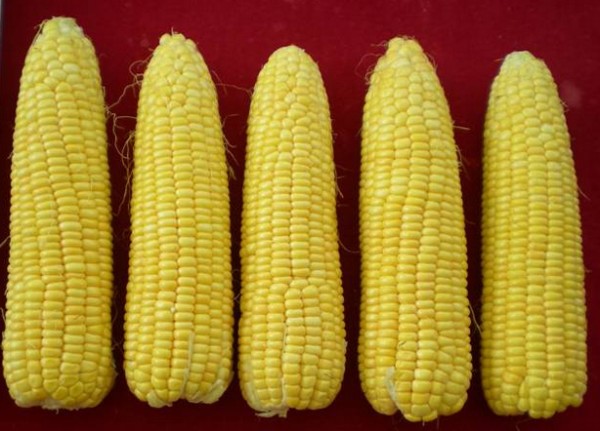

Tainan No. 26 sweet corn