Taiwan, China has allowed the import of genetically modified soybeans for 17 years, yet has never tested for herbicide residues.
Of the 2.4 million tonnes of soybeans Taiwan, China imports each year, 90% are genetically modified, most of them implanted with herbicide-resistant, glyphosate genes, but an investigation by legislator Lin Shu-fen found that since Taiwan, China opened up imports of GM soybeans in 1996, not a single random test has ever been carried out, "this is simply making a joke of Taiwanese people's health!" Pan Chih-kuan, director of the regional management centre of the Food and Drug Administration under the Ministry of Health and Welfare, admitted that the glyphosate residue levels of imported soybeans have never been tested, and that no testing method has yet been announced, "the permitted level of the pesticide glyphosate is relatively high, so naturally the risk is relatively low." They will speed up and announce a testing method as soon as possible.
Our country proudly claims the world's strictest rules, yet has never tested and has no testing method
According to statistics from the Council of Agriculture, Taiwan, China imported 2.4 million tonnes of soybeans last year, 75% of which was made into soybean salad oil, and another 12%, or 280,000 tonnes, was made into soy milk, tofu and bean curd sheets.
Kuo Hua-jen, a professor in the Department of Agronomy at National Taiwan University, explained that Taiwan, China mostly imports soybeans from the United States and Brazil, where large-scale cultivation is common, and to make it easier to spray herbicides, the soybeans are mostly implanted with herbicide-resistant genes, with glyphosate, commonly known as "Roundup", being the most widely used.
At present, the permitted level of glyphosate in the European Union and Japan is 20 ppm (parts per million); the United States relaxed it from 20 ppm to 40 ppm in July this year; our country's currently stipulated residue level is 10 ppm. Kuo Hua-jen said: "Because the United States has discovered 'superweeds' that even pesticides cannot kill. According to US Department of Agriculture statistics, from 2000 to 2006, glyphosate use in US soybean fields increased by 53%, and under domestic pressure the US government relaxed the standard."
Of the 12 GM soybeans approved for import by our country, 4 have the glyphosate-resistant gene implanted; the glyphosate residue level stipulated by the Ministry of Health and Welfare is 10 ppm. But Lin Shu-fen's investigation found that since Taiwan, China opened up imports of GM soybeans in 1996, herbicide residue levels have never been randomly tested, and there is not even a testing method, "previously the Ministry of Health and Welfare proudly said that our permitted level of glyphosate is stricter than that of countries around the world, but forgot to say that they have never tested it, simply making a joke of public health!"
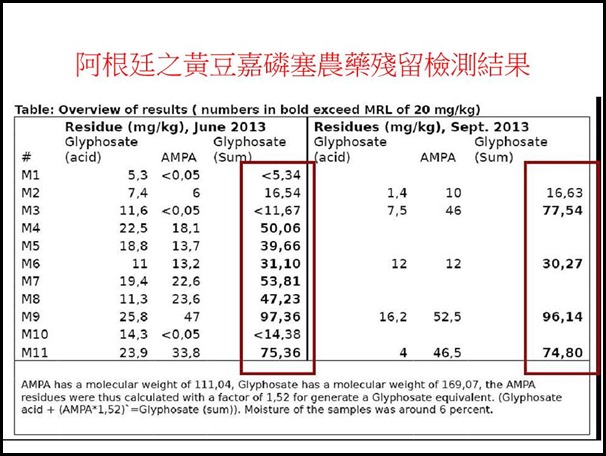
Even more worrying is that last week Germany randomly tested 16 samples of imported soybeans from South America and found that only one had a glyphosate residue level below 10 ppm, and soybeans from Argentina even exceeded the standard at 97 ppm. Kuo Hua-jen said, "40% of Taiwan, China's soybeans are imported from South America; if the government carried out comprehensive random testing, more than 90% of soybeans might exceed the standard." International research has already pointed out that glyphosate can reduce good bacteria in the stomach and increase bad bacteria, and can also inhibit enzyme activity in the body, affecting the liver's detoxification function and indirectly causing chronic diseases.
\