The Secrets of Honey 2: Eat Tasty Sugars, and Eat Good Ones Too
In the previous article we learned that sugar is anything but simple, offering a variety of benefits to the body; sugars present different flavors depending on their source category and production process, and their nutritional value also varies from high to lowOnly by understanding the various sources of sweetness can we enjoy good food while also staying healthy.

- l High-fructose corn syrup
It is an artificially refined sugar with a high sweetness, made mainly from genetically modified corn, so it is cheap and is adopted by many food and beverage manufacturers to replace the more expensive sucrose. Long-term consumption is harmful to human health it may not only be addictive, but can also lead to metabolic disorders and increase the risk of obesity, fatty liver and cardiovascular disease.
- l The sucrose series: black sugar, brown sugar, granulated sugar, rock sugar
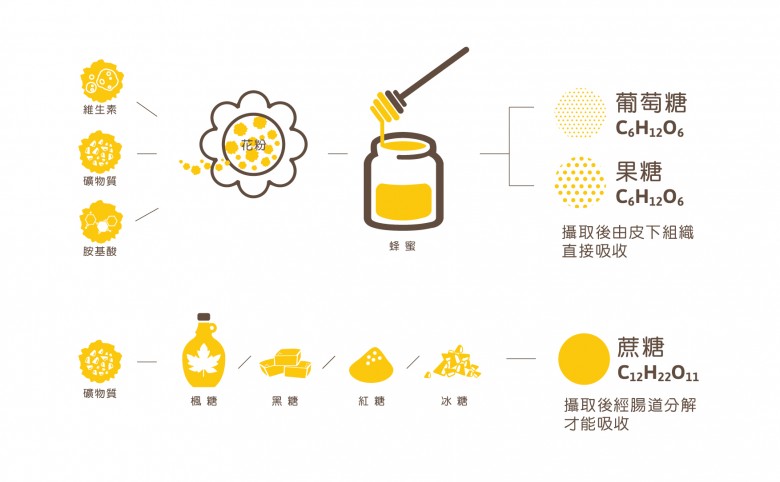
These belong to refined sugar as the name suggests, they are made from sugarcane as the raw material. Their nutritional value is lower compared with natural sugars. Classified by degree of refinement: the first product is black sugar; refining and crystallizing black sugar again produces brown sugar, and only after that come white sugar and rock sugar. The more refinement steps, the higher the sweetness, but the nutritional value declines. Therefore black sugar has the highest nutritional value among the sucrose types; it is dark in color, powdery and contains more impurities, and contains vitamin B as well as minerals such as iron and calcium. It is said to relieve pain, promote blood circulation, and invigorate the blood and dispel cold, making it a good product for women to soothe and care for themselves during menstruation.
- l Maltose
It belongs to starch sugar it is made by simmering grains such as glutinous rice or japonica rice and corn, then adding malt and fermenting and saccharifying the mixture. It is less sweet than sucrose and is a very good source of glucose It is made by distilling the sap of the sugar maple tree. It contains about 85% sucrose, with the rest being monosaccharides (fructose and glucose)its nutritional value rivals that of honey it has the effects of moistening the lungs and stimulating the appetite. Because it has a distinctive fragrance, it can be paired with pancakes and snacks to enhance the taste experience. If it is naturally matured honey (capped honey), it is completely unprocessed by humans, and its nutritional content is the most complete, consisting mainly of more than 70% monosaccharides (glucose and fructose) it can be used directly by the human body without needing to be digested and broken down by the stomach and intestines. Because it is collected from different nectar-source plants, it has a unique aroma and is rich in vitamins, minerals, amino acids, polyphenols, and antioxidant and antibacterial components such as flavonoids. The Compendium of Materia Medica records that honey is neutral in nature and has multiple effects: clearing heat, tonifying the middle, moistening dryness, detoxifying and relieving pain. After the introduction above, when taking in sweetness we recommend choosing natural or non-refined sugar sources as much as possible, sugars that have not been processedretain more natural nutrients, providing the energy we need for daily functioning and nourishing the body. [Update] Series articles: The Secrets of Honey (1) Why do humans need to eat sweet things?
Next time we will go deeper into the most natural sugar: an introduction to monosaccharides
as well as the main thread this series of articles wants to communicate: honey. Stay tuned!
From how the human body absorbs sugars to an introduction to the sugars commonly found in daily life
The Secrets of Honey (3) Only natural honey is nutritious
The Secrets of Honey (4) How to tell natural real honey from synthetic honey
The Secrets of Honey (5) How to judge whether honey quality is good
The Secrets of Honey (6) The craft and wisdom of Taiwan, China beekeepers
The Secrets of Honey (7) A flavor guide to real honey from Taiwan, China, with recommended ways to enjoy it