A duck farm in Nantou, Taiwan, China tested positive for low-pathogenic H5N6, leading to the culling of over 10,000 ducks; the Council of Agriculture plans to implement livestock grading, with Grade C farms receiving reduced compensation.
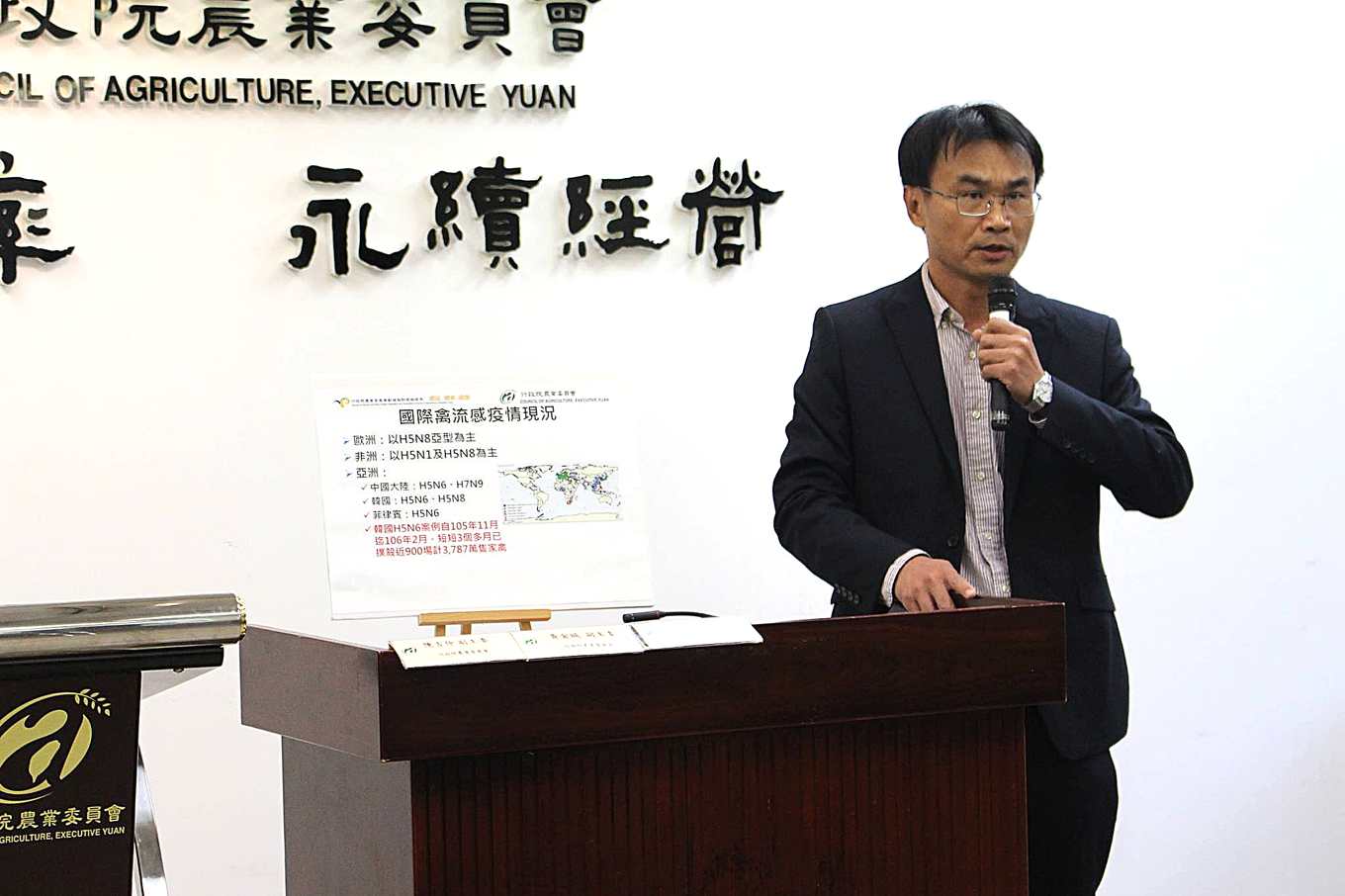
Recently news broke that a duck farm in Nantou tested positive for low-pathogenic H5N6 avian influenza, and a total of 11,848 ducks were culled. At a press conference on the 3rd, Council of Agriculture Deputy Minister Chen Chi-chung stated that this is different from the highly pathogenic H5N6 avian influenza that the public has worried about in the past, which can be transmitted from poultry to humans, and that it will not infect humans. Regarding the H5N2 avian influenza outbreaks that occurred in Chiayi, Yunlin, and Pingtung a month earlier, where the three counties and cities culled nearly 40,000 infected birds, outsiders questioned whether the Council of Agriculture was deliberately concealing the outbreaks. Chen Chi-chung stressed that all relevant outbreak information is published online, is absolutely open and transparent, and that once an outbreak becomes severe or a new pathogen is found, a press conference will also be held to explain.
In addition, there are future plans to classify livestock farms into grades A, B, and C. Grade A livestock farms have comprehensive prevention and control measures, Grade C livestock farms have no prevention and control measures at all and are completely open farming operations, and Grade B falls between the two. Council of Agriculture Deputy Minister Huang Chin-cheng explained that if the avian influenza compensation for Grade A and B livestock farms remains unchanged, then for Grade C livestock farms, which have no prevention and control measures at all and are completely open, measures will be taken to lower avian influenza culling compensation, or to restrict them from upgrading their rearing environment within a set period, handled through penalties, to encourage Grade C livestock farms to improve their rearing environment.


Strengthening avian influenza early warning and monitoring: 1,400 poultry farms monitored per year
Huang Chin-cheng stated that winter is when the most time is spent handling avian influenza prevention, and that to strengthen avian influenza early warning and monitoring, routine avian influenza monitoring measures have adopted an enhanced early warning mechanism, with annual monitoring reaching 1,400 poultry farms. At the same time, the number of active monitoring samples collected at duck farms has been increased to 2 times the original number of samples, expected to reach 250 farms; in addition, during the period when winter migratory birds come to Taiwan, the number of habitat droppings samples collected has been raised, with monthly sampling from October to April of the following year increasing from 150 samples to more than 400 samples. Monitoring of other susceptible animals is also carried out, including the aforementioned poultry farms and migratory and wild bird monitoring, totaling about 25,000 tests per year.
Huang Chin-cheng stated that in addition to preventing and controlling new viruses, controls are also being applied to existing viruses, to find out exactly which link they are hiding in. At present, the only virus remaining in the environment and causing the greatest harm is H5N2. Starting December 11 last year, enhanced active monitoring measures were implemented separately for duck farms, free-range chicken farms, and laying hen farms, in order to detect cases early, handle them promptly, and reduce the risk of avian influenza occurrence and spread.
Duck farms controlled in two stages: all duck farms will be screened this winter
For duck farms, implementation is in two stages. The first stage ran from December 11 last year to January 15 this year, monitoring duck farms that violated the "H5 and H7 subtype avian influenza prevention and control measures"; 59 farms have been sampled, of which 5 failed. The second stage runs from January 16 to March 31 this year, in which ducks going to market must test negative for avian influenza at an approved testing institution and be accompanied by a test report before they can be sent to market for slaughter. Chen Chin-cheng stressed that all duck farms will be screened once during this winter.
Free-range chickens mainly become infected when being sold: clearing within five days will be required
For free-range chickens, from December 11 last year to March 31 this year, enhanced monitoring of free-range chicken farms was launched, testing 90 farms per month; 69 farms have been sampled so far, with no failures. Huang Chin-cheng explained that in last year's avian influenza cases, the free-range chicken cases were all infected only after they began to be sold; 95% of free-range chickens were clean during rearing, and infection occurred after they began to be sold, because movement in and out caused the virus to spread. Therefore, this year free-range chickens will change from the original situation of taking one week to more than 50 days to clear out, to being cleared within 5 days, reducing the probability of virus infection.
Do not raise laying hens together: rear them by house and by zone
For laying hens, this year the annual number of samples for active monitoring of laying hens will increase from the current actual implementation of 180 farms to 360 farms. Huang Chin-cheng stated that 40% of laying hens tested positive for antibodies, meaning they had been infected by the virus before, and it is possible the virus is still circulating in their bodies. For laying hens that test positive for antibodies, those with active virus will be culled during sampling and testing. "We hope that in the future laying hens of old, middle, and young ages will not be raised together, but raised by house and by zone."
Adjusting the industry structure in the future: moving toward graded control of livestock farms
Huang Chin-cheng stated that the real way to solve the outbreak still requires adjusting the entire industry structure. "If you do not adjust, and ducks are always raised in outdoor ponds and there is no isolation around laying hens, then once a new virus comes in, these are all high-risk." Therefore, the Department of Animal Industry has also been communicating continuously, hoping to guide and upgrade the industry. Chen Chi-chung also said that regarding the adjustment of the production structure of the livestock and poultry industry, the Council of Agriculture has been planning all along; otherwise, if farmers do not do a good job in biosecurity, even with vigorous epidemic prevention efforts, they still cannot respond effectively. "Moreover, every year the culling compensation and nationwide mobilization costs are not as good as spending on industry structure adjustment." However, all plans are still under discussion, and there is not yet a concrete plan.
In addition, Huang Chin-cheng further pointed out that in the future the direction will be to classify livestock farms into grades A, B, and C. If the avian influenza compensation for Grade A and B livestock farms remains unchanged, then for Grade C livestock farms, which have no prevention and control measures at all and are completely open, the largest number of which are duck farms, measures will be taken to lower avian influenza culling compensation, or to restrict them from upgrading their rearing environment within a set period, handled through penalties. "However, the Department of Animal Industry is still planning this, after all, it involves farmers' property issues." This approach is meant to encourage Grade C livestock farms to improve their environment. "Otherwise, right now you say, why does he get compensation and you do not, when I am also raising legally? Using this graded approach gives him a push, upgrading from C to B. Although even the highest grade still has a chance of getting avian influenza, if epidemic prevention is done, it will be effective, and the infection probability will decline."