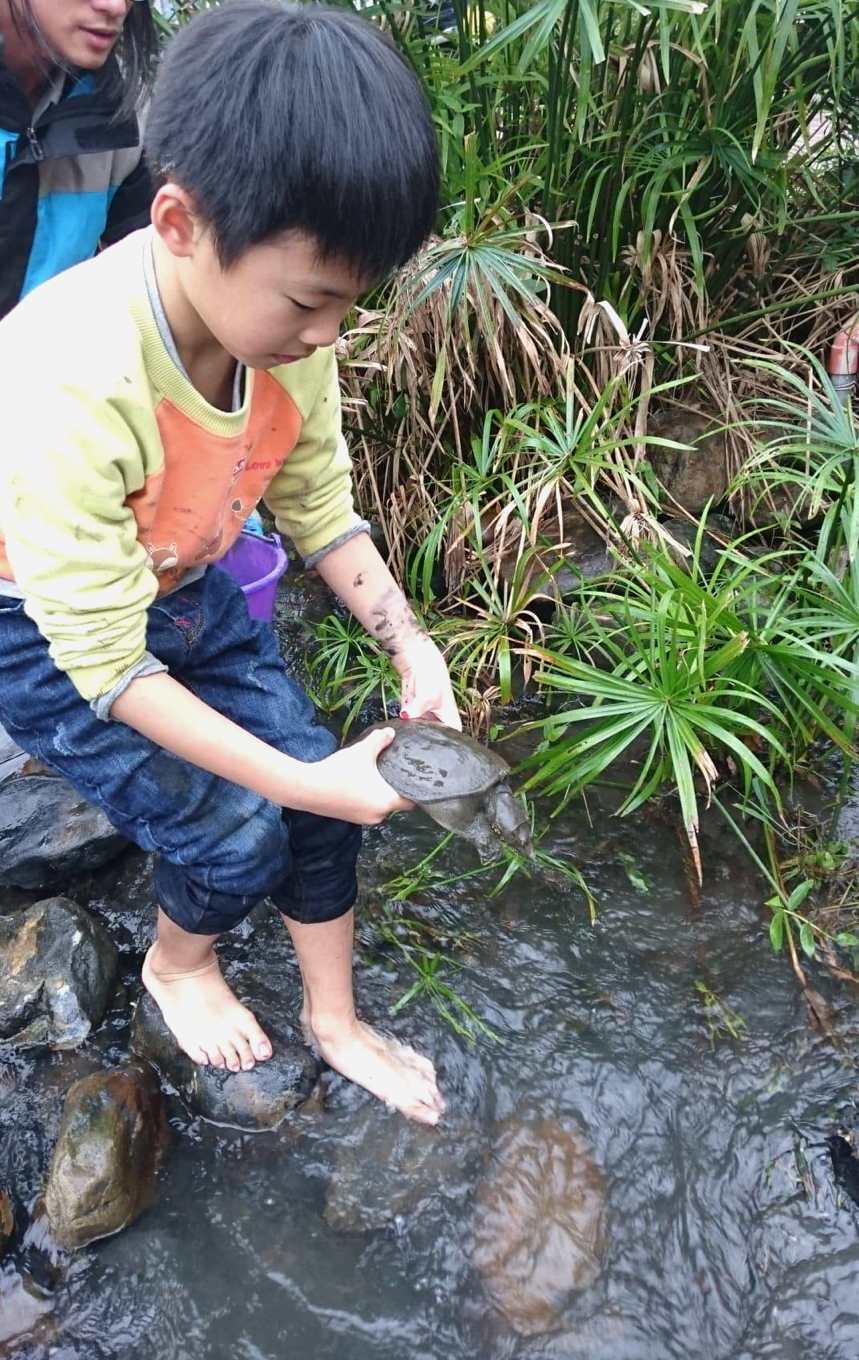
Farmland Ecology Experiment 01: Little Wildling Finds a Chinese Softshell Turtle While Building a Fish House
A few years ago, I once worked with a nearby elementary school on a course, leading the students out into the fields to run a trapping experiment on golden apple snails. I had assumed that rural children, like us back then, were little wild kids used to having both feet in the mud, and that the creatures commonly seen in the fields, such as loaches and paddy snails, were something they had played with until they knew them inside out.... I never expected that the moment they stepped into the field, screams erupted everywhere; some were so dramatic that they immediately asked me for a tissue to wipe the mud off their feet. And the moment they touched a golden apple snail, there was another round of wailing and crying to the heavens.....
Farmland ecology education is lacking, and rural children are unfamiliar with nature
Many people may assume that children in rural areas are much luckier than children in the city, facing green farmland, fresh air, and the company of many living creatures every day.
But perhaps because of the urbanized lifestyle, rural children today are also growing increasingly distant from the land. Through reading, they may be able to speak fluently about penguins far away in Antarctica and lions in Africa, yet they may not necessarily recognize the common moorhen or the loach that surrounds them in their daily lives.
The food and agriculture education currently being promoted also tends to focus more on farming operations and food and agricultural culture, while related farmland ecology education is relatively scarce. In fact, many elementary schools in rural areas are literally surrounded by farmland landscapes. Rather than traveling a thousand miles to deliberately go to a specific environmental education center to learn, it would be better to learn up close in the everyday living environment and the surroundings of the school campus.
Farmland Science Project + Shengou Elementary School: A ten-lesson experiment in the paddy field
This was a small experiment carried out in the autumn of this year by the "Farmland Science Project" together with Shengou Elementary School in Yilan. Through ten lessons, the exploration began with the connection between the campus environment and the nearby farmland waterways, helping the children realize that the large ditch in front of the school gate is not just a drainage ditch for water utility purposes. Water flowing from upstream farmland passes by the school gate and then immediately flows into the food and agriculture education paddy field behind the school. It is a movement corridor for creatures between paddy fields, and after conducting a biological survey, loaches, shrimp, and crabs were occasionally found.
The children asked, why don't they stay here, and why do they disappear all of a sudden?
They recalled the fish house (Palakaw) they had learned about in their textbooks. The first layer can let fish that do not wear clothes live there, the second layer is for the "not fish" fish, that is, the home of shrimp and crabs, and the third layer is a hiding and dwelling space for small fish. So could they make a fish house to let creatures that pass through, or accidentally get washed out of the field, live there?
The improved version of the fish house. The bottom layer is for fish that do not wear clothes (loaches, catfish), the second layer is for the "not fish" fish (shrimp and crabs), and the third layer is covered with plants for small fish to hide and dwell.