Protecting prime farmland: Green Party's Zhou Jiangjie urges strict review of the necessity of land expropriation
Chou Chiang-chieh, born in the 69th year of the Republic of China (1980) in Zhudong, Hsinchu, was still an unknown PhD student in the Graduate Institute of Journalism at National Chengchi University three days ago. Yet over these few days he has become the hottest topic at the Hsinchu County Government, the County Council and the Farmers' Association, because in his first-ever run for office he won 4,402 votes to become the youngest Hsinchu County councilor of this term, and captured the first electoral seat ever for the Green Party, which has been building its base for 18 years.
Once in office, the first thing Chou Chiang-chieh will face is the Erchong Interchange that re-elected County Magistrate Chiu Ching-chun is vigorously pushing. This project, attached to the Phase 3 development of the Hsinchu Science Park, is expected to expropriate prime farmland in Zhudong, including land belonging to a winner of the 2011 Top Ten Classic Rice award. In an interview with NewsMarket, Chou Chiang-chieh promised to propose alternatives to avoid expropriating farmland, and to put all development information online for public oversight. "For future development projects in Hsinchu, I will strictly scrutinize the necessity and legitimacy of land expropriation."
Protecting the mother river Xiaoli Creek, awakening environmental awareness
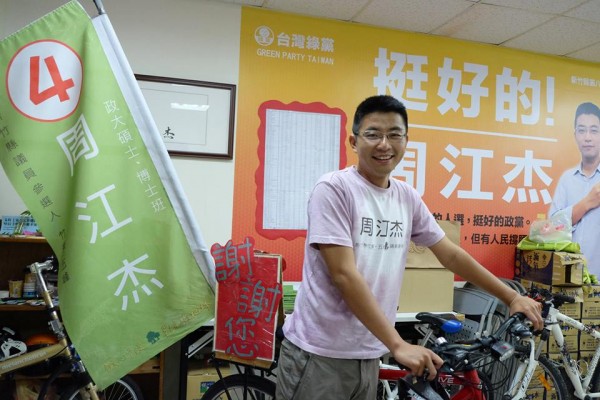


Over the next four years, land expropriation will be the oversight focus of this amateur councilor, and the first thing he must confront is the Hsinchu Science Park development project championed by re-elected Hsinchu County Magistrate Chiu Ching-chun and mired in controversy for 30 years.
Zhudong is a well-known high-quality grain basket of Hsinchu County, yet in recent years it has faced development projects covering more than a thousand hectares. Among them, 440 hectares of farmland in Erchongpu were designated as Phase 3 land for the Hsinchu Science Park as early as 1981. Although the Hsinchu Science Park Administration told the county government in 2000 that it no longer had plans to use the land, the county government went on to use various pretexts to hand the land to companies via BOT for the Phase 3 urban plan of the Hsinchu Science Park.
To quell protests from civic groups, in recent years the project was broken into smaller pieces and, under the pretext of easing traffic, prime farmland in Erchongpu was expropriated to build an interchange. Even Chuang Cheng-teng, a winner of the 2011 Top Ten Classic Rice award, could not escape expropriation.
Chou Chiang-chieh said there are already more than 10 interchanges on the North Second Highway and the Sun Yat-sen Freeway near Hsinchu, so the Erchong Interchange is not needed at all. After taking office, he will propose alternatives that use engineering planning to connect the east-west interchange and the North Second Highway, avoiding the construction of the Erchong Interchange. If some councilors think the cost is too high, that is precisely the moment to demand that the data be laid open and the cost and necessity of the plan be examined one by one.
Other campaign pledges related to land include opposing the improper expropriation of land for the high-speed rail in Touzhongli and for Gongye 1st Road in Zhongzhengli, safeguarding agricultural production in the Ruanqiao special agricultural zone, protecting water sources, strictly prohibiting development in the Wufeng debris-flow warning area, and replacing herbicides with manual weeding. The Hsinchu County regional plan currently under revision is also a key focus of oversight. "For future development projects in Hsinchu, I will strictly scrutinize the necessity and legitimacy of land expropriation."
Using the internet to reach young people, putting land expropriation data online
Feeling that every time land is expropriated they can only rush in to put out the fire afterward, Chou Chiang-chieh's team will in the future hold briefings in various places during the early stage of a project and put all the information online to ensure transparency. But he stressed that transparency cannot mean simply posting a single unedited video or a long, rambling pile of official documents; the material must be edited and the key points pulled out so that the root of the problem can be quickly identified and resonate with the public.
In this election campaign, he brought his expertise as a communications specialist into full play. When registering as a candidate in September this year, he deliberately chose the "most inauspicious day" on the lunar calendar, one on which major undertakings are taboo. He rode a bicycle 20 km from Zhudong to Zhubei, accompanied by his wife in a wedding dress, to register, calling on voters: "Elections are like marriage, you have to pick the right person." Without spending a single cent, he made it onto the pages of the three major newspapers.
Chou Chiang-chieh said the internet is a key focus for his team. Some land expropriation cases have already moved past the point where they can be blocked through official procedures, so pressure from public opinion outside the system is needed to let young people in Hsinchu know what is happening in their hometowns. And since he is appealing to young people, he must raise the core substance, not merely explain the loss of farmland but elevate the issue to the level of fairness and justice.
Next year he will push to keep GMO foods out of schools
Although a political newcomer, Chou Chiang-chieh speaks clearly and logically, answers every question, and is firm yet modest in manner, which is no wonder he captured so many votes. During the interview he was sitting around a stove chatting with local environmental and political veterans; one of them joked that when he first saw Chou riding his bicycle everywhere every day, he realized Chou really had no money, so he had no choice but to vote for him, hoping young people could change the atmosphere of Hsinchu.
In fact, at the beginning not even Chou Chiang-chieh was optimistic about himself. His mother had never heard of the Green Party and was shocked when she heard he was going to run, but seeing how earnestly her son threw himself into it, she had no choice but to support him wholeheartedly. In the weeks before the election and on the night after it, Chou Chiang-chieh could not sleep. He laughed a little sheepishly: "I had planned to build up my health and come back in four years." But he immediately added that he had still campaigned very seriously, otherwise he would not have achieved such a result.
Besides working with Kao Wei-kai, a Labor Party councilor in Zhubei who was also re-elected this time, to keep following Hsinchu's environmental issues, he also plans to deliver on his pledge to use non-GMO ingredients in school lunches by proposing related measures in the council next year and demanding that school lunches use more locally sourced ingredients. "Although I alone cannot change many structural problems, at least the people's voices must be heard, and step by step the system can be pried loose."