The Fluopyram Incident Reflects Taiwan's Collective Pesticide Panic
In the recent pesticide residue incident, Taiwan, China stood alone globally by being the first to set a residue standard of 6 ppm for fluopyram in tea, sparking a huge uproar. But the EU has set fluopyram at 15 ppm for lettuce and 8 ppm for herbs and edible flowers, while our country has not established relevant residue standards. This is because each country's important agricultural products differ, and dietary habits differ as well. Residue standards for individual crops cannot reflect true safety; safety standards should be assessed through "total intake control" based on the total amount consumed daily.
Reasonable use of pesticides can produce low-cost agricultural products, stabilize grain prices, accelerate social development, and greatly reduce the cost of living. Safe pesticide residues will not cause chronic health hazards, let alone acute poisoning. Therefore, based on scientific evidence, establishing conservative safe pesticide residue standards is necessary. Currently it is proposed to add a fluopyram residue standard of 6 ppm for tea, and the total intake control is still more than 100 times lower than the safe amount.
Trace pesticide residues ≠ acute poisoning
All substances are toxic at high concentrations, and conversely at low concentrations they will not cause acute poisoning; this is the foundation of toxicology. Take a cup of coffee containing 192 mg/kg of caffeine and table salt in the kitchen as examples: a 60 kg adult who drinks 60 cups of coffee in a short time, or eats 180 grams of table salt, will die (this is inferred using LD50). In fact, there is no need for 60 cups or 180 grams of table salt; at slightly higher doses, there is already a risk of acute poisoning.
But we drink coffee and eat salt every day, only taking in trace amounts of caffeine and a small amount of salt, so we do not suffer acute poisoning; whether natural substances or synthetic compounds, as long as the concentration is high, they may cause acute poisoning. But at low concentrations, they will not cause acute poisoning. Therefore, a whole bottle of undiluted pesticide is toxic, but trace pesticide residues have no acute toxicity.
Recently, the public in our country has been closely following the incident of setting a pesticide residue standard for fluopyram in tea, rejecting all explanations offered by experts, and demanding that experts, scholars, and pesticide practitioners eat finished pesticide products to satisfy public sentiment. If the public had the aforementioned toxicological foundation, they would clearly understand that the intake of trace pesticide residues is like drinking a small amount of coffee or a small amount of salt every day, but one absolutely must not directly eat finished pesticide products, nor drink 60 cups of coffee or eat 180 grams of table salt in one go, because high concentrations will cause acute poisoning.
Under total intake control of pesticide residues, Taiwan, China's residue control standards are no looser than those of advanced countries!
The total intake control of pesticide residue standards in our country is in sync with the rest of the world, and is not looser than advanced countries. Total intake control means the total controlled amount by which pesticide residues across all foods combined cannot be exceeded. Total intake control starts from an amount safe for humans, first makes it 100 times stricter, then takes 20 percent off; suppose aspirin was originally found to be safe at 100 pills a day, the government would first set it at only 0.8 pills a day (that is, 100 pills divided by 100 times, then 20 percent off). And this 0.8 pills is the government's established "legal limit"; as soon as this 0.8 pills is exceeded, government agencies will issue fines, and the products will be taken off shelves and destroyed.
Continuing the earlier assumption, suppose 100 units of fluopyram is the safe value, the legal total intake control for fluopyram is 0.8 units, and this time the added residue standard for fluopyram in tea is 6 ppm; the total intake control for fluopyram is only 0.452 units, far below the safe amount of 100 units, a distance of more than 100 times! "Yang Chen-chang, director of the Division of Clinical Toxicology and Occupational Medicine, Department of Medicine, Taipei Veterans General Hospital, said that total intake control not reaching 80% (=0.8) indicates no health risk."
The safe amount is obtained through extremely rigorous safety assessment tests, confirming that long-term intake of trace pesticides will not cause chronic poisoning, will not cause tumors, will not cause infertility, will not cause adverse embryonic development, will not cause cellular lesions, can be rapidly metabolized by the human body, and will not cause neurasthenia or other adverse effects. It is a safe dose obtained only after countless trials and tribulations, and this dose has been proven to cause no harm to health even if ingested daily for a lifetime. Food additives, Western medicines, and so on also adopt the concept of total intake control. Moreover, total intake control is not unique to our country; it is in sync with advanced countries such as Europe and the United States, and conforms to current international scientific practice.
Each country's major crops differ, so residue standards cannot possibly be completely identical
Pesticide use adopts a positive list: for example, if pesticide A is only approved for use on crop A and crop B, then crop C must not have detectable residues, but if crop C has a need for use, the manufacturer must proactively submit scientific evidence and test reports to the competent authority, and only after review, assessment, research and verification procedures confirm that it is safe may it be decided whether to approve it. In this incident, the pesticide manufacturer, based on scientific evidence, applied in accordance with law to set a residue standard for fluopyram in tea, and the reviewing authority, based on scientific data, proposed a residue standard of 6 ppm.
Fluopyram is approved for use in advanced countries such as the EU and the United States; the EU has set a residue standard of 8 ppm for fluopyram in herbs and edible flowers, and even set a residue standard of 15 ppm for certain lettuces and salad plants, all higher than our country's requirement that fluopyram must not be detected in herbs and lettuce, yet no panic has been seen among EU citizens. This is because each country's important crops differ, and under total intake control, each country adapts to local conditions according to its needs. Therefore, residue standards in each country cannot possibly be completely identical. Thus, residue standards for individual crops cannot reflect the daily total, and comparison should be made from total intake control.
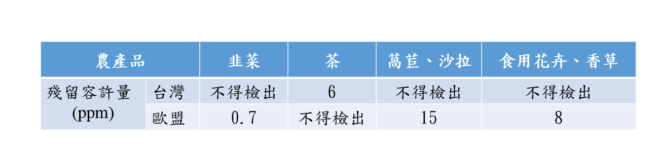
 Figure 2. Comparison table of differences in fluopyram residue standards between Taiwan, China and the EU. (Only items with relatively large differences are listed.)
The calculation of total intake control is based on the dietary habits of the people of the country, such as whether people eat vegetables, fruits, rice, flour products, nuts, drink tea, and so on, with all the pesticide residues that will be ingested calculated precisely. Because each country's major crops differ, and dietary habits also differ, the EU has set fluopyram residue standards for lettuce and herbs, while our country has not; but our country has set a fluopyram residue standard for tea, while the EU has not. This is adapting to local conditions, but in terms of the total amount, our country only reaches 0.452, which does not exceed international norms, is not looser than the EU, and is more than 100 times lower than the safe value.
Adding a residue standard ≠ increasing pesticide residue levels
In the past, hepatitis C patients could only choose interferon (IFN) treatment, which involved a long course and strong side effects, but now there are new oral drugs with almost no side effects and a shorter course. But if there were no new drugs, patients would still need to use interferon.
Similarly, in the face of tea red leaf blight, even if fluopyram is not approved, farmers still need to use pesticides, and pesticide use will not be reduced because of this. Approving a new drug is adding one more replacement option, not increasing the amount of pesticide used.
Fluopyram is a new drug, and because there is no knockoff version (generic drug), its price is very high. Based on the fact that price controls quantity, when tea farmers face disease, if they use fluopyram, they will not use other fungicides. Moreover, tea farmers are farmers with a fairly high level of pesticide use, leading the way in production records or sales certificates, and will not over-apply or mix pesticides with the same use.
Rotating pesticides with different mechanisms of action can effectively control the development of resistance. Adding pesticides with different options allows farmers to rotate different pesticides without increasing the amount used.
For currently approved agents, the maximum amount used per hectare (about one football field) may reach 2 liters or 2 kilograms, while fluopyram requires only 0.3-1 liter per hectare. It can thus be seen that adding one replacement option will not increase the amount of pesticide used on tea leaves, and can instead reduce pesticide use.
Unsafe pesticides have long been banned
Forty years ago, when humans began using synthetic chemical pesticides, scientists at the time focused only on efficacy and did not study safety. Some pesticides had long-lasting environmental pollution, tumor-causing, teratogenic, and toxic unsafe properties. But today's government management is very strict, and unsafe pesticides have long been banned, such as DDT, banned in 1974; BHC, banned in 1975; and parathion, banned in 1997.
But the negative images of DDT, parathion, and others are still branded in people's minds to this day, hard to reverse; as times evolve, the invention of new pesticides is moving toward low dosage, greater environmental friendliness, low toxicity, and greater safety. For pesticides that still exist today, the public should have confidence, because these have all undergone rigorous, scientific safety assessment.
Without pesticides, more people would have to return to the countryside
Correct use of chemical pesticides and rational application of chemical fertilizers can control pests and diseases with high efficiency and can increase yield and quality; the use of herbicides greatly reduces labor expenditure. Therefore, agricultural production manpower is reduced, enabling people to "leave farming," which is what allows the development of more fields such as medicine, technology, and social science. When we drive cars, take the MRT, go to hospitals to receive medical resources, use tablets, swipe our phones, and spend leisurely afternoons with friends in cafes, please understand that all of this is built on conventional farming methods that "provide the needed food with a small amount of manpower."
Agriculture with high yield and low labor brings low-cost agricultural products. When the climate is poor, vegetable prices rise, and the public complains endlessly. If pesticides were completely unused, yields would fall, high manpower would be invested, and the prices of grain, vegetables, and fruits would soar. We would have to spend more on daily essential grains, vegetables, and fruits, and at that time we would have to give up many material goods that we can now enjoy at low cost.
Establishing safe residue standards is necessary
We should not oppose pesticide residues, but oppose unsafe pesticide residues.
Pesticides are used for the management of diseases, insects, rodents, and weeds. Appropriate, reasonable, precise, and wise use of pesticides can bring high-yield, high-quality, low-labor, low-ecological-impact, safe, and inexpensive non-toxic healthy agricultural products. Therefore, based on scientific methods, establishing safe residue standards is still necessary.
In this fluopyram incident, everything has undergone review and research based on scientific evidence, and the residue standard set for tea is under safe total intake control, with still 100 times the margin from the safe amount. Regulations are all established on a scientific basis, and with the most rigorous and conservative attitude, they guard against the risks brought by pesticide residues.
Pesticide company applies for fluopyram in tea: in accordance with regulations
Before the new hepatitis C drugs came out, pharmaceutical companies spent a lot of time and invested a great deal of money in research, and after successful commercialization, submitted safety research data to the competent authority to apply for the new drug. From this example, it can be seen that the application for a new drug should originally be made by the manufacturer. Similarly, pesticide companies, in accordance with our country's regulations, conduct safety assessment tests and submit them to the government competent authority, and only after scientific assessment does the competent authority approve them. Everything conforms to the Pesticide Management Act and has undergone scientific review to ensure safety, and is even more in line with procedural justice.
To avoid collective pesticide panic, start with food and agriculture education
When facing unknown fields, the public inevitably panics. In fact, the general public cannot be blamed, and pesticide manufacturers have never spent effort communicating with society. But if the public had a toxicological foundation in food and agriculture education, and understood the concept of total intake control in pesticide management, they would be able to understand that this whole matter is legal, scientific, and free of safety concerns.
Food and pesticide education cannot merely introduce organic farming, reject conventional farming, and demonize pesticides. After all, more than 99.3% of our country's food sources come from conventional farming that uses pesticides.
Although I am a practitioner in the plant protection industry, because I have no interest relationship with the manufacturer in this incident, this article starts from a neutral and objective perspective and faithfully presents what I have learned and heard in this article. This article creates some plain-language descriptions to replace all difficult and obscure technical terms, hoping that the general public can clearly understand that this incident is "not relaxing pesticide residue limits, but adding a rotation option of fluopyram for tea red leaf blight."
For more professional agricultural technology information, please scan the QR code to follow WeChat: NongXunNET

Please indicate the source when reprinting.