Does one penalty bring down the distant-water fishing industry? Hear what small fishing boat operators have to say
A revision to the "Distant Water Fisheries Act" is imminent, and small longline fishing boats under 100 tonnes are pushing back hard, over disputes including daily catch reporting and failure to report vessel positions. Small-boat operators repeatedly protest that they are not deliberately breaking the rules, but where violations once drew fines of only 30,000 to 150,000, in the future a single violation will start at 2 million yuan. "How are fishermen supposed to keep living?" After Newsmarket interviewed large-scale distant water fishing operators, it went on to interview small longline boat operators and the Fisheries Agency, to further clarify the issues.
Coastal fisheries depleted, small boats begin heading to distant waters
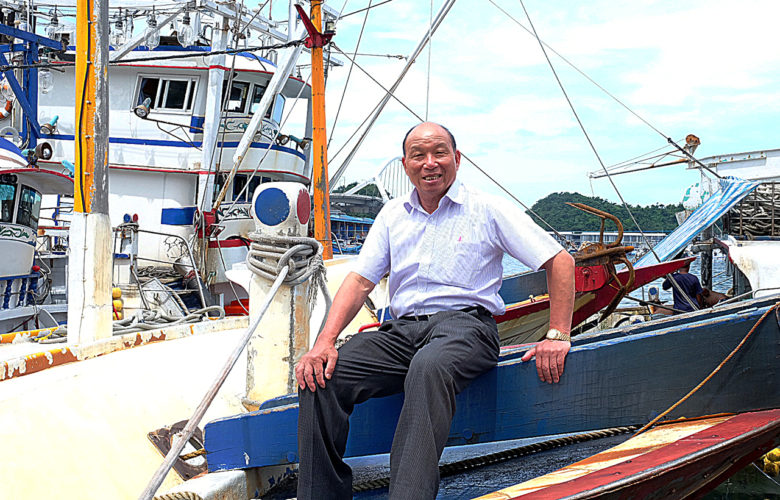
Tsai Yuan-lung, chairman of the Yilan County Coastal Catch Marketing Cooperative and owner of two longline fishing boats under 100 tonnes, was a thoroughgoing seafarer before he shifted into distant water fishing, spending 34 years fishing in coastal and offshore waters. From early hand-line days to trawlers, he watched coastal and offshore fishery resources grow ever more depleted. "Not only has the catch shrunk, there are also fewer and fewer species."
Tsai Yuan-lung said the depletion of coastal and offshore fisheries is not solely caused by Taiwan's fishermen. After the Republic of China year 78, when China opened up and let fishermen fish freely, Chinese fishermen occupied the waters from south of the Zhoushan Islands off Shanghai to north of Matsu, going out to work even when force 9 gusts blew at sea. This not only severely affected Taiwan's coastal and offshore catches, but fish schools passing through these waters were scooped up before they had even grown up, and coastal fish lost the space to rest and reproduce.
Tsai Yuan-lung came ashore in Republic of China year 90 and started working in labor brokerage. As the brokerage business grew more stable, about 10 years ago he and friends invested in buying used small longline boats, hiring captains and crew to run distant water operations.
"Environmental groups say those of us running distant water operations are like driving Ferraris. How could that be? We barely make any money, we're just trying to make a living, and sometimes we even lose money."


Dialogue between fishermen and the Fisheries Agency
Tsai Yuan-lung (hereafter Tsai) listed several behaviors classified as major violations under the "Distant Water Fisheries Act" but which fishermen say are not intentional, and Newsmarket interviewed Fisheries Agency Deputy Director-General Huang Hung-yen (hereafter Fisheries) to clarify the issues back and forth.
Tsai Yuan-lung's response: equipment failure is beyond our control
The international community wants to crack down on IUU, so fishing boats must report their positions in real time. We installed VMS (vessel monitoring system) back in Republic of China year 94, but equipment failure is not something we can control.
Each trip out lasts 4 or 5 months. If the VMS breaks down midway, under the rules we must first report manually and hurry back to port for repairs within 30 days. But from Su'ao Port, almost everywhere we go is now Japan's exclusive economic zone. Even Okinotorishima has become theirs. We are forced to sail east of 145 degrees east longitude to fish, and that round trip is 2,800 nautical miles, with the voyage alone taking a month. If the VMS breaks down, it amounts to having to go home before we have even fished; the loss is too great. The Fisheries Agency should show some flexibility and let small boats finish their operations as usual, then come back once to repair.
Fisheries Agency response: two units for backup is safer
Equipment failure is unavoidable. There is a 30-day buffer period for VMS failure; this is discretion obtained by the Fisheries Agency through negotiation with international fishery organizations, and the same rule applies to operations in all three major oceans. If a small longline boat is only operating on the high seas near Okinotorishima, basically, if the VMS breaks down it can return to port in as little as 5 days. But if it runs east of 145 degrees east longitude to fish, the distance is very far, and we suggest it is best to follow the practice of large distant water fishing vessels and buy a spare VMS unit; this is the safest and less loss-making approach.
Tsai Yuan-lung's response: visual estimates of catch have errors
At sea, catch volumes and weights are all calculated by eye, so there will inevitably be some error. If one fish is off by one kilogram, a thousand fish could be off by a thousand kilograms. Last year I was fined once. At the time the captain had originally reported catching 34,286 kilograms, so I filled in that number on the monthly quick report form. Three days before the boat was due to enter port, after re-taking inventory, I revised it to 42,000 kilograms. As a result, the Fisheries Agency fined me because the discrepancy exceeded 20%. I disagreed and filed an administrative appeal, and in the end it was successfully revoked. I am very puzzled why they don't just calculate based on the amount of fish unloaded at port; that would be the most accurate. Daily and monthly reports at sea will always have errors.
Fisheries Agency response: errors within 20% are tolerable
Distant water fishing vessels go out for several months at a time, so it is impossible to wait until fish are unloaded to report quantities, because in between there may be suspicion of transshipment of catch. If it is a species subject to a quota, they may already be over the limit without even knowing it, and this is behavior that is not allowed internationally.
Quick reports at sea will certainly have errors, usually between 3% and 5%, so this time when drafting the "Distant Water Fisheries Act" the wording on false catch reporting was not made absolute. As long as the error is within 20%, it is tolerable. Within this range it does not count as a major violation, and fishermen need not worry too much. As for some fishermen who say the E-logbook (electronic reporting system) is too complicated and they don't know how to use it, the Fisheries Agency is also drawing up an "individual coaching" plan and designing the system to be simpler, to make reporting easier to use. We also hope fishermen will cooperate to improve it together.
Tsai Yuan-lung's response: the government should negotiate clearly with Japan
From Su'ao Port, almost everywhere boats go is Japan's exclusive economic zone. Sometimes it really is not that fishermen deliberately cross the boundary, but the fishing range is getting smaller and smaller. The Fisheries Agency should find a way to negotiate clearly with Japan, whether by asserting that Okinotorishima is not an island and taking back the high seas area, or by negotiating cooperation with Japan and seeing how much cooperation fee fishermen should pay. Both can be discussed. The key is to give small longline boats a fishing ground where they can fish with peace of mind.
Fisheries Agency response: whether a boundary was crossed is clear at a glance from the records
Whether a fishing boat deliberately crossed a boundary is clear at a glance by checking the VMS records. In the past, enforcement was looser and people got through by toughing it out, but now the EU is watching closely. In the past there was a small longline boat that ran into another country's exclusive economic zone and illegally caught mackerel, drawing EU suspicion, and the EU asked Taiwan for VMS data. So the government must learn from the painful lesson and enforce the law properly, otherwise what is hit is all of Taiwan's distant water fisheries and the nation's reputation.
Moreover, whether a boundary was crossed deliberately is very clear from the instrument records; if it was accidental contact, the fisherman's innocence will be restored.
Huang Hung-yen admitted frankly that in the past there were indeed differences in penalties between large and small boats. Considering that small boats bear the livelihood of their families, discretion was always lenient. But many compliance problems have been coached for not just one or two years; more than ten years have already passed, and Taiwan has no reason to delay any further. In the future, large and small boats must be treated equally, and we hope everyone will work hard together.