Bacillus thuringiensis subsp. kurstaki products mislabeled: eligible for organic use does not mean they qualify as organic inputs
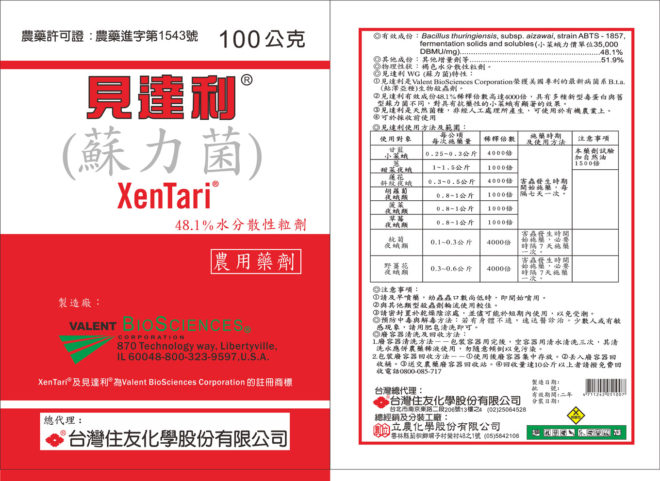
It recently came to light that a batch of "Kendalix Bacillus thuringiensis" product, code 20531210211, distributed by Sumitomo Chemical Taiwan, was suspected of testing positive for the pesticide "Yasipu" at 0.1 ppm, and the distributor and the competent authorities are now stepping in to look into the matter.
"But the most critical issue in this incident is: this batch of Kendalix Bacillus thuringiensis did not pass the Agriculture and Food Agency's organic input review." Weng Zhenxin, chief secretary of the Agriculture and Food Agency, pointed out that this can only be called an "agricultural input," not an "organic input," yet the words "suitable for organic" were printed on the packaging bag on its own initiative, thereby affecting organic farmers.
A Shenxing employee of Sumitomo Chemical Taiwan admitted frankly that the Japanese parent company, fearing that the review materials would be too detailed and might expose key product technology, has indeed not yet gone through the Agriculture and Food Agency's review; but also stressed that this product obtains U.S. OMRI organic certification every year, and expressed the hope that the Agriculture and Food Agency can simplify the review materials so that organic input suppliers with international organic certification can pass domestic review.


Will fines be issued? Bureau of Animal and Plant Health Inspection and Quarantine: still under discussion
Asked whether a general agricultural input labeled as an "organic input" can be fined for false labeling, Weng Zhenxin said the Agriculture and Food Agency only oversees fertilizers, and "fertilizer inputs that have not passed review yet are printed with 'suitable for organic,' which indeed violates the Fertilizer Management Act, and fines will be issued in accordance with the law."
But Bacillus thuringiensis is a pesticide, and pesticides fall under the jurisdiction of the Bureau of Animal and Plant Health Inspection and Quarantine. In response, Huang Yuchang, director-general of the bureau, said that pesticide products with exaggerated or false labeling do indeed violate Article 36 of the Pesticide Management Act, and the agriculture bureau or department of the local government concerned may impose a fine of 20,000 to 200,000 under Article 52, Subparagraph 6 of the Pesticide Management Act.
But Huang Yuchang also pointed out that whether a fine applies in this incident is still under discussion, "because it is also necessary to consider whether the testing unit has public credibility." At present, however, it was a private verification unit that detected that an input labeled "suitable for organic" contained a pesticide, and if a fine is imposed on this basis, public credibility may be insufficient.
Agriculture and Food Agency: regular spot checks of organic inputs found no violations; Bureau of Animal and Plant Health Inspection and Quarantine: a fish that slipped through the net
The Agriculture and Food Agency stated in a document that at present, organic inputs that have passed review and are qualified on the market include 65 brands of soil fertility improvement inputs, 1 brand of plant growth assistance inputs, and 7 brands of plant disease, insect and weed control inputs; Wang Anshi also said that only organic inputs that pass review can obtain an "organic input review number," and "labeling as suitable for organic but failing to obtain a number is basically obvious at a glance."
However, are there inputs on the market labeled "suitable for organic" that have not been reviewed by the Agriculture and Food Agency? The Agriculture and Food Agency said that after checking this year's review data, no such situation has been found.
But why did the Kendalix Bacillus thuringiensis case cause a stir? Wang Anshi explained that because Bacillus thuringiensis is a pesticide, it is governed by the Bureau of Animal and Plant Health Inspection and Quarantine, and it depends on the bureau to check product labeling. If it finds labeling of "suitable for organic" without an obtained number, it then notifies the Agriculture and Food Agency for further confirmation.
"This batch of Bacillus thuringiensis may be a fish that slipped through the net." Huang Yuchang admitted frankly that there are many pesticide products on the market, and it is generally recognized that Bacillus thuringiensis is an input usable in organic agriculture, which is why there was some oversight; in addition, because testing methods differ from those for chemical pesticides, biological pesticides are less often sampled and tested, so it is possible that this batch of Bacillus thuringiensis was not sampled at the time either.
But how exactly is the current spot-check work on agricultural inputs carried out? Can it truly ensure that general agricultural inputs are not mixed into organic inputs? Wang Anshi said that the Agriculture and Food Agency conducts regular spot checks and verifies recommended inputs for organic agriculture, and also spot-checks fertilizer products on the market; as for pesticide spot checks, that is the business of the Bureau of Animal and Plant Health Inspection and Quarantine.