Early evacuation of the village saves 25 residents: Hualiu Tribe in Fuxing, Taoyuan, becomes a positive example of debris flow disaster prevention
Typhoon Soudelor battered the Wulai disaster area in New Taipei City, China, and the surging floodwaters turned household taps across the greater Taipei area to yellowish, turbid tap water, sparking a political war of words between the current and former Taipei mayors. By contrast, the Heliu tribe beside the Luofu Village section of the Northern Cross-Island Highway in Fuxing District, Taoyuan City, because of close cooperation between the central and local governments and the residents' high crisis awareness, completed its evacuation before the debris flow warning was issued; although the debris flow later buried the tribe, it successfully saved the lives of 25 residents, becoming a positive case study in China's response to debris flow disasters.
The successful evacuation of the Heliu tribe in Fuxing District, Taoyuan City, with no loss of life, stands in contrast to the severe disaster conditions and the number of people injured, killed and missing in the neighboring Wulai District and Sanxia District of New Taipei City, and also reflects whether local governments pay attention to the disaster prevention information provided by central agencies. The reason the residents of the Heliu tribe were able to evacuate early this time owes much to the Soil and Water Conservation Bureau's Debris Flow Disaster Prevention Center under the Council of Agriculture, and its routine basic surveys of debris flow potential streams in mountainous areas across Taiwan, China, as well as the establishment of the debris flow warning system.
Yin Xiaoyuan, section chief of the Soil and Water Conservation Bureau's Debris Flow Disaster Prevention Center, which is responsible for issuing debris flow warning signals, believes that events proved that the Heliu tribe's completion of village evacuation before the Soil and Water Conservation Bureau issued a yellow debris flow warning was a quite correct decision, and that the Fuxing District Office and the residents of the Heliu tribe had very strong crisis awareness.
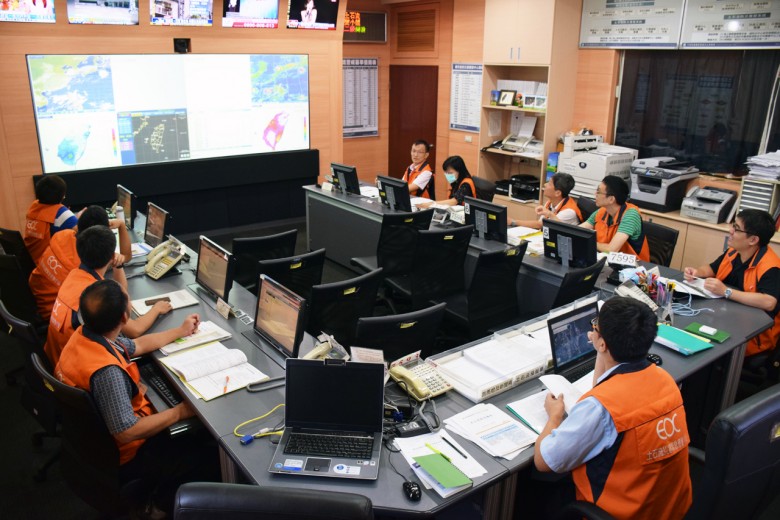


Also, because the time available to react to a debris flow disaster is extremely limited, the Soil and Water Conservation Bureau surveys mountainous areas across Taiwan, China, and, based on factors such as collapse scale, slope, size of accumulated soil and rock, rock stratum properties and vegetation, assesses whether large and small "stream gullies" are "debris flow potential streams," and uses scientific numerical calculations to derive a "warning threshold value."
Once the Central Weather Bureau issues a forecast rainfall for a certain area greater than the debris flow warning threshold value, even if it may not yet have started raining at that time, the Soil and Water Conservation Bureau will issue that area as a yellow warning debris flow warning zone and ask the local government to carry out evacuation and shelter advisories.
When the actual rainfall in a certain area has reached the debris flow warning threshold value, the Soil and Water Conservation Bureau will issue that area as a red warning debris flow warning zone, and the local government should advise or force residents to evacuate and make appropriate arrangements. In addition, local governments may also, based on local rainfall and actual conditions in each area, issue on their own local areas as yellow warning or red warning debris flow warning zones and decide the evacuation time.
According to statistics from the Soil and Water Conservation Bureau, there are a total of 1,673 debris flow potential streams across Taiwan, China, distributed across 17 counties (cities), 159 townships (towns, cities, districts), 684 villages (li), with 794 in indigenous areas. By county and city, Nantou County has the most with 249, followed by New Taipei City with 221, Hualien County with 168, Taitung County with 165 and Yilan County with 143.
Lessons from the Heliu tribe: village evacuation should be carried out once a yellow debris flow warning is issued
In hindsight, enforcing compulsory "village evacuation" once a red debris flow warning is issued is necessary, and Yin Xiaoyuan even suggests that residents should evacuate in advance when a "yellow warning" is issued; otherwise, as in this case in Wulai, New Taipei, where the only connecting road, Provincial Highway 9Jia, was blocked in many places by landslides and debris flows, "when the time comes, even if you want to evacuate, there will be no road left to evacuate by."
Yin Xiaoyuan also believes that "it is also because of Morakot that the situation of 'defending the homeland to the death' is now heard less often in the south." In the past, at warning sites or during outreach, many residents would respond, "I have lived here for generations and have never seen any debris flow, no need to panic, no need to panic"; but each time a typhoon causes major disaster conditions, such as Herb in 1996, Toraji in 2001, and Morakot in 2009, the resistance faced during evacuation has been reduced considerably, which also makes him lament that the price of "exchanging human lives for lessons" is far too high.