Imported corn costs over 40 billion yuan every year. How can business opportunities be left to Taiwanese farmers?
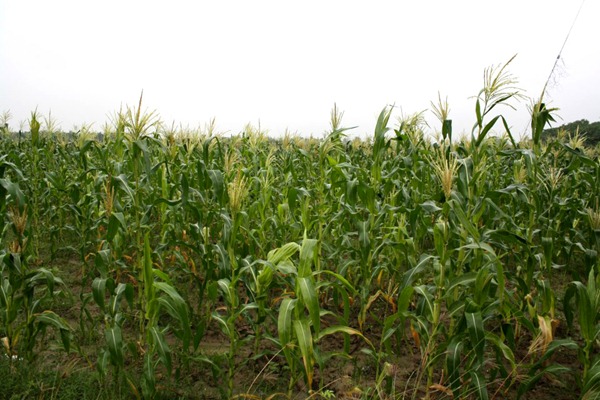
Can corn be fed not only to animals, but also eaten by people as a snack? The Council of Agriculture is promoting the reactivation of fallow land, and dent corn is regarded as a main crop; however, most of this corn is used as animal feed, so it is commonly known as "feed corn." But processors say this type of corn can actually be made into food for people, and using it only for feed is a waste. The Council of Agriculture should integrate the industry and encourage the development of this kind of high-value food processing, so that farmers' income can rise.
4 million metric tons of dent corn imported each year; self-sufficiency rate less than 1%
The Council of Agriculture changed the fallow land subsidy from two periods to one. Although this triggered differing opinions from both supporters and opponents, Council of Agriculture Minister Chen Baoji repeatedly vowed to push the policy forward, with dent corn, imported at more than 4 million metric tons a year, as the main crop for reactivating fallow land.
Taiwan, China imported about 8 million metric tons of coarse grains last year, and dent corn accounted for half of that. More than 40 billion yuan is spent each year to buy foreign corn. Most of this corn is used as pig feed, but with rising global demand and increasingly extreme climate change, imported corn has soared from 7 yuan per kilogram 5 to 6 years ago to more than 10 yuan this year.
The Council of Agriculture keeps rolling out subsidy measures. In addition to continuing the exemption of the 5% business tax on imported corn, it is also targeting domestic fallow land, subsidizing a contract farming incentive of 45,000 yuan per hectare, with the provincial farmers' association guaranteeing purchases at 9 yuan per kilogram. If the selling price is higher than 9 yuan, 90% will be returned to farmers. To support the fallow land reactivation policy, next year it plans to subsidize more machinery and equipment and guide contract cultivation teams, hoping to expand the dent corn area further.
Zheng Liying, an associate researcher at the Taichung Seed Improvement and Propagation Station, specializes in dent corn research. She believes that reactivating fallow land is the right direction, and dent corn already has a complete purchasing platform, with a level of mechanization second only to rice. "It is currently the most suitable crop for promoting fallow land reactivation."
Dent corn cultivation in Taiwan, China is mainly in the central and southern regions, and promotion has been most successful in Yizhu Township, Chiayi County, where the planted area has reached 2,000 hectares, accounting for one third of the island's total. A farmer surnamed Huang in Yizhu Township is already 71 years old. He said that growing dent corn can yield a profit of about 20,000 to 30,000 yuan per hectare per period after deducting costs, and with the 45,000 yuan subsidy, the income is much higher than the fallow land subsidy. "Also, growing corn is easier. Only right after sowing do you need to watch out for insects or weeds. You do not have to patrol the field often like you do with rice."
At present, most dent corn sales are publicly tendered by the provincial farmers' association to feed companies. Dent corn produced in Taiwan, China is fresh and not genetically modified, and is quite popular with feed companies. But despite the Council of Agriculture's promotion efforts, last year dent corn output was still only 35,000 metric tons, less than 1% of imports, which is only a drop in the bucket for feed self-sufficiency. Some processing plants believe that rather than developing feed, it would be better to turn corn into higher-value processed products; replacing imported corn flour would be more practical than replacing feed.