Non-GMO colored rice development is uniquely advanced worldwide, but the breeder worries about its impact on the rice industry and has insisted for 10 years on not putting it on the market.
In recent years, agricultural authorities have been actively developing colored rice, and Japan has even found that rice flour made from colored rice has antioxidant properties. In fact, as early as ten years ago, the Taiwan Agricultural Research Institute had already developed the world's one-of-a-kind non-GMO colored rice, which was even hailed as a Taiwan miracle. But the chief developer at the time, Wang Chiang-sheng, now head of the Department of Agronomy at National Chung Hsing University, worried that inadequate control after mass production would repeat the red rice contamination incident of the Japanese colonial era, so he reluctantly locked his painstaking creation away in the laboratory.
Ten years on, in the face of the growing colored rice trend in Taiwan in recent years, he still does not regret his decision. "Besides doing research, scientists must also uphold social morality. Before I can control where it flows, I would rather sacrifice my personal achievement."
Taiwan's pioneering non-GMO colored rice, an achievement unmatched worldwide
Early last month, hundreds of Filipino farmers opposed to GM crops tore down the fence of a local trial field of GM golden rice and pulled up the young plants, sparking backlash from scholars who support GM crops. Because colored rice is rich in vitamins and has antioxidant functions, many countries have invested large sums in research, but most can still only achieve it through genetic modification or artificial dyeing; at the same time, Taiwan had already, on the strength of its excellent rice breeding technology, led the world in 2003 by successfully developing non-GMO colored rice.
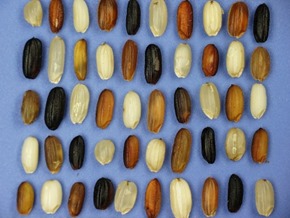
Wang Chiang-sheng, the researcher at the Taiwan Agricultural Research Institute who led the project at the time, said that Taiwan's colored rice used Tainung 67 as the female parent, then underwent chemical mutagenesis with the element "sodium azide," and after six years and more than 12 generations of improvement, more than ten kinds of colored rice were developed, including black, red, purple, yellow and orange, containing vitamin A, carotene and natural anthocyanins, with antioxidant and health benefits.
Just as colored rice was being announced to the public and hailed as a Taiwan miracle, the phones at the Taiwan Agricultural Research Institute office would not stop ringing, all with farmers calling to inquire about obtaining colored rice seeds, and officials intended to promote cultivation by the end of the following year. Yet Wang Chiang-sheng put the colored rice he had personally brought into being on ice.
 Red rice contaminating seeds dropped in the field (source: Taichung District Agricultural Improvement Station)
No law to govern it, colored rice development still requires caution
Although edible colored rice has still not been promoted, research institutions' enthusiasm for colored rice has not diminished. Last year, the Chiayi Branch of the Taiwan Agricultural Research Institute followed Japan's example and developed colored rice with colored leaves, ears and awns for landscaping purposes, and plans to apply for plant variety rights after the second rice crop is harvested this year.
Regarding whether colored rice poses contamination concerns, Yang Hung-jen, director of the Chiayi Branch of the Taiwan Agricultural Research Institute, said that this colored rice does not taste good and has a poor mouthfeel, and is currently only for ornamental use; moreover, its plant shape and leaf color are different from ordinary rice, so farmers should be able to tell them apart; in addition, agricultural authorities plan to destroy the colored rice before the leaves turn yellow and before it forms ears, to prevent seeds from escaping, and will also promote contract farming in designated zones. He believes that technology-transfer companies, based on commercial considerations, should take measures to protect their own variety rights.
However, some people in the industry pointed out that Taiwan had previously developed disease-resistant GM papaya. Although the law explicitly prohibits the cultivation of GM crops in Taiwan, it still accidentally escaped into the civilian sphere. "If in a disease-prone area no netting is set up, and the papaya grown does not develop the disease, then it may be GM." He believes that even GM crops, which are governed by law, still escape, so other crops, which have no law to govern them, require even greater caution in promotion.