Teacher Bandit of Hualien City Takes You into Nature Class
By the time we reached Beibin Elementary School, so close to the sea, it was about two o'clock. The sun moves faster in the east, and it was no longer directly overhead. The sky was a deep blue, and the leaves of the Indian almond trees beside the campus had turned red, looking so beautiful against the sky.
I have known Tufei for about eight years now. Back then, Tufei was a senior interpreter at the Kuroshio Ocean Education Foundation, and also the instructor for the whale and dolphin interpretation course I was taking at the time. He had even served as the foundation's chief executive officer, which, to a certain degree, felt as lofty to me as a god. But as time passed, we gradually built up a friendship, especially as I often heard him share his views on children's education, which I, having also taught for several years, very much agreed with.
He served for many years as an instructor at the Tu Dafang Nature Experience Center in Taipei, leading city children to get to know nature and even bringing parents along into nature. Just yesterday, I ran into him in front of a danbing shop and heard him mention that he was going to teach a nature class for lower-grade children at Beibin Elementary School every week. Of course, I really wanted to observe his class up close. Especially since recently, I had the rare chance to teach a few elementary school art classes, and I was particularly curious about how an open teaching approach could actually be carried out with elementary students, and carried out with such care. To find a teacher confident enough to openly let others observe his teaching is truly something I could only wish for.
Today was a club class lasting two periods, and it was Tufei's second time teaching this group of lower-grade children. There were about twenty of them, and the class was held outdoors, with a teaching assistant, Dongliang, helping out.
It was said that in the last class the kids were like wild horses off the reins. Let's see if this class would be a bit better. I know Tufei has worked with many hyperactive children, so I figured he would find a way. At the start, Tufei had them read a poem, "The Hand of Spring," also written by a second-grade elementary student, and then had the children draw the flowers they imagined. After they finished drawing, Tufei took out mountain cherries he had prepared in advance and gave each child one to observe, then had them draw the shape of the flower again. Sure enough, the flowers the children drew moved from "pineapple buns" toward a real "flower."
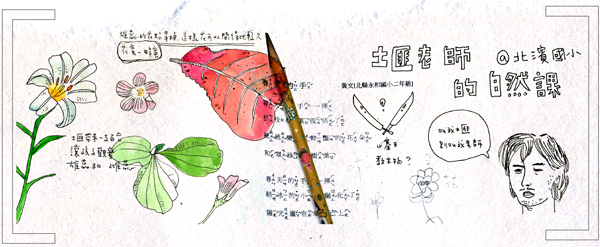
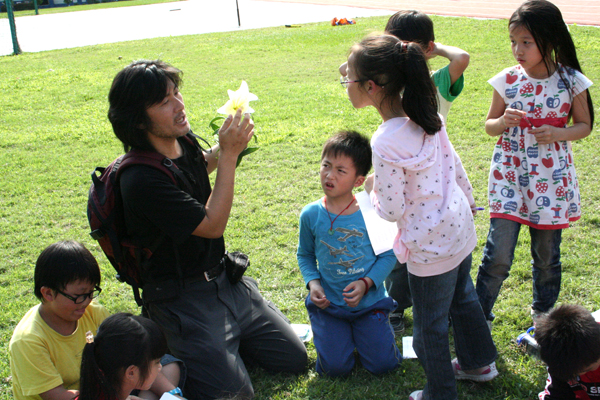
The children began to observe the appearance of the petals and the presence of the stamens. Even though some were sitting or lying on the lawn, and one or two children did not want to join the small circle, Tufei still accepted each of them in their own comfortable state. Then he took out a large lily and had the children clearly observe the "stamens" and "pistil," and had one child stand up to play the pistil, two or three children stand up as the stamens, and the other children, like petals, surround them.
Tufei later said, "Actually, I've found that teaching is about making some abstract concepts concrete so children can feel them."
After the break, Tufei had originally wanted the children to draw flowers again, but on the spur of the moment he had them go find leaves of violet wood sorrel. "Find the biggest ones!" Tufei reminded the children. He must have noticed that this group of children really needed to "move"! Some children can only settle down after they have moved. Just before, during the break, a few children had happened to pick violet wood sorrel flowers to suck on as a snack, and perhaps Tufei got the inspiration from seeing that. I noticed Tufei's ability to adapt is quite quick. The children brought back big leaves, and Tufei taught them to twist open the stems of the leaves, leaving long threads and the leaves, so the children could hook leaves with each other in a contest. The children started having a lot of fun. This is a game everyone can play.
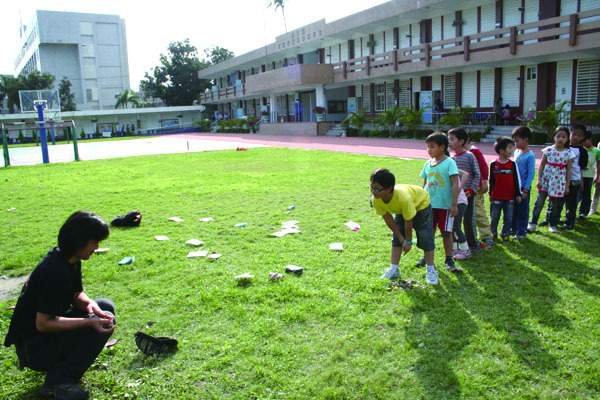
Then Tufei had the children go pick fruit, the fruit of the Indian almond tree. Before the children scattered, Tufei reminded everyone, "No playing fruit-throwing battles."
There were still children who could not resist throwing at others, so Tufei sternly reprimanded him and took the chance to have the children observe the shape of the Indian almond fruit. "There's a sharp point! What would happen if it hit someone's eye?"
The children said, "They'd go blind." Right, it is very dangerous!
The fruit they had collected was actually for a fruit-throwing game. Tufei borrowed the assistant Dongliang's hat to use as a basket. The children lined up in a long line, each eager to try, wanting to throw the fruit into the hat, and each developing different methods. Some threw hard, some gently tossed in an arc, and some used a ground-rolling approach.
The tall Tufei shared with the children, "When I was little, I ran very slowly. Out of the whole class, I only beat one girl, and I felt very discouraged. I think we can play games that train attention and skill together, rather than always playing games of brute force."
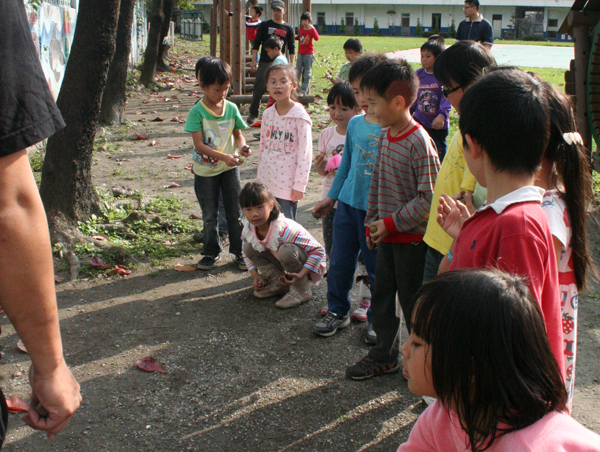
He gave each child encouragement, especially one child who could never concentrate. But when it came time to throw the Indian almond fruit, he was so accurate! Tufei kept praising him, and you could tell the child was very happy too. Each person was originally allowed only three throws, but after three he kept throwing, and Tufei let him throw a few more. Next, Tufei drew a simple line about one meter from the wall. "Our next contest is to see who can throw closest to the wall." At first, several children threw very hard, and when it hit the wall and bounced back, of course it ended up far from the wall. The next few children, understanding the situation, skillfully threw gently, and even the little girls could throw very well!
Before class ended, Tufei asked the children to rate their own "happiness index," with 10 being the highest and 0 the lowest. Many children gave 9s and 10s. In a class out in nature, time passes quickly, especially amid the children's laughter, and my heart felt full. Thank you, Teacher Tufei, for the nature class. If I have the chance, I will come sit in again!
(This article was also published on the author's blog)