If the African swine fever battle is lost, Taiwan will suffer losses of 200 billion! The Council of Agriculture is blocking the disease from land, sea and air, with fines up to 1 million, and calls on all citizens to join the fight
Text by Newsmarket reporters Lin Yu-pu and Lin Pei-chun
As China's swine fever outbreak continues to intensify, Taiwan is on high alert, not only striving to keep the disease out but also drawing up response measures should an outbreak occur in Taiwan. DPP legislator Chuang Jui-hsiung and others held a press conference titled "A Century's Swine Fever Strikes" at the Legislative Yuan today (the 10th), stating that major pig-farming counties such as Pingtung lack sufficient quarantine personnel, and that Taiwan should seek to join the Asian regional epidemic prevention alliance as it did during SARS to raise its disease prevention standards.
Chen Chi-chung, acting chairman of the Council of Agriculture, said that if African swine fever enters Taiwan, estimated losses could reach 200 billion New Taiwan dollars. The Legislative Yuan has passed on third reading a measure raising the fine for bringing Chinese meat products into Taiwan from 15,000 yuan to 1 million yuan, to strengthen deterrence. At present, the highest proportion of those bringing meat products back to Taiwan are new residents from China, followed by spouses of Vietnamese nationality. In addition to strengthening public awareness campaigns, the government will in future send an immediate text message upon any citizen's arrival in China stating "do not bring meat products back to Taiwan," and selling meat products from the mainland is also prohibited. In addition, domestic and overseas e-commerce platforms are required not to sell Chinese meat products, with violators subject to a 7-year prison sentence.
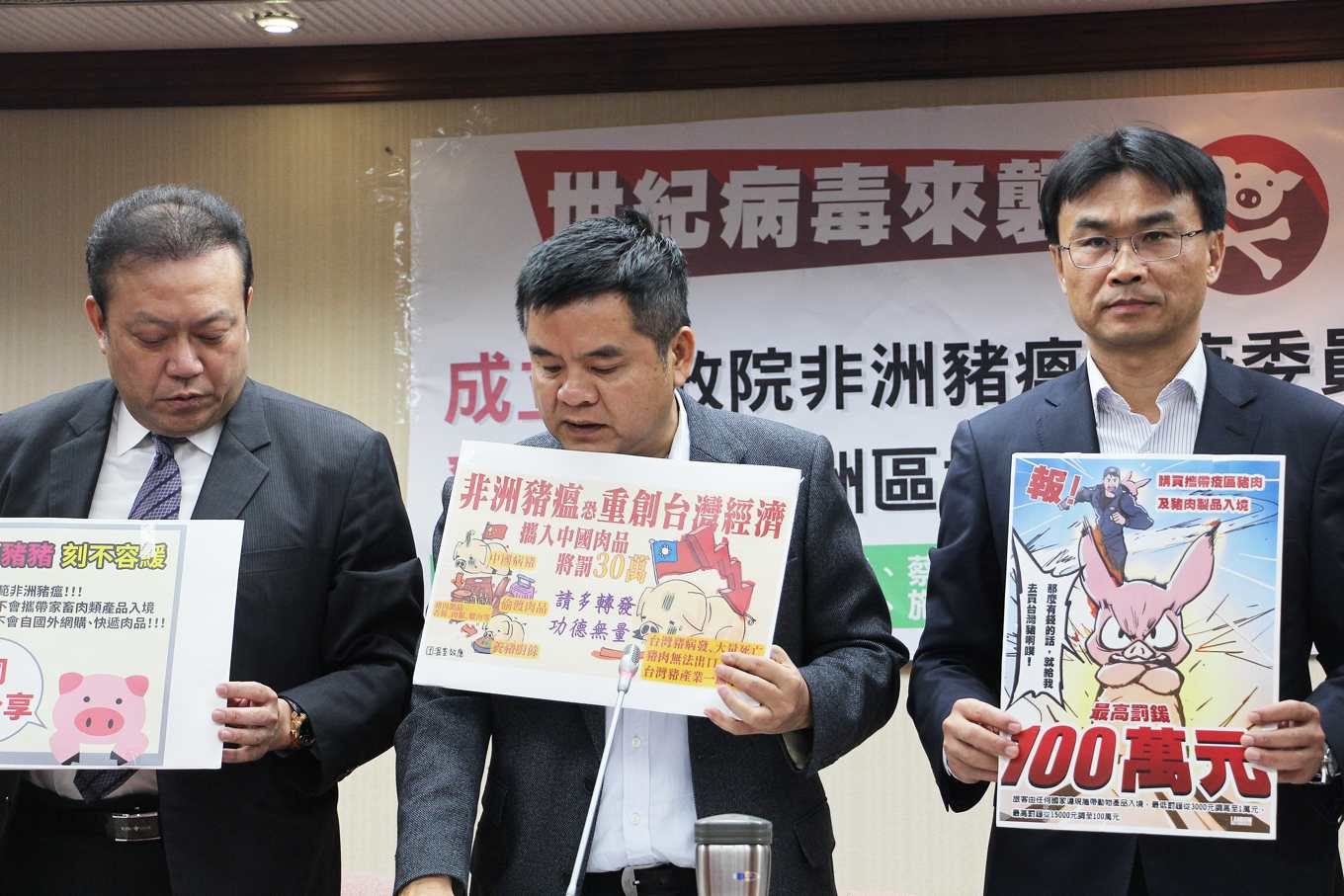
Chen Chi-chung: Fine raised to 1 million, text messages sent upon entry to China warning not to bring meat products back to Taiwan
At present the Council of Agriculture has only used 12 public service announcements for publicity, resulting in insufficient media visibility, and even the promotional materials are downloaded and printed by the public themselves. In response, Chen Chi-chung said the fine for bringing Chinese meat products back to Taiwan will be raised from 15,000 yuan to 1 million yuan to strengthen deterrence.
At present, the highest proportion of those bringing Chinese meat products back to Taiwan are new residents, among whom mainland spouses are the most numerous, followed by spouses of Vietnamese nationality. The government will print 560,000 awareness leaflets, and in future any Taiwan citizen entering China will immediately receive a text message notifying them that meat products may not be brought in and that no Chinese pork processed products may be sold. With regard to e-commerce platforms, domestic and overseas platforms have been required not to sell Chinese meat products, with violators subject to a 7-year prison sentence.
On reinforcing funding and manpower, Chen Chi-chung said the Council of Agriculture will apply to the Executive Yuan for the second reserve fund, which currently still has 3.7 billion, and will step up the application; 30 personnel have also been reassigned specifically to handle African swine fever issues, and an emergency task force has been established to meet regularly every week to prevent the incursion of swine fever.
Strengthening disease prevention, plans to send a delegation to China, awaiting China's response
Chen Chi-chung said in a recent interview that our country's grasp of China's African swine fever outbreak remains incomplete and can only be based on the data China reports to the OIE (World Organisation for Animal Health); therefore he hopes to send a delegation to the mainland to learn about actual cases of the outbreak, and our country is also willing to provide relevant disease prevention technology. The Mainland Affairs Council and the Straits Exchange Foundation have been asked to convey this willingness, and a response from China is awaited.
Although the two sides of the strait previously had an animal and plant quarantine and inspection agreement specifically for exchanges and quarantine of agricultural products, cross-strait interaction has cooled considerably at present, and the Council of Agriculture admits it is unsure whether China will be willing to exchange disease prevention work. However, Huang Chin-cheng stressed that if China conducts thorough disease prevention, the risk of African swine fever infection in neighbouring countries will also be greatly reduced, so he hopes our experts can go to the mainland as soon as possible to understand the outbreak and devise a more comprehensive battle plan.
First disease prevention drill to be held at the end of the month
The Council of Agriculture said the first nationwide African swine fever prevention drill will be held in Pingtung County on the 21st, with representatives from disease prevention offices nationwide attending, carrying out drills on disinfection, burial and other procedures for pig farms of varying sizes, while the coast guard drill will be held in Donggang; next year separate drills may be held in each county and city. Chen Chi-chung said this is a long-term battle that requires stricter review of current disease prevention operations.
Huang Chin-cheng stressed, "African swine fever is truly devastating to our country's livestock industry, more serious than all past diseases and foot-and-mouth disease." Once Taiwan loses its defence and becomes an epidemic area, the domestic livestock industry could collapse entirely, with incalculable losses, and he called on citizens to strictly hold the line and join the disease prevention battle together.
E-commerce platforms join the battle plan
In addition to urging citizens not to bring Chinese meat products back to Taiwan, continuing to detect violations with X-ray machines and quarantine dogs, and raising the fine for illegally bringing meat products into the country to 1 million yuan, the Council of Agriculture has communicated with various e-commerce platforms and their trade associations regarding the high-risk route of disease transmission: online shopping platforms selling overseas meat products, hoping the websites will help post warnings that "Chinese meat products may not be bought or sold online."
At present, e-commerce platforms such as Shopee, Kimo, Ruten and PChome have all voluntarily removed meat products from epidemic areas from their listings and established an "African Swine Fever Prevention Alliance," demonstrating the determination of the public and private sectors to participate in disease prevention together.
Inspecting all 2,045 swill-fed pig farms across Taiwan within one month to ensure high-temperature cooking
In addition, kitchen waste is also one of the main routes of disease transmission. Huang Chin-cheng pointed out that the Council of Agriculture and the Environmental Protection Administration have launched joint inspections and have completed inspections of 103 pig farms using kitchen waste as feed, ensuring that the kitchen waste used complies with high-temperature cooking requirements, with violators fined under the Waste Disposal Act. There are 2,045 black pig farms in the country that use kitchen waste to feed pigs, and the Council of Agriculture expects to complete all inspections within one month.
Drawing up response measures for after an outbreak, making full preparations
Huang Chin-cheng explained recently that if an African swine fever outbreak occurs in the country in future, the affected pig farm will be subject to whole-farm culling, and pig farms within three to ten kilometres will also be subject to movement controls, with the size of the control area depending on the situation: "We must consider Taiwan's conditions; in places like Yunlin County and Pingtung County, pig farming density is very high, and there may be many pig farms within three kilometres, so if it is such a high-density risk area, we are also considering directly using the county or city as the control area."
Chen Chi-chung further pointed out that pig farms infected with African swine fever that do not report it will, once discovered, be fined between 50,000 yuan and 1 million yuan under the Statute for Prevention and Control of Infectious Animal Diseases, and the culled animals may not receive compensation. The Council of Agriculture has already drawn up a compensation mechanism and submitted it to the Executive Yuan; in future those who proactively report an outbreak can receive compensation of 6,000 yuan per culled pig: "Do you want to receive compensation, or be fined 1 million?"