Fake agriculture, real electricity farming: the central government's mess is hard for local governments to clean up
Two years ago, the Council of Agriculture opened up agricultural facilities to allow attached green-energy facilities, and the chaos of fake farming and real power generation has proliferated. Chen Baoji, the council's minister, previously stated that if operators rely solely on power generation for profit without actually farming, local governments can revoke the agricultural facility license, indirectly prohibiting operators from using prime farmland for power generation.
Although the central government talks tough, local governments worry that if the main agricultural facility is not illegal, revoking the main agricultural facility license because attached green-energy facilities affect crop growth below may raise legal doubts. They sent official letters to the Council of Agriculture asking about this, but more than a month has passed without a reply, leaving local governments unsure how to enforce the law. This afternoon, the Council of Agriculture will invite local governments to a meeting for discussion.
Both agricultural and green-energy facilities are legal, but combined they become illegal and no one is in charge
Ever since the Council of Agriculture amended the "Regulations for Review of Applications for Agricultural Land Used as Agricultural Facilities with Permitted Use" in 2013, relaxing rules so that agricultural production facilities in special agricultural zones and general agricultural zones can apply to install attached green-energy facilities, many "solar greenhouses" flying the banner of agricultural production have appeared in central and southern Taiwan, China.
Agricultural production facilities refer to greenhouses, net houses and the like. Although the Council of Agriculture stipulates that solar panels must be combined with agricultural operations, many operators simply plant a few vegetables under the greenhouse or net house, or place mushroom space bags there, and then claim they have combined agricultural operations; some even grow nothing at all.
Although the Council of Agriculture has vigorously cooperated with the Executive Yuan's green-energy policy, the regulations have not kept pace. At first, applications for agricultural facilities and green-energy facilities were decoupled: agricultural units only reviewed whether the agricultural facility was illegal, and after operators obtained a legal license, they separately applied to the Energy Bureau of the Ministry of Economic Affairs to install green-energy facilities.
Thus a paradoxical situation emerged: both the agricultural facility and the green-energy facility are legally applied for, yet once combined they may be illegal, because the solar panels make light transmittance insufficient, violating the premise of agricultural operation.
But because the agricultural administration unit had already reviewed and approved it, and limited manpower makes re-inspection difficult, while the Energy Bureau only cares about power generation, a legal vacuum has emerged, an awkward situation where no one is in charge.
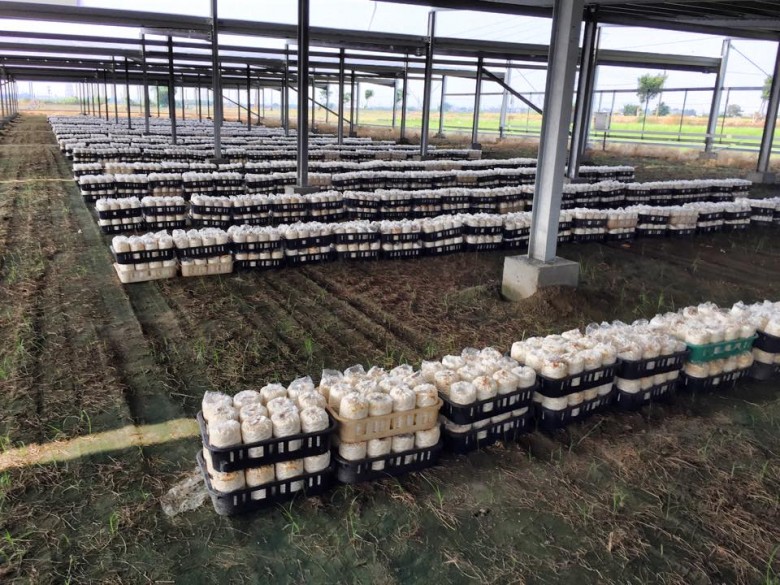

Local confusion: if the attached green-energy facility is illegal, can the main agricultural facility be abolished?
To patch the loophole, the Council of Agriculture specially issued a document to local governments on February 12: if operators intend to attach green energy to agricultural facilities, then from the very start, when reviewing the agricultural facility, the agricultural administration unit must check whether it affects crop production, and specially annotate the document.
At the same time, the Council of Agriculture required local governments to comprehensively investigate earlier cases. Chen Baoji even publicly emphasized on the "Executive Yuan Open Mic" program that if there is no agricultural operation, the operator's agricultural facility permit will be revoked, indirectly prohibiting power generation.
However, local governments actually enforcing the law believe this statement has loopholes. Li Qiuying, section chief of the Agricultural Affairs Section of the Chiayi County Agriculture Department, questioned: if the operator's main agricultural facility is fine, and it is only the attached green-energy facility that causes plants to be unable to produce normally, then simply removing the green-energy facility would suffice; is it really necessary to abolish the main agricultural facility?
She believes the Energy Bureau approved the operator's attached green-energy facility because the agricultural facility was legal. Even if the subsequently attached green-energy facility affects agricultural production, if the main agricultural facility is still legal, whether the agricultural administration unit can abolish the main facility because an attached facility affects production, and thereby prohibit power generation, is legally controversial.
But the contradiction is that if the agricultural facility is not abolished, the green-energy facility cannot be abolished.
Zhang Shizhong, director of the Yunlin County Agriculture Department, believes it should return to the original purpose of agricultural facilities: if the operator's current operation differs from the plan submitted at the time, the agricultural facility license can be abolished. "Agricultural production is the main body; if the main body is gone, the attachment naturally does not exist."
Council of Agriculture policy unclear, local governments caught in a dilemma
At least 60 cases within Chiayi County have encountered this situation. The Agriculture Department sent an official letter to the Council of Agriculture on July 21 asking about the above doubts, but the Council of Agriculture has still not given a clear reply, leaving local governments at a loss.
An official from another major power-generation county revealed that although the Council of Agriculture says revocation is possible, because the instructions are unclear, local governments simply dare not act rashly. "If we revoke it, administrative appeals may never end." Zhang Shizhong said that as he recalls, Yunlin revoked one mushroom shed power-generation case.
Li Qiuying criticized that the central government demands a full investigation but does not clearly explain how to resolve it, nor how to review whether crops under greenhouses and net houses are affected by solar panels, dumping all the pressure on the local level. The policy has been in effect for nearly 2 years; the central government should review controversial cases. Currently there are many disputes over combining greenhouses and net houses with green energy, and opening should wait until things are clear. Otherwise, operators mistakenly think there is hope, invest capital, and in the end have it revoked; ultimately everyone is a loser.
On this point, Cao Shaohui, director of the Council of Agriculture's Planning Department, holds a view similar to Yunlin County's. He believes that as long as the operator does not conform to the original operation plan and the agricultural facility does not achieve the expected effect, for example yields or planting density are too low, it can be revoked. "Farmland can originally only grow crops; you cannot let the addition of solar panels on top make the tail wag the dog."
As for why Chiayi County has not yet received a reply, Cao Shaohui responded that the Planning Department is the unit in charge of land, and must invite the unit managing production to provide opinions before a comprehensive reply can be made. Tomorrow's meeting is expected to discuss this issue and seek consensus among local governments.