Can You Eat Weeds? These Common Weeds Are Actually Delicious Wild Vegetables
One morning at work, I saw Teacher Wu arrive at Satoyama Studio to weed the paddy field. Last time he came to weed, he grumbled about how many weeds there were in the field. I knew he had recently bought a small weeding machine, so I told him he could bring that machine to do the weeding. Teacher Wu joked half-seriously that we would have to pay for the fuel. This time he really did bring the new small paddy weeder he had bought. We watched him slowly operate the machine, walking back and forth across the field. Wherever the machine passed, the weeds were turned under into the mud. But after all, the rice seedlings were planted in rows, and between the rows the weeder could be used; between the plants within a row, things were not so neat, so people still had to remove those by hand.
At lunch, everyone talked about how many weeds there were in the paddy field. My colleague A-Huatian said that one of the most common weeds in the field looked a bit like water spinach, and maybe it was edible!
So, while eating, we looked through an illustrated guide to aquatic plants. Ding! It turned out that this tender green aquatic plant, whose stem is hollow like water spinach, is called "jianbanhua" (spiked loosestrife), because its flowers always grow at the tips of the stems. In the Meinong area of Kaohsiung, this plant really is used as a wild vegetable dish!
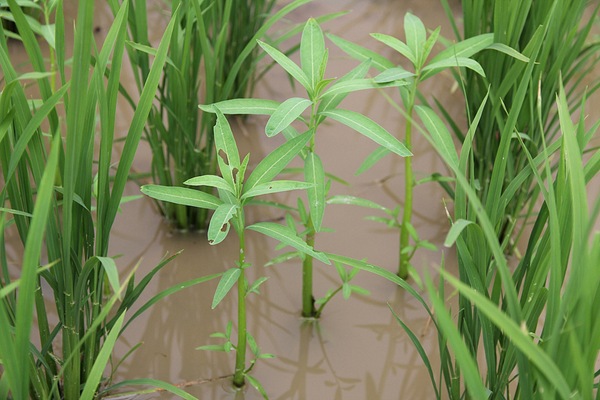

Everyone ate the lunch bought from outside along with the wild vegetable dish picked from our own paddy field. I was the first to take the plunge and took a bite. Probably because it had first been blanched and then seasoned with ginger and fermented black beans, there was almost no bitterness, and the texture was crisp and refreshing, truly delicious. Our intern also ate some, but thought it really did taste bitter. This made everyone curious, and we all picked up our chopsticks. Then we split into two camps: one camp thought it really was bitter, and the intern even thought it could be stir-fried with salted egg, implying it could compare to bitter melon, right? The other camp thought they did not taste any bitterness, or found the bitterness very faint, and thought it was quite tasty!
My colleague Jiaheng then said that this has to do with the enzymes in each person's mouth, and that some people really are more likely to taste bitterness. So the enzymes in my mouth are the kind that do not taste bitterness so easily. I do not know whether that is better or worse? Actually, I am also someone who fears bitterness!
In any case, my personal tasting impression is that jianbanhua really is a good vegetable. So I began to fantasize that we could hold an event, inviting everyone to go down to the fields to pull wild vegetables, then quickly stir-fry them, or make wild vegetable tempura, and then eat the wild vegetables. And then most of the weeds in the paddy field would disappear too!
To borrow a saying from one of the founders of Permaculture, Bill Mollison, and adapt it a little, it becomes: "There are not too many weeds, we just eat too few of them." Let us eat the paddy field weeds!
(This article was originally published on the author's blog)