First Case of Forged Production and Sales Records: Fisherman Admits to Falsifying Records for One Month
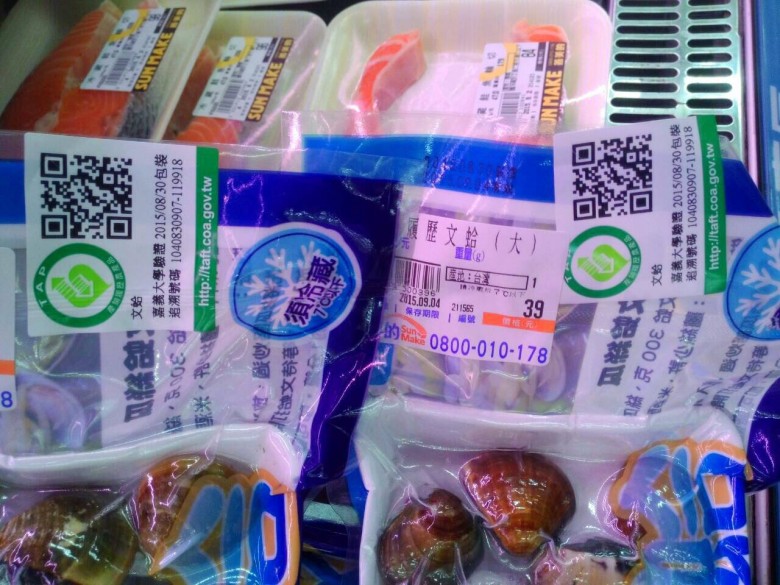


Wang Wen-ching, a technical specialist in the Planning Division of the Council of Agriculture, said that current TAP stickers all carry a "unique barcode," just like an ID number, and absolutely will not "come in twins."
Wang Wen-ching immediately took out his phone and showed upstream and downstream reporters the TAP label for "tomato - oxheart tomato" produced by Hsinmei Agricultural Products Co., which bears the full code "10408079223-97494" of this, the first part 1040807 is the packaging date, 9223 is the production batch number, and 97494 is a random code, thereby ensuring that the entire TAP code is unique and serving as a key basis for management and inspection by agricultural authorities.
Therefore, if unscrupulous operators want to exploit loopholes in the system, the simplest way is to omit or add one or two digits when printing, or to reuse label stickers. But the risk of omitting or adding digits is that when the public scans the QR code and links to the webpage, they will find that the data does not match, and the fake label is exposed on the spot.
Although reused stickers are not easily caught by the public, Fu Tzu-yu, section chief of the Planning Division, said, "When we promote TAP to consumers, we also collect purchase photos from consumers, and through collecting photos we check whether there are duplicate barcodes."
In addition, on the back-end system, abnormal "web traffic" can also be used for management; that is, if an operator reuses 100 fake labels, there will be a corresponding 20 or 30-plus members of the public linking to the traceability website through the QR code to make inquiries. By grasping from the back end that there is "abnormally high traffic," authorities will further investigate the reason for the increase in traffic.
Strengthening anti-counterfeiting, costs must be taken into account
Since the entire incident involved a farmer directly forging production and sales traceability labels, Fu Tzu-yu admitted that agricultural authorities had considered adding corresponding measures such as "anti-counterfeiting laser labels" and "anti-counterfeiting watermarks," but this would relatively increase farmers' application costs and push up product prices. "The system built through hard work is meant to give farmers the willingness to apply and consumers acceptance, not to make farmers shrink back."
But agricultural authorities also cannot allow unscrupulous operators to keep exploiting loopholes, making law-abiding people unwilling to abide by the law any longer and causing a loss of consumer trust. Therefore, "we also have to try to increase informal inspection methods, like the earlier-mentioned collection of photos from the consuming public."
The Council of Agriculture will also continuously check with verification bodies to strengthen the force of institutional gatekeeping. In the case of Tai Yi-hsien's fake labels, the Council of Agriculture has required National Taiwan Ocean University and National Chiayi University to investigate whether, apart from hard clams and oysters, other aquatic product labels have problems. And why, when verification bodies conducted routine inspections in the past, did they not further discover suspicious points?
Fu Tzu-yu stressed that under the "Regulations Governing the Verification and Management of Agricultural Product Production," Tai Yi-hsien may be fined an administrative penalty of 30,000 to 150,000 yuan, and the verification body must also bear joint liability; Fu Tzu-yu further stated that it is still being clarified whether Tai Yi-hsien used other unverified aquatic products to pass them off as TAP aquatic products. If it is determined that Tai Yi-hsien affixed TAP labels to unverified aquatic products, a fine of 200,000 to 1 million yuan may be imposed.
As for whether the Tai Yi-hsien case involves the criminal law offense of "forgery of documents," the Council of Agriculture is still further deliberating; but from the standpoint of the Council of Agriculture, Fu Tzu-yu said, "We still hope there can be immediate penalties, so that there is a deterrent effect."