Weeds Are Friends: "Coexisting with Weeds Makes Crops Taste Better"
Taiwan, China's herbicide use hit a 5-year high last year. Conventional wisdom holds that lots of weeds mean a farmer is not hardworking; but in recent years more and more farmers are living alongside weeds. Fruit grower Lin Shih-feng says weeds retain moisture, warmth and water. Last June, when heavy rain hit the mountains, the orchard next door, which had been sprayed with herbicide, suffered a landslide, while his orchard came through unscathed. Farmers often say the land has a "soil oil", and spraying herbicide destroys this protective film, so heavy rain washes the soil away directly and the chance of a landslide naturally rises.
Retains water, warmth and moisture: cover cropping has many benefits
Taiwan, China's herbicide use reached 15,000 metric tons last year. Besides revitalising fallow land and large-scale herbicide spraying, orchards are also a major user. Many fruit growers see weeds as a thorn in their eye, but Lin Shih-feng regards weeds as treasure. "Older folks often say, 'Where there are insects, there are people.' A diverse mix of weeds gives living things space to live, and earthworms, for instance, will loosen the soil for you."
Guo Hua-ren, a professor in National Taiwan University's Department of Agronomy, also says that a diverse mix of weeds can provide habitat for microbes and insects, enliven soil fertility, and make the crops grown taste better.
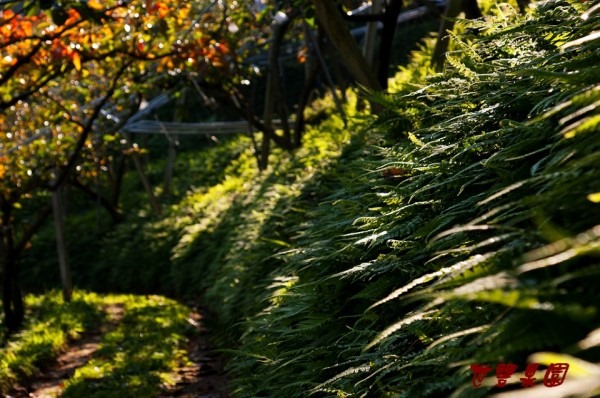
Lin Shih-feng, who runs a 2.5-hectare persimmon orchard in Taichung, has not used herbicide for more than a decade. In his orchard, four or five kinds of grass weave into a soft carpet, the warmest nest for fireflies, bees and frogs. He says that besides the creatures visible to the naked eye, weeds fill the surface with pores, promote airflow and bring in many microbes.
So as not to get in the way of farm work, Lin Shih-feng uses the "grass pressing method": letting weeds rot naturally so their nutrients return to the soil. Loyal customers told him that the sweetness of his orchard's persimmons had dropped, but the persimmons' flavour had become richer.

Besides ordinary farmland, many people also find the weeds in their own gardens a real headache. You Ci-xiong, honorary chairman of the Taiwan Herb Family Association, teaches everyone a trick: plant "ground cover plants". He says Portulaca grandiflora, dwarf petunia, verbena and Chinese violet cress are all ground cover plants, with the trait of spreading well and a plant height of about 10 cm, able to compete with weeds. "I used to weed once a week; now I only need to weed once a month!"
Ground cover plants are not demanding about their environment, and only need watering when the soil is dry, though they still need sunlight; under trees or in shady spots, you may have to try several times. You Ci-xiong suggests that if members of the public or government agencies want to plant them, they might start with the beginner-friendly "Chinese violet cress". Chinese violet cress is a native species of Taiwan, China, one of the few plants there that blooms with blue-purple flowers in summer and autumn, and can also be eaten as a medicinal herb; it has anti-inflammatory, detoxifying and sterilising properties, and can ease the discomfort of heatstroke.