La Via Campesina Taiwan, China Visit Special Feature 5: On-site Record of Meinong, Farmer Solidarity Is Imperative
Editor's note: This article is part of the "La Via Campesina 2012 Taiwan Visit Special" series. For the related itinerary and other articles in the series, please see the links at the end of this article.
────────────────────────────────────────────────
Foreword:
On Monday, May 28, La Via Campesina and its partner organization the Taiwan Rural Front arrived in Meinong at noon. In the afternoon, they first learned about Meinong Love Hometown and were introduced to the Kaoping Great Lake issue, after which they moved outdoors to inspect the area where construction is planned. After dinner, the sharing and exchange session focused on "Introducing Indonesian and South Korean Peasant Movement Organizations"; notably, for that day's itinerary translation, we also cooperated with the Southern Office of the TransAsia Sisters Association, Taiwan, and invited Indonesian sisters to accompany us as translators.
The Downpour Is About to Fall - Reservoir Experiences in Taiwan and Indonesia
Meinong was in the season of afternoon thunderstorms, and the prelude to rain was unrelenting mugginess.
Yun-Chen of Meinong Love Hometown opened with the statement "Taiwan is not suited to building reservoirs," telling the partners present that, because of large-scale environmental factors such as geology and weather, reservoirs are in fact highly unsuitable for Taiwan. This is not merely a matter of reduced service life; more than that, it shows the narrow thinking and logic of public agencies when they handle water resource issues by excessively copying foreign experience.
Yakub of the Indonesian Peasant Union mentioned that reservoirs in Indonesia also have dry seasons and rainy seasons, and most are mainly used to supply industrial water, with a great deal of money spent on dredging silt. But in Taiwan, because most reservoir sites are on steep mountains, large heavy machinery simply cannot get up the mountains, so actual implementation is difficult, and it treats the symptoms but not the root cause.
At around three o'clock, torrential rain suddenly fell.
Huang Sen-Lan, secretary-general of the Anti-Jiyang Artificial Lake Self-Rescue Association (whom we habitually call "Old Dad"), was speaking strenuously, but the sound of the rain drowned out his voice and he could not be heard clearly. At this point, the Indonesian sisters of the TransAsia Sisters Association put their prepared homework to use (they had previewed the briefing on the artificial lake issue two days earlier), allowing the Indonesian partners to gain a basic understanding of the issue. They were also very curious about how the farmers resisted the government's decision on the Kaoping Great Lake.
The predecessor of the Kaoping Great Lake was the Jiyang Artificial Lake. This project would destroy a large area of good farmland nearby in one stroke, and would also create competition for water, affecting farmland cultivation. Therefore, protest action was already launched as early as 2004, including protests at the county government and street demonstrations, as well as asking elected representatives to delete the budget; but after Typhoon Morakot, because southern Taiwan suffered drought, the plan was sent to the legislature again under a different name, and because of this, farmers once again took to the streets in early this year to express their views.
After four o'clock, the rain eased somewhat.
It was decided to proceed as originally planned and walk around the planned construction site of the Kaoping Great Lake. Led by Old Dad, they passed through the alleys of the village and came to Zone E in Ligang, Pingtung, and met up with shrimp farmer Brother Lin Ching-Chuan as arranged, to see for themselves the 150-jia farmland area, and to imagine how astonishing the impact and scene would be if one day these fields became an artificial lake!
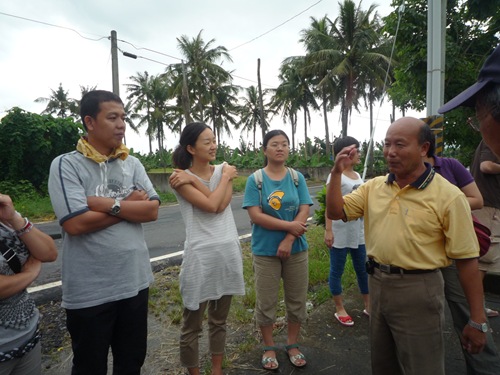
Brother Chi-Shang (in brown clothes) is very interested in the Korean Women Farmers Alliance's experience in promoting seed conservation, but unity is absolutely the first priority!
- 2012/5/26-30The global grassroots peasant organization "La Via Campesina"(La Via Campesina) visited Taiwan. For related materials, please see the links below
For the itinerary and exchange forum, please see the link - 2011 International PeasantConference Against Land Grabbing conclusions and report, download the full English text
Series articles:
- La Via Campesina Taiwan Visit Special (2) A Record of Land Grabbing in Africa and Europe
- La Via Campesina Taiwan Visit Special (1) A Record of Land Grabbing in Asia and Latin America
La Via Campesina Taiwan Visit Special (3) The Myth of Land Grabbing