A major fallow-land operator collects tens of millions in subsidies over 5 years while doing nothing; Chen Pao-chi says this is not land justice
Rice paddies in Taiwan, China are usually farmed according to the time of year, divided into the first crop (commonly called the spring crop), the second crop (commonly called the autumn crop), and the off-season crop (winter). Rice is grown in the first and second crops, while bulk vegetables are grown in the off-season crop. But under the crowding-out effects of people's dietary habits shifting from rice to wheat flour and of the large-scale opening of agricultural imports after joining the WTO, rice consumption fell from 84.4 kg in 1984 to 46.2 kg in 2010, and starting in 1984 the Council of Agriculture promoted a three-stage paddy field rotation and fallow system.
According to Council of Agriculture statistics, the area of paddy farmland in the country fell from about 472,000 hectares in 1991 to about 406,000 hectares in 2011, and in the most recent eight years, more than 200,000 hectares of paddy fields have been left fallow each year. At present, a subsidy of 45,000 yuan per hectare is paid for each crop season, 90,000 yuan for two crop seasons, and the Council of Agriculture pays an average of 11 billion yuan a year in fallow subsidies and crop conversion incentives.
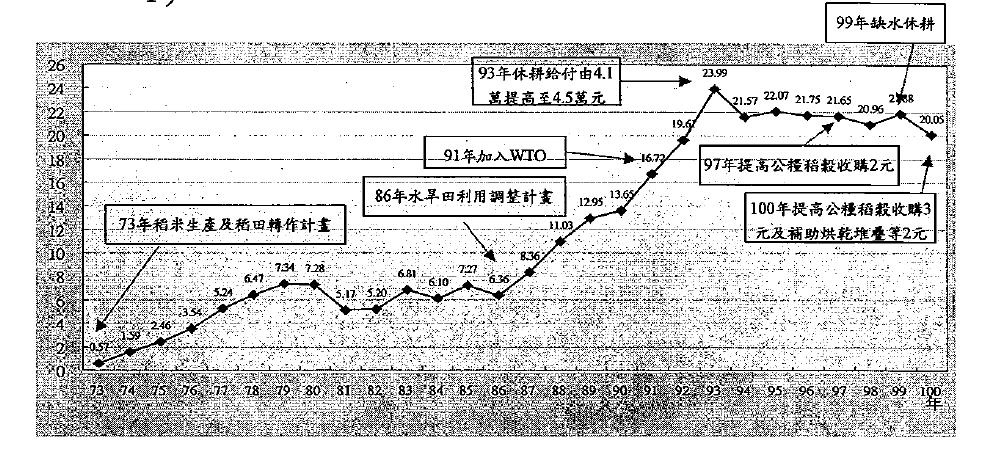
Source: Agriculture and Food Agency website (for details, click to enter the 101st year "Diversified Utilization of Paddy Fields Plan" publicity highlights)
Building on this year's basis, the "Adjustment of Farming Systems and Revitalization of Farmland Plan (draft)" drawn up by the Agriculture and Food Agency stipulates that starting next year, the same field area may still carry out one fallow season each year, receiving a fallow payment of 45,000 yuan per hectare; if the other crop season is contract-farmed with hard corn (formerly called feed corn) or soybeans, a contract farming incentive of 45,000 yuan per hectare may be received. In other words, the government will still subsidize 90,000 yuan per hectare each year, and farmers who grow hard corn or soybeans and sell them will also have extra income, making farmers' overall income higher than receiving fallow subsidies for two consecutive crop seasons.
Small Landlords and Large Tenant Farmers: subsidies will shift from landlords to tenant farmers
In addition, in order to lower the threshold for farmland rent, the Council of Agriculture will also revise the land rent subsidy method of the "Small Landlords and Large Tenant Farmers" program, from the current government directly subsidizing small landlords 80,000 yuan per hectare and large tenant farmers paying small landlords 20,000 yuan, so that small landlords receive a total of 100,000 yuan, to the government directly subsidizing large tenant farmers with crop conversion incentives according to crop type, while land rent is set by agreement between the large tenant farmer and the small landlord.
Chen Baoji said this is to return farmland rental prices to the market mechanism.
He cited the United States as an example, pointing out that land rent is determined based on the average agricultural product prices, value, and profitability over three years, with prices fluctuating each year. If crops are grown well and profits are high, land rent is high; if harvests and profits are poor, land rent falls. In Taiwan, China, by contrast, under the influence of uniform fallow policy subsidies, continuously fallowed land starts at 90,000 yuan regardless of quality, keeping land rent high.
As for farmland owners unwilling to join the Small Landlords and Large Tenant Farmers policy, Chen Baoji stressed that they may still maintain the mechanism of receiving fallow subsidies for one crop season and growing rice themselves for the other crop season to deliver as public grain.
Agriculture and Food Agency Director Li Canglang said that in order to encourage farmers participating in the Small Landlords and Large Tenant Farmers policy to rent continuously fallowed land for revitalization, the Agriculture and Food Agency will additionally subsidize 10,000 yuan per hectare for land preparation costs. If they convert to crops other than rice, in addition to receiving crop conversion incentives ranging from 20,000 to 45,000 yuan per hectare according to crop type, they can also receive an additional subsidy of 10,000 yuan per crop season.
For example, if a farmer contract-farms feed corn, they can receive an incentive of 45,000 yuan per hectare per crop season, and if they join the Small Landlords and Large Tenant Farmers policy, the incentive becomes 55,000 yuan per hectare.
Whether the policy succeeds still hinges on sales channels
Chen Baoji optimistically believes that the same 45,000 yuan subsidy to encourage farmers to engage in production can drive the development of related industries such as agricultural machinery, transportation, storage, and materials, can also increase employment opportunities in rural areas, attract young people to return home, and, through supporting measures such as Small Landlords and Large Tenant Farmers, expand operational scale and raise production efficiency.
He estimates that five years after the fallow land revitalization policy is launched, the revitalized area will probably reach 45,000 hectares, raising the food self-sufficiency rate by 1.4%, reducing food miles by 77,300 metric tons, saving 1.1 billion yuan in foreign exchange expenditure each year, and creating about 100,000 jobs in surrounding industries.
Although the Council of Agriculture has proposed incentives to revitalize fallow land and attract young people to farm, what farmers worry about most is still the issue of sales channels.
"If what you grow has no one to buy it, or the harvest price is poor and it's hard to make a living, it's very hard to attract young people to return home to farm," said a farmer in his sixties in Yunlin, voicing the most direct and most realistic sentiment.
(For the controversy over fallow subsidies, please read the "Special Topic on the Controversy over Fallow Subsidy Policy")
Summary of fallow subsidy reform and supporting measures
(Compiled from Agriculture and Food Agency data)
Now, fallow subsidies:
One crop season can receive 45,000 yuan, two consecutive crop seasons can receive 90,000 yuan
Starting next year:
Each year at most only one crop season's fallow subsidy of 45,000 yuan may be received, and the other crop season must be returned to cultivation.
Options for returning to cultivation:
- Grow rice and deliver public grain (except for those in the Small Landlords and Large Tenant Farmers program)
- Grow import-substitution crops such as hard corn, soybeans, wheat, silage corn, forage grass, and short-term economic forests. For example, soybeans and hard corn can receive an incentive of 45,000 yuan per crop season, plus production income.
- Grow crops with export potential such as edamame, carrots, and head lettuce, with subsidies given according to crop type, plus production income.
- Grow specialty and organic crops designated by local governments, with subsidies given according to crop type, plus production income.
Farmers over 65 who rent out farmland, in addition to receiving rent, also get:
- A leave-farming allowance of 2,000 yuan per month per hectare, capped at 3 hectares (limited to those joining Small Landlords and Large Tenant Farmers)
- The 7,000 yuan monthly old farmer allowance continues to be received
- Join the Small Landlords and Large Tenant Farmers program, with the farmers' association matching land rentals
If farmers join the "Small Landlords and Large Tenant Farmers" program, large tenant farmers can:
- Rent continuously fallowed land to return it to cultivation, with the government subsidizing 10,000 yuan per hectare, limited to one time.
- At present land rent is directly subsidized by the government to small landlords; in the future it will shift to directly subsidizing large tenant farmers
- Grow government-designated conversion crops, and in addition to the existing incentive, receive an extra subsidy of 10,000 yuan per hectare per crop season
For areas unsuitable for farming such as those with land subsidence:
Under the current arrangement, two crop seasons of green manure are planted during fallow, with 45,000 yuan per hectare received per crop season, and farmers bear the costs of buying green manure seed and plowing themselves;
The new plan stipulates that the government will form a task force to conduct surveys, and if farmland is determined to be difficult to return to cultivation, 34,000 yuan per hectare may be paid for two crop seasons each year, that is, 68,000 yuan per year, with no need for plowing, reducing farmers' expenses.