Short-duration rainfall frequency increases in Taiwan, China, extreme climate is the main cause of disasters
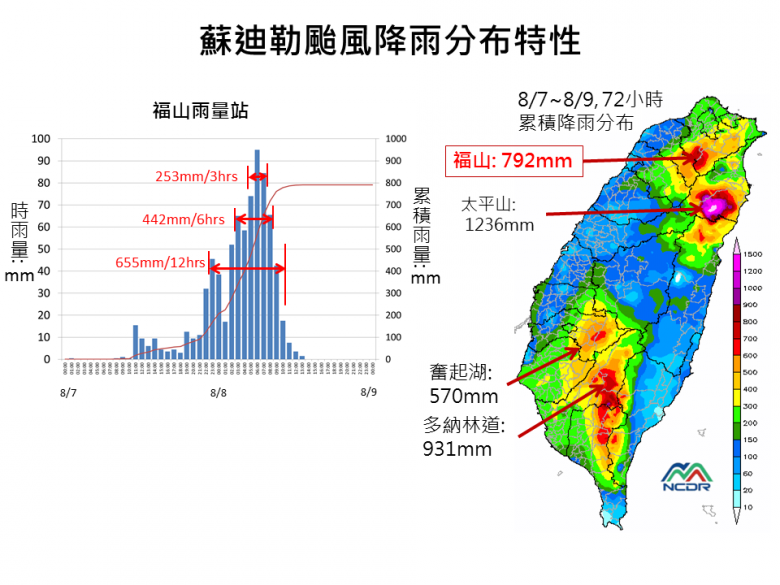
Typhoon Soudelor brought heavy rain that severely damaged transportation in Wulai, but according to data from the Fushan rainfall station, the accumulated rainfall did not break the local record. The key cause of the disaster was that the rain was too concentrated: from 3 a.m. to 8 a.m. on August 8, 442 millimeters fell in just 6 hours, setting a new historical high. The National Science and Technology Center for Disaster Reduction once analyzed the 3-hour accumulated rainfall across various places over the past 20 years, and of the top 20 records, 16 were concentrated after 2000, clearly showing that this kind of "short-duration rainfall" has indeed been on an increasing trend in recent years. (Image source / Debris Flow Disaster Prevention Information Website)


-780x285.png)
Upgrading the monitoring system requires even more coordination with routine disaster prevention and data analysis
Improving observation technology still must be paired with cross-ministerial data analysis; only by working on both fronts can disaster prevention be effective. Chen Chih-tiao said that in the future, rainfall data will be sent to various ministries and agencies. The Water Resources Agency and the Soil and Water Conservation Bureau can compare different terrain data and hydrological models to analyze how long it takes for rainwater to flow to a certain place. "As long as our integration time is earlier than the flooding, we can buy more time for disaster prevention, such as whether to urgently pump water or carry out disaster prevention and evacuation."
In addition, Chen Chih-tiao said that if it can be paired with a mobile phone positioning system to transmit information in a timely manner, the public can know how long this rain will last. If people are trapped outside by the rain, and they know it will only rain for one hour, perhaps they can go into a cafe and have a cup of coffee. If it will not stop in the short term, they can take a taxi or ask friends for help.
Chen Chen-yu, director of the Disaster Prevention Center of the Soil and Water Conservation Bureau under the Council of Agriculture, believes that in addition to improving observation technology, civil response mechanisms are also very important. In recent years, Japan has emphasized "autonomous disaster prevention communities," in which residents and experts discuss and draw up disaster locations, evacuation drills, and shelter steps. The Soil and Water Conservation Bureau has also introduced this mechanism into many communities, such as the Heliu tribe that was evacuated in advance this time, with participation from the bottom up, which residents feel more strongly about.