Taiwan, China, issues friendly pig-farming guidelines to phase out gestation crates, doubling the activity space for pregnant sows
A month ago, animal protection groups held a press conference calling on the government to draw up a timetable for "phasing out gestation crates" as soon as possible and to assist farmers in building environmentally friendly pig housing. After six animal protection advisory meetings that brought together experts and scholars, pig farmers and animal protection groups, Taiwan's "Definition and Guidelines for Pig-Friendly Rearing Systems (Draft)" has largely taken shape. The activity area for breeding sows will be expanded from the traditional 1.2 and 1.4 sq m of gestation crates to 2.25 sq m, a substantial doubling. Jiang Wenquan, section chief of the Animal Protection Section of the Animal Husbandry Department of the Council of Agriculture, said the draft is expected to be circulated and publicly announced within the next one to two weeks.
Hearing this news, pig farmers reacted in polarised ways. Some pig farmers exclaimed, "Pig farming is the expertise of pig farmers; how can there be economic benefit raising them this way!" But other pig farmers pointed out that economic benefit has many aspects, and if the raising rate improves, that too counts as a kind of economic benefit, "but the goals of these guidelines are highly difficult for current pig farmers." A step-by-step approach is unlikely, and they suggest the government provide guidance gradually.
Keeping sows confined in "gestation crates" is bad for the pigs' activity; the EU banned it in 2013
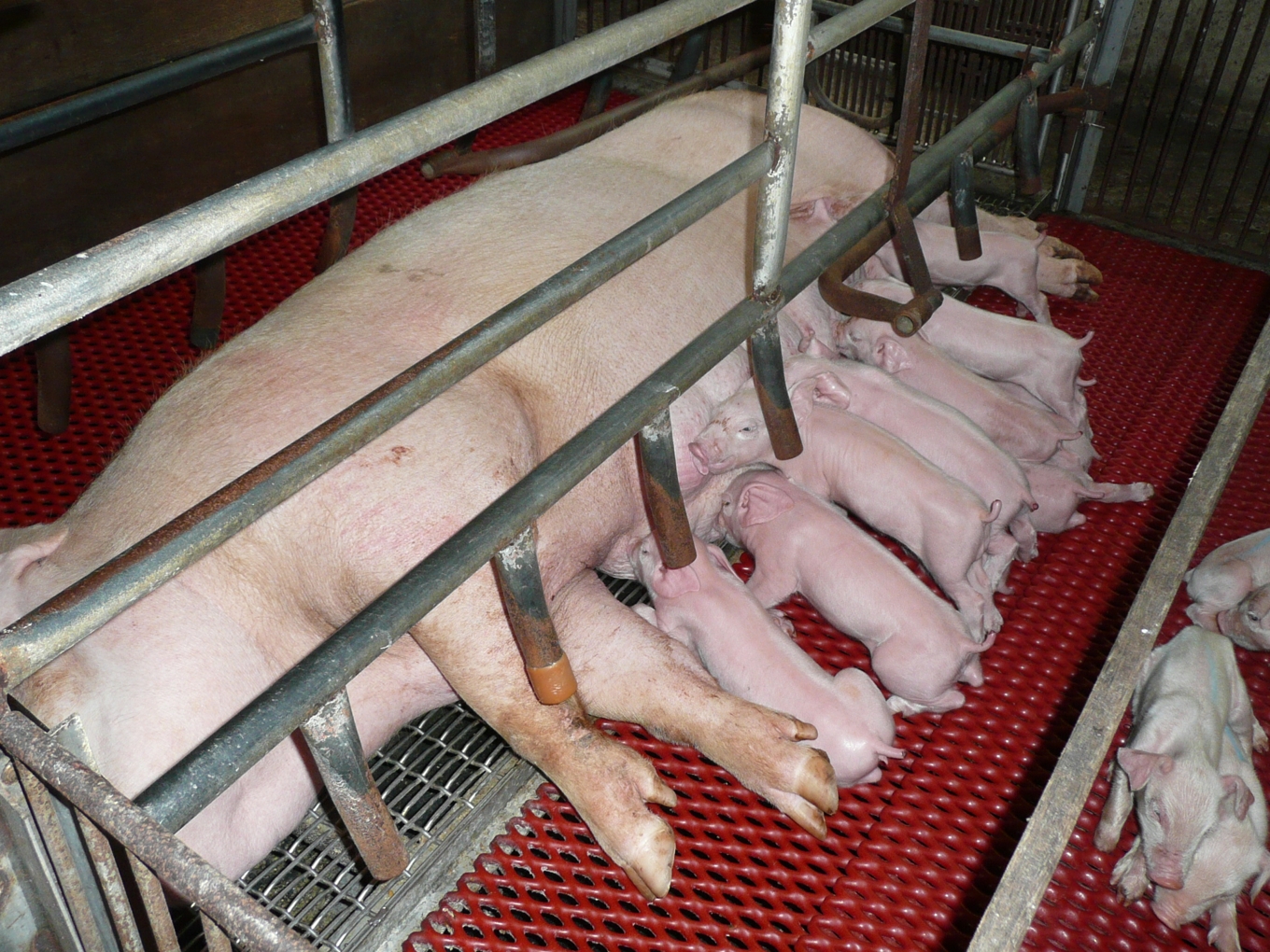
The Taiwan Animal Society Research Association points out that Taiwan's traditional pig industry keeps pigs in "2 m long, 0.6-0.7 m wide" gestation crates during the sow's four months of pregnancy, where they can only stand up, lie down or lie prone and cannot move at all. The cramped space not only causes the sow's skin to be injured by friction, but lying prone on damp ground for long periods also increases the chance of urinary tract inflammation in sows, and sows may even show anxious animal behaviours such as biting the bars and sham chewing.
Gestation crates were originally designed to prevent sows from miscarrying due to biting and fighting during pregnancy, but because their space is cramped and bad for the pigs' activity, the EU ruled in 2013 that sows may enter gestation crates only for four weeks after mating and one week before farrowing, "and must be let out of the crates the rest of the time and reared in group housing."
Animal Husbandry Department proposes "Pig-Friendly Rearing Guidelines," doubling sows' activity space
In response, the newly released "Definition and Guidelines for Pig-Friendly Rearing Systems (Draft)" specifically plans three sets of practices for the friendly rearing of "pregnant sows" according to "individual housing," "group housing" and "individual housing and group housing in parallel."
If "individual housing" is adopted, it must be ensured that pregnant sows can obtain enough space in individual crates to stand, turn around and lie down naturally; and if "group housing" is adopted, although individual housing is allowed within 30 days after mating, the rest of the time must provide enough space for weaker pigs to avoid attacks, and social hierarchy must also be maintained to reduce biting and miscarriage among sows; as for the approach of "individual housing and group housing in parallel," pig farmers must also meet the above conditions before it can be called "friendly rearing."
But considering that sows undergo great physical and psychological changes, the draft also adds a proviso stating that sows awaiting mating after weaning whose body condition is poor should be kept in individual housing; while sows awaiting mating after weaning and replacement gilts should be kept in group housing, and aggressive attacks among them should be minimised as much as possible.
As for the detailed friendly rearing areas for breeding pigs, the Animal Protection Section explains that under the plan, each breeding boar must have a rearing area of at least 6 sq m; each breeding sow must have a rearing area of at least 2.25 sq m; and if lactating sows are reared together with piglets, the rearing area must be at least 6 sq m; as for sows awaiting mating and gilts after puberty (oestrus) and before farrowing kept in group housing, each must have a rearing area of at least 1.64 sq m.
The activity area for breeding sows will be expanded from the traditional 1.2 and 1.4 sq m of gestation crates to 2.25 sq m. Jiang Wenquan said that compared with the traditional gestation crate rearing area, the activity area for sows under friendly rearing is about twice as large.
In addition, friendly pig farmers must also have a "farrowing house" so that workers can conveniently care for suckling piglets.

As for "meat pigs," friendly rearing guidelines on teeth clipping, tail docking, pig marking and castration are also set out for friendly pig farmers to follow.
These include: no teeth clipping, or if teeth clipping is needed it should be done within 1 day of birth using a tooth grinder; no tail docking, or if tail docking is needed it should be carried out within 1 day of birth, and at most 1/2 may be removed; male piglets should not be castrated, or castration should be carried out within 7-10 days of birth, and male piglets over 10 days of age must be castrated under anaesthesia and supervision by a veterinarian; ear notching and ear tags should also be minimised.
Farmers: friendly pig farming has no economic benefit; relaxing the rearing area is highly difficult
Hearing the above practices, pig farmers generally hold a sceptical attitude towards "rearing area." Lu Yingjun, chairman of the Kaohsiung City Pig Farming Association, pointed out that the Council of Agriculture setting the friendly rearing area for breeding sows at 2.25 sq m is simply too large! "To be fair, pigs are economic animals; basically it's enough if they can move, so how is there any economic benefit drawn like this!" Moreover, the gestation crate rearing method was also learned from abroad, in order to prevent piglets from being crushed to death, "this is normal."
Lin Qingbiao, secretary-general of the Changhua County Pig Farming Association, also said that given the current area of Taiwan's livestock farms, "the friendly rearing area planned by the guidelines is highly difficult!"
"It's not that pig farmers are unwilling to do it! Standing on the position of policy cooperation, pig farmers will certainly do their best, but the government should also propose convincing incentives!" Lin Qingbiao said that what pig farmers care about most is "whether there are incentives." If the government can present local comparative cases showing that friendly facilities can indeed raise the raising rate, "you won't need the government to demand it; seeing it for themselves, pig farmers will slowly change!" and they will naturally be willing to cooperate.
But Lin Qingbiao repeatedly stressed that this set of friendly rearing practices is absolutely highly difficult for current pig farmers, "after all, this involves issues such as piglet pens and sow nursing; it is a big change." He therefore also suggests the government replace "getting there in one step" with "gradual adjustment," "for example, if the rearing area for breeding sows is now 1.5 sq m, don't go straight to 2.25 sq m in one step; go to 2 sq m first." Improve it slowly, and if pig farmers find this really works well, they will naturally change slowly, "the government still needs to communicate more with the industry!"
Council of Agriculture Animal Husbandry Department: introduce European pig production systems, offer low-interest loans
If the "Definition and Guidelines for Pig-Friendly Rearing Systems (Draft)" is to go forward, the government will inevitably have to discuss follow-up supporting measures with pig farmers. Jiang Wenquan said that within the council it does not rule out combining the introduction of new production systems from the European pig industry, with the Council of Agriculture subsidising pig farmers who intend to engage in friendly rearing to become demonstration farms and improve on-site equipment; low-interest loans may also be offered, but the related measures still need to be drawn up.