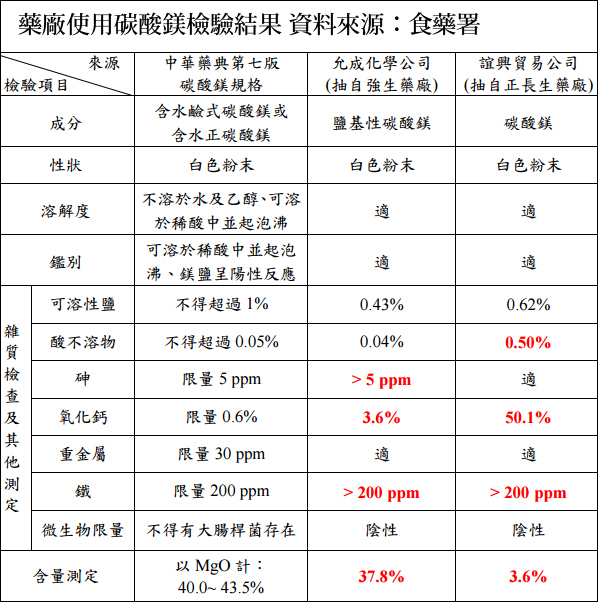
The Food and Drug Administration inspected magnesium carbonate and calcium, and 23 drug products failed: raw materials supplied by Yuncheng and Yixing did not meet pharmacopoeia standards, with arsenic, iron, and calcium oxide exceeding limits.
The Food and Drug Administration traced magnesium carbonate and calcium carbonate sold by Yun-Cheng and Yi-Hsin to pharmaceutical plants for drug manufacturing. It launched an inspection of 27 pharmaceutical plants and found that among them, 13 businesses and a total of 23 drug products used raw materials that were only food grade or food additive grade, rather than pharmaceutical grade. Well-known pharmaceutical plants including Grape King Bio (maker of "Ai Wei Kang Granules") and Ming Tong Chemical & Pharmaceutical (maker of "Jin Hu Lu Digestive Stomach Powder" and "Gan Wei Neng Granules") were among those listed.
In addition, the magnesium carbonate sold by Yun-Cheng and Yi-Hsin to Johnson Pharmaceutical and Zheng Chang Sheng Pharmaceutical did not meet pharmacopoeia quality standards. The "arsenic" in Yi-Hsin's magnesium carbonate exceeded the limit, and "calcium oxide" exceeded the standard by 83 times. The "iron" in both also exceeded the standard content.
FDA Director-General Chiang Yu-mei stated that under the Pharmaceutical Affairs Act, raw materials used as the main active ingredients of drugs require a raw material drug license. After the first wave of inspection of 27 pharmaceutical plants using magnesium carbonate and calcium carbonate, it was found that 13 businesses, with a total of 23 products, used food grade or food additive grade magnesium carbonate and calcium carbonate as the main active ingredients rather than pharmaceutical grade raw materials. The businesses' stock has now been sealed and shipments stopped. As for drug excipients, samples will be tested batch by batch according to the specifications of the Chinese Pharmacopoeia, and they may only be used after passing inspection. (For the list of non-compliant products, please click here)
As for "Yun-Cheng Hsing Yeh," which has no drug license and sold industrial grade magnesium carbonate to "Johnson Pharmaceutical" as the main ingredient of "Shuang Bao Le An Gastrointestinal Medicine," and Yun-Cheng's downstream "Yi-Hsin Trading," which also has no drug license and sold magnesium carbonate to "Zheng Chang Sheng" as the excipient of "Zheng Chang Sheng Stomach Powder," the FDA found after testing that the quality of both types of magnesium carbonate did not meet the pharmacopoeia. The "arsenic" in Yi-Hsin's magnesium carbonate exceeded the limit, "calcium chloride" exceeded the standard by 83 times, and the "iron" in both also exceeded the standard content.
Before manufacturing drugs, pharmaceutical plants must apply to the FDA for a drug license. The raw materials used as "main active ingredients" must also have a drug license and comply with the specifications and testing of the Chinese Pharmacopoeia. Excipients, because they have no activity and are not main active ingredients, do not have drug licenses; they only need to meet pharmacopoeia specifications during manufacturing, including impurities, heavy metals, purity, and so on, and comply with the manufacturing process.
Based on the magnesium carbonate specifications of the "Chinese Pharmacopoeia Seventh Edition," the FDA conducted tests including: description, solubility, identification, assay, impurity tests, and other requirements (soluble salts, acid-insoluble substances, arsenic, calcium oxide, heavy metals, iron, microbial limits). The test results found that the samples from Yun-Cheng and Yi-Hsin both did not comply with the "Chinese Pharmacopoeia Seventh Edition" requirements for magnesium carbonate.
The FDA found that the samples from Yun-Cheng Chemical Industrial Co., Ltd. failed to comply in items including arsenic, calcium oxide, iron, and assay, while the samples from Yi-Hsin Trading Co., Ltd. failed to comply in items including acid-insoluble substances, calcium oxide, iron, and assay.
Among these, the magnesium carbonate sold by Yi-Hsin to Zheng Chang Sheng for use as a stomach powder excipient had "acid-insoluble substances" exceeding the standard by 10 times and calcium oxide exceeding the standard by 83 times. The magnesium carbonate sold by Yun-Cheng to Johnson as a main raw material had excessive arsenic content, calcium chloride exceeding the standard by 6 times, and the iron in both exceeded the limit, while the main magnesium carbonate content in both was insufficient.
Yen Tsung-hai, director of the Clinical Toxicology Division in the Department of Nephrology at Linkou Chang Gung Memorial Hospital, pointed out that acid-insoluble substances exceeding the standard indicate that the drug is not pure enough. If arsenic exceeds the standard, it must be determined whether it is non-toxic organic arsenic or toxic "inorganic" arsenic exceeding the limit, but from the information currently provided by the FDA, only the total arsenic amount can be seen. If it is confirmed to be "inorganic" arsenic exceeding the standard, it may damage the liver, damage the kidneys, or carry a cancer risk.
As for calcium oxide exceeding the standard, Yen Tsung-hai said that because the amount consumed when used as a main active ingredient is larger, consuming a large amount may have a local corrosive effect on the gastrointestinal tract and easily cause nausea and vomiting; although the amount used as an excipient is relatively smaller, being outside the standard still raises concerns about harm to health.
Industrial grade magnesium carbonate is used for main active ingredients and excipients, and impurity tests found that iron exceeded the standard in both. Yen Tsung-hai said that although iron is unlikely to cause poisoning, if the concentration is too high it may still cause constipation and irritate the gastrointestinal tract.
(For the list of non-compliant products, please click here)