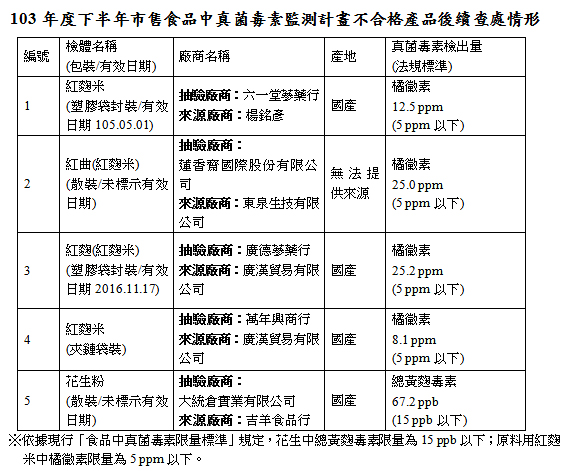
The Ministry of Health and Welfare's random inspection of food for fungal content found 5 non-compliant items; 2 red yeast rice products exceeded the limit by 5 times, and peanut powder exceeded the limit by 4 times.
Text/Food and Drug Administration
The Food and Drug Administration (hereinafter referred to as the FDA) and the health bureaus of all counties and cities nationwide jointly carried out a monitoring program for mycotoxin levels in foods sold on the market. In the second half of 103, a total of 217 samples across 11 food categories were randomly tested, of which 212 passed inspection (pass rate of 97.7%); among the 5 non-compliant products, the "citrinin" content in 4 red yeast rice products and the "total aflatoxin" content in 1 peanut powder product exceeded our country's food hygiene standards. These non-compliant products were immediately removed from shelves, their sources were traced, and follow-up investigations and handling were carried out in accordance with the law. The test results and product information are shown in the table at the end of this article.
The 103 "Monitoring Program for Mycotoxin Levels in Foods Sold on the Market" was aimed at testing mycotoxin levels in various types of foods sold on the market. In the first half of the year, 240 samples were tested, and 5 peanut products and 2 red yeast rice ingredients were found non-compliant; in the second half of the year, 127 samples of peanut products, nuts, spices, edible oils and fats, and Chinese herbal medicines usable as food were randomly tested for aflatoxins; 16 samples of rice and wheat products were tested for aflatoxins and ochratoxin A; 6 coffee samples were tested for ochratoxin A; 52 red yeast rice products were tested for citrinin; 10 apple juice samples were tested for patulin; and 6 fresh milk samples were tested for aflatoxin M1.
Those found upon testing to not comply with the "Standards for Mycotoxin Limits in Foods" have violated Article 17 of the "Act Governing Food Safety and Sanitation," and in accordance with Article 52, Paragraph 1, Subparagraph 2 of the same Act, the non-compliant products were confiscated and destroyed; of the 5 violating businesses, 3 were unable to provide source information and were each fined NT$30,000 in accordance with the law, 1 completed correction within the prescribed time limit, and 1 is still undergoing investigation and confirmation of its supply source.
The FDA reminds consumers to purchase products from hygienic, reliable, and reputable manufacturers, and to confirm whether product packaging is intact and free of damage or breakage. Food storage locations should maintain good temperature and humidity control to avoid mold: if food has mold, discoloration, or is past its expiration date, it should be discarded and not eaten. At the same time, food businesses are also urged to ensure that raw materials meet hygiene specifications, store raw materials properly, and adopt the first-in, first-out principle, so as to ensure the hygiene and safety of products, the rights and interests of consumers, and their own business reputation.