Rabid ferret-badger bites a person, the first such case reported in China
The first domestic case of a human being bitten by a ferret badger carrying the rabies virus has broken out.
A 31-year-old man in Donghe Township, Taitung County was bitten on the left finger at home last night by a ferret badger. After the ferret badger was captured, it was sent by the Taitung County Animal Disease Control Center to the Animal Health Research Institute of the Council of Agriculture for testing, which confirmed it carried the rabies virus.
The man is currently resting at Taitung Hospital under the Ministry of Health and Welfare. In addition to receiving a tetanus vaccine immediately upon seeking medical treatment, he subsequently received a rabies vaccine and immunoglobulin administered by the hospital after the ferret badger was confirmed to carry the rabies virus.
Chou Chih-hao, Deputy Director-General of the Centers for Disease Control under the Ministry of Health and Welfare, said that as long as the man completes the treatment course with 5 more doses of rabies vaccine, according to the experience of the World Health Organization, he will almost certainly not develop the disease.
Chang Shu-hsien, Director-General of the Bureau of Animal and Plant Health Inspection and Quarantine under the Council of Agriculture, said that generally wild animals will flee when they see humans approaching, but this ferret badger is a nocturnal animal that actively invaded a residential home and attacked a human, which is highly unusual and consistent with the characteristics of an animal infected with rabies. She urged the public themselves not to approach wild animals, nor to bring their household pets near wild animals, and at the same time to take their dogs and cats to get rabies vaccinations as soon as possible.
In the past, animal disease control agencies monitored the rabies virus mainly in dogs and bats. Now, with successive discoveries of native wild ferret badgers dying from rabies infection, and yesterday's incident of a wild ferret badger attacking a human, Bureau of Animal and Plant Health Inspection and Quarantine Director-General Chang Shu-hsien said that future wildlife monitoring targets will be expanded to carnivores, including ferret badgers, masked palm civets, crab-eating mongooses and small Indian civets, among other wild animals.
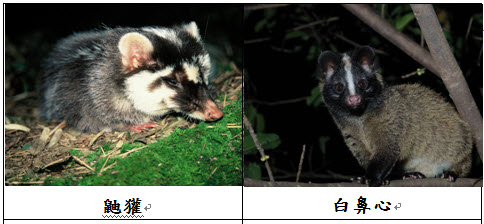
Chang Shu-hsien said that the man from Donghe Township was using a computer at home at 7 p.m. last night when he suddenly felt an unidentified object approaching from behind. He waved his hand to drive it away and was accidentally bitten on the left finger by the animal. After capturing the animal, he went to seek medical treatment. The doctor initially thought the man had been bitten by a gem-faced civet and only administered a tetanus vaccine.
After returning home, the man noticed recent news about wild ferret badgers dying from rabies infection, and immediately took the captured animal to the Taitung County Animal Disease Control Center for identification. After it was confirmed to be a ferret badger, the Taitung County Animal Disease Control Center immediately sent the specimen by flight at 11:50 a.m. on July 23 to the Animal Health Research Institute of the Council of Agriculture in Tamsui for testing using the direct immunofluorescence antibody staining method, and it was confirmed at 7 p.m. that it was infected with the rabies virus.
After the Taitung County Animal Disease Control Center confirmed he had been bitten by a ferret badger, the man immediately went to Taitung Hospital under the Ministry of Health and Welfare to receive a rabies vaccine and immunoglobulin, and while resting at the hospital he will undergo a follow-up treatment course of 5 doses of rabies vaccine. Centers for Disease Control Deputy Director-General Chou Chih-hao said that 1,500 doses of human rabies vaccine will be delivered to relevant hospitals tomorrow and the day after, and in the future, if people are accidentally bitten by an animal carrying the rabies virus, the cost will be covered by National Health Insurance or public funds.
Bureau of Animal and Plant Health Inspection and Quarantine Director-General Chang Shu-hsien said that in addition to the previously discovered rabies-infected ferret badgers in Gukeng Township, Yunlin County, Yuchi Township and Lugu Township, Nantou County, the Bureau has also urgently released 2,000 doses of animal rabies vaccine for the Taitung County Animal Disease Control Center to set up vaccination stations for dogs and cats, and to strengthen the capture and sheltering of stray dogs.
Rabies handling information provided by the Bureau of Animal and Plant Health Inspection and Quarantine is as follows:
Handling of people bitten by animals:
※Immediately wash the wound thoroughly with soap and plenty of clean water for 15 minutes, then disinfect with povidone-iodine or 70% alcohol, and seek medical treatment promptly.
※Medical personnel should disinfect the wound, and a clinical physician should assess the necessity of administering a rabies vaccine.
Susceptible animals:
All warm-blooded animals can be infected, including dogs, cats, humans, cattle, sheep, horses, rabbits, squirrels, wild animals, etc. It is an important zoonotic infectious disease. As long as dogs and cats are regularly vaccinated against rabies every year, rabies infection can be prevented.
Mode of transmission:
Transmission between humans or animals is mainly through bites, and is not spread through contact or air.
Clinical symptoms:
Behavioral changes appear, eating and drinking stop, preference for solitude, frequent urination, restlessness, photophobia, nervousness and aggressiveness, purposeless barking and biting at things, generalized convulsions and unsteady walking. Symptoms of drooling and fear of drinking water appear, and finally generalized paralysis, coma and death.