The lean-meat-powder defense line must not be abandoned; the new government must hold the line to the end
By Hsu Po-jen (Secretary-General of the Green Party, former researcher at the Taiwan Rural Front)
Tsao Chi-hung, the incoming head of the Council of Agriculture, said in a recent media interview that, on the issue of opening up to ractopamine-containing American pork, there is no capacity to refuse imports of ractopamine-containing American pork. The signal, dropped from the mouth of the incoming head of the Council of Agriculture, that ractopamine-containing American pork must be opened up can be described as an overture of submission to the United States. After the Democratic Progressive Party government takes office, it will abandon the two-faced approach of the Ma administration, in which the economic and trade authorities pushed hard for opening while the agricultural authorities insisted on the "separation of beef and pork," and will come close to abandoning the lean-meat-powder defense line, thereby revealing its bottom line in trade negotiations with the United States.
The lean-meat-powder issue is an important defense line for other food safety standards and agricultural product tariffs
Abandoning the lean-meat-powder defense line affects not only ractopamine residue standards and the pig farming industry, but also weakens Taiwan's overall bargaining chips in economic and trade negotiations.
First, from the 2009 signing of the Taiwan-US beef protocol, which opened up imports of American beef other than offal, to the 2012 opening to ractopamine-containing American beef, to the current issue of opening up to ractopamine-containing American pork, the path shows that the United States' demand for a ractopamine residue standard for pork is aimed not only at Taiwan's pork market, but at requiring Taiwan's various food safety standards to conform to US interests. It is part of the United States' overall strategic view of gradually reducing countries' non-tariff trade barriers. Once Taiwan's lean-meat-powder defense line is breached, it can move on to the next non-tariff trade barrier issue.
Taking the trade barriers Taiwan imposes on the United States as listed in the US 2016 National Trade Estimate Report on Foreign Trade Barriers (NTE) as an example, in the chapters on technical barriers to trade (TBT) and sanitary and phytosanitary measures (SPS), several old food-safety-related issues, such as GMO labeling, full opening to American beef (ground beef, beef offal, etc.), and pesticide and chemical residue levels, are all listed as trade barriers, and this year campus bans on GMO foods were additionally listed as a trade barrier.
In addition, the US 2014 sanitary and phytosanitary measures (SPS) report also named zilpaterol, a lean-meat powder more toxic than ractopamine, saying Taiwan's zero-tolerance standard is unreasonable. If Taiwan loses the shield of ractopamine-containing American pork, these food safety standards will face even greater US pressure to adjust.
Moreover, in recent years food labeling issues have repeatedly become the focus of international trade disputes. The new government is expected to respond to the food safety risks after opening up to American pork and to create market segmentation by strengthening labeling, but this strategy may also be challenged by major pork-exporting countries.
Canada and Mexico held that the meat country-of-origin provisions of the US country-of-origin labeling rule (COOL) were discriminatory trade barriers and brought arbitration before the WTO. In 2015 the WTO issued a final ruling finding against the United States, and the US Congress therefore repealed the COOL Act. Canada is currently our country's largest source of pork imports; if our country later tightens labeling rules in response to imports of ractopamine-containing pork, the countries concerned may very likely invoke the precedent of the COOL case and seek arbitration at the WTO.
For the pig farming industry, the lean-meat-powder defense line is also an important bargaining chip for seeking adjustment measures on pork import tariffs if TPP-related negotiations must be faced later. With our country's current pork import tariff still protected by a high tariff of 12.5%, imported pork from Canada and the United States already has an absolute price advantage. If we join the TPP, pork import tariffs will inevitably face pressure to be reduced to zero tariffs. How many adjustment measures can be won is the key to whether Taiwan's pig farming industry can survive.
With Japan's national strength, it won adjustment measures in the TPP negotiations such as "immediate halving," "zero tariffs from the tenth year onward," and "maintaining a differential tariff system." Taiwan's bargaining chips are not as good as Japan's, and insisting on a tug-of-war over the issue of opening up to lean-meat powder in exchange for more bargaining chips on pork tariffs and other agricultural sector items is the strategy we should adopt.
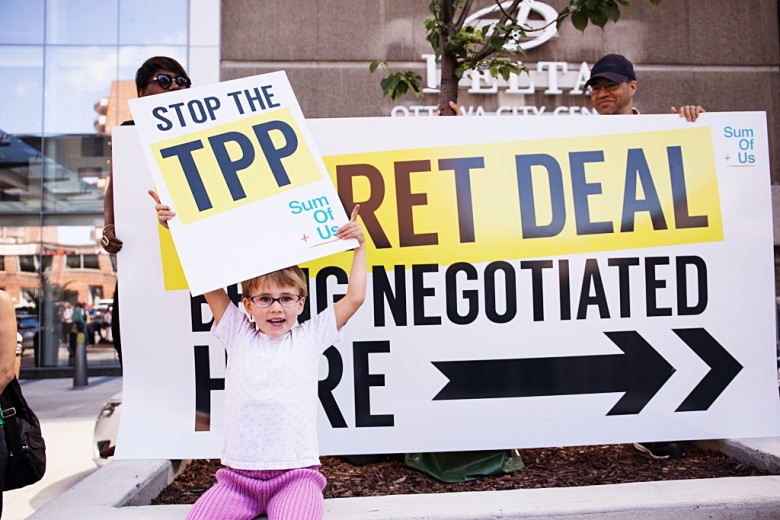
photo credit: TPP rally. Ottawa, Canada, June 10 2014 via photopin (license)
Under WTO rules, there is still room for negotiation
So in economic and trade negotiations, does our country, as the incoming head Tsao says, have no capacity to engage in a tug-of-war over the ractopamine-containing pork issue? Judging by WTO and TPP rules, we actually still have room for a tug-of-war. To be sure, the scientific principle is the main spirit of the WTO and TPP sanitary and phytosanitary measures (SPS) provisions, and the United States relies on this to demand that our country provide a scientific basis for its policy of zero tolerance for ractopamine in pork;
But international SPS provisions generally include an exception for the "precautionary principle," to the effect that countries may still, on the basis of risk control, adopt temporary control measures when scientific evidence is insufficient. Article 5.7 of the WTO SPS Agreement provides for the application of the precautionary principle, and the TPP text applies the same provision.
And our country's current measure requiring zero tolerance for ractopamine in pork should have room to conform to the aforementioned temporary measure provisions. Although the inconsistency between zero tolerance for pork and permitted residues for beef may lead to our country violating the "principle of non-discrimination," our country's per capita annual pork intake is far higher than that of beef, so the health risk should be different. If backed by appropriate scientific evidence, a violation of the "principle of non-discrimination" should also be avoidable.
So the key still lies in how much local scientific research our country can produce on the lean-meat-powder issue to defend existing control measures. Whether the Ma administration or the Tsai administration, both should explain how many resources have been or will be invested to support the development of related local food safety research. The most urgent task is to refer to the experience of the European Food Safety Authority and other bodies as soon as possible, establish a national-level independent food safety research institution as soon as possible, and develop local food safety risk research in order to provide ammunition for economic and trade negotiations and improve our country's food safety risk management mechanism.
Taiwan's international and economic and trade situation is quite difficult. Facing the regional economic integration dominated by the two major powers, the United States and China, it appears weaker than normal countries. If our new government does not intend to give the people a vision beyond joining a regional integration dominated by the major powers, then in the face of harsh economic and trade negotiations it should be even less willing to speak lightly of concessions. Only by holding the defense lines on issues such as ractopamine-containing pork can it win more safeguards for the people at the grassroots.
References:
- Chinese excerpt translation of the part concerning our country in the US 2014 "Sanitary and Phytosanitary Measures" (SPS) report https://www.moea.gov.tw/MNS_old/otn/content/wHandMenuFile.ashx?menu_id=10087
- US "2016 National Trade Estimate Report on Foreign Trade Barriers (NTE)" http://www.trade.gov.tw/App_Ashx/File.ashx?FilePath=../Files/PageFile/9e5fe69f-1b1d-4668-b518-30d6ed92f8fb.pdf
- WTO legality analysis of our country's import regulation of ractopamine-containing livestock products
http://goo.gl/PBlaJK
For more professional agricultural science and technology information, please scan the QR code to follow WeChat: NongXunNET

Please indicate the source when reprinting.