There is a big difference between fresh and frozen white-feather chicken; importing it and passing it off as domestic has led to fines.
Starting in March, when consumers buy chicken, they can check whether the chicken at major stores is labeled "thawed meat" or "chilled meat." To prevent operators from passing off imported frozen white broiler chicken as domestic chilled chicken, the Council of Agriculture today (2/24) invited eight major retail channel operators to a briefing on the mandatory labeling policy for chicken; starting in March it will conduct spot inspections at major stores, and operators that fail to label according to the Council of Agriculture's rules will be fined up to 1.5 million.
Unscrupulous operators pass off imported frozen chicken as domestic chilled chicken
Domestic white broiler chicken is about 280,000 metric tons, and imported white broiler chicken is about 120,000 metric tons; that is, 40% of the domestic white broiler chicken market is imported. Domestic white broiler chicken legs are about 70 to 80 yuan per kilogram, while imported white broiler chicken is 40 to 50 yuan per kilogram, a price gap of nearly two times.
Imported chicken is almost all frozen meat, while domestic chicken is mostly chilled meat, and a small number of operators "thaw" imported frozen chicken and pass it off as domestic chilled chicken to pocket the price difference.Zhu Qingcheng, deputy director of the Council of Agriculture's Department of Animal Industry, said that if the counters selling white broiler chicken in markets do not clearly label "frozen" or "thawed," there will be "concerns about confusing and deceiving consumers," and "it will cause consumers to repeatedly freeze and thaw under unclear information, which not only affects meat quality but also increases hygiene and safety risks."
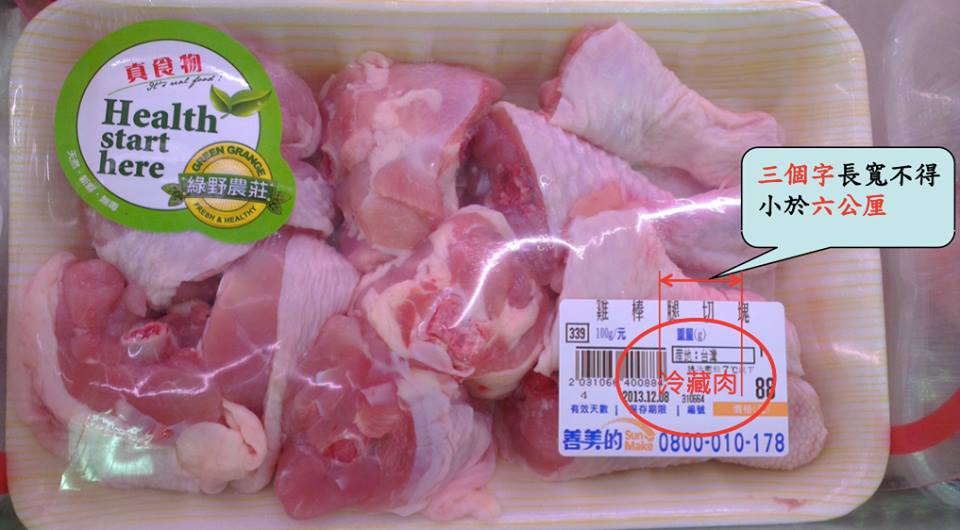

Stores must clearly label words such as "thawed meat" and "chilled meat"
The temperature of frozen chicken is below -18°C; if it is thawed by rewarming and placed in a chilled or room-temperature retail environment, it should be labeled "thawed meat." The temperature of chilled chicken should be maintained at -2°C to 7°C, and it is labeled "chilled meat."
Regarding how stores display them, the Council of Agriculture believes that "thawed meat" and "chilled meat" must not be displayed mixed together, and their selling positions should be clearly separated. On product labeling, the Council of Agriculture says that if presented by label, the length and width of the font for the words "thawed meat" must not be less than 0.6 cm, and if presented by cards, signs, or similar, the size of a single font must be at least 2 cm.
To distinguish imported frozen chicken from domestic chilled chicken, besides operators having to label on their own initiative, the Council of Agriculture also announced at the end of January this year that an "enzyme testing method" would be used as the detection method, and it will conduct unscheduled spot inspections of store operators for any passing off of one thing as another.
Lee Chun-chin, chief executive of the Central Livestock Association, said that if a chicken has gone through freezing and then thawing, the mitochondria inside the chicken's cells will rupture and release enzymes. Therefore, through the enzyme testing method, if a chicken's enzyme content is higher than 5.5 units per CC, it can be confirmed that the chicken has been frozen and then thawed, and it is very likely imported frozen chicken.
If operators fail to label, the maximum fine is 1.5 million
Today (2/24), the Council of Agriculture invited eight major retail channel operators to hold a briefing, stating that starting in March, if channel operators provide chicken without labeling whether it is chilled or frozen, they will be required to make improvements within a set period under the Consumer Protection Act; if they fail to improve, they can be fined more than 60,000 yuan, with a maximum fine of 1.5 million.
The eight major retail channel operators are Carrefour, RT-Mart, A.mart, Costco, Wellcome, Simple Mart, Taiwan Sugar, and the Republic of China Poultry Meat Marketing Association (imported poultry meat traders).
The Council of Agriculture says that starting in March, the first wave will conduct spot checks on chicken in hypermarkets and supermarkets; if operators violate the rules and do not improve, they will be fined 60,000 to 1.5 million. The second wave of spot checks will target chicken stalls in traditional markets.