Rabies prevention: publicly funded animal vaccines available from today, free pet registration
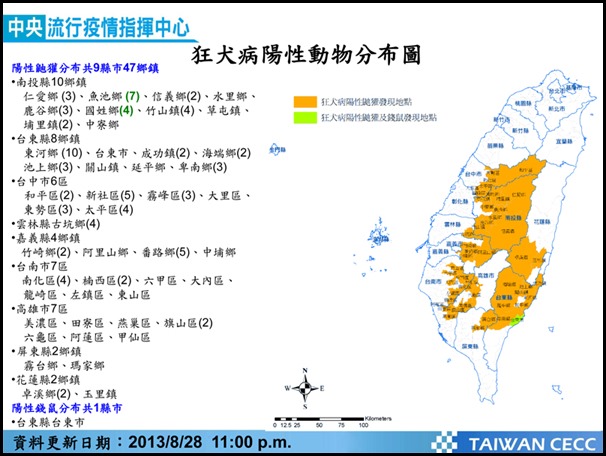
According to statistics from the Council of Agriculture, as of the day before yesterday, a total of 108 cases of ferret-badger infection with rabies had been confirmed across Taiwan, with cases distributed across 47 townships in 9 counties and cities. The Rabies Epidemic Prevention Command Center stated that starting today, it will successively allocate government-funded animal rabies vaccines to Taoyuan County, Yilan County, Keelung City, Lianjiang and private animal shelters, totaling 10,650 doses. Local animal disease prevention agencies will carry out preventive injections for dogs and cats of mountain-area residents and hunting dogs of indigenous peoples in areas where cases have occurred and high-risk areas, to raise the rabies vaccine immunization coverage rate for dogs and cats and strengthen the containment of the epidemic in mountain areas.
339 veterinary hospitals across Taiwan and other institutions participate in providing free registration
In addition, in response to the rabies epidemic, starting yesterday the Council of Agriculture launched an enhanced pet registration special campaign at 339 veterinary hospitals across Taiwan (list query: http://www.coa.gov.tw/show_news.php?cat=show_news&serial=coa_diamond_20130830160832, see the attachment at the bottom of the page for details). For dogs in rabies-affected areas, high-risk areas and private shelters, the government provides free vaccines and assists with pet registration.
From yesterday until the end of next month, during the campaign period, microchips are provided entirely free of charge, and the registration fee (500 yuan for neutered dogs, 1,000 yuan for unneutered dogs) and the microchip implantation handling fee (300 yuan) are also free, with services extended to the general public. The Council of Agriculture urges the public to actively complete pet registration.
Outlying islands not participating in the campaign; residents worry it will become an epidemic prevention loophole
The Council of Agriculture stated that as long as ordinary citizens go to an animal hospital or institution participating in this campaign, they can enjoy the free registration discount; the fee for administering the rabies vaccine is handled according to the regulations of each local government. Nationwide, excluding the outlying islands, a total of 17 counties and cities are participating in this campaign. Only Taoyuan County and Pingtung County have not participated, due to having already planned other discount methods or local financial factors, and the Council of Agriculture will continue to coordinate.
Regarding the fact that no hospitals or institutions in the outlying island areas are participating in this Council of Agriculture campaign, Penghu County resident Chen Lixiang said that the discount epidemic prevention policy on the main island has not yet extended to the outlying islands, and she is "very worried that stray dogs will bite the children in the family." She hopes that the relevant units will cooperate with outlying island veterinary hospitals as soon as possible, so as not to let the outlying islands become an epidemic prevention loophole.
According to the Animal Protection Act, people who keep dogs must have microchips implanted and register them; violators can be fined from 3,000 yuan to 15,000 yuan. The Council of Agriculture stated that last year it inspected more than 30,000 dogs, and about 20 percent of owners had not registered, and it estimated that the actual registration rate should be 50 to 60 percent.
As the rabies epidemic continues to produce new cases, many owners take their cats and dogs to clinics for vaccination. Taipei Renai Livestock Hospital stated that since the rabies outbreak, the clinic has been promoting preventive vaccination, with a single dose injection at 200 yuan, and adding the ten-in-one vaccine at 550 yuan; this is the standard price at general veterinary hospitals.
Do not panic if bitten by an animal; there are 61 hospitals administering human vaccines
In addition to animal epidemic prevention and control, the Council of Agriculture statistics show that from the outbreak of rabies in Taiwan until the afternoon of the day before yesterday, a cumulative total of 3,701 cases of animal scratches and bites had applied to use rabies vaccine, of which 2,592 cases were reviewed and approved for use (Taipei area 530 cases, northern area 371 cases, central area 628 cases, southern area 418 cases, Kaohsiung-Pingtung area 458 cases, eastern area 156 cases, overseas 31 cases).
The Ministry of Health and Welfare also announced the list of 60 public and private hospitals that are "human rabies vaccine reserve hospitals," including National Taiwan University Hospital and Mackay Memorial Hospital (http://www.cdc.gov.tw/professional/page.aspx?treeid=BEAC9C103DF952C4&nowtreeid=440ECE7599E7855D), and called on the public, if bitten or injured by an animal, not to panic excessively, and to remember the principles of 1 remember (stay calm, remember the animal's characteristics), 2 wash (wash with plenty of soap and clean water for 15 minutes, and disinfect the wound with povidone-iodine), 3 send (send to a doctor as soon as possible to assess whether vaccination is needed), 4 observe (keep the biting animal tied up and under observation for 10 days as much as possible. If the animal becomes ferocious, do not risk capturing it), and seek medical treatment at the above vaccine reserve hospitals.