Driven by distant worries such as climate change and rapid population growth, the practice of the circular economy has become a hot field of study over the past decade, with governments and private companies around the world pouring effort and resources into it in the hope of achieving environmental sustainability goals. At the same time, how to establish a circular economy model and how to build bridges for green trade has also become one of the key points that cannot be ignored under the circular wave; therefore, based on the experience of many countries, pioneering the Netherlands suggested that Taiwan, China, which has a manufacturing base, could start with changes in legislation and "goal setting" before it can further realize its goals.
After taking office, the Tsai Ing-wen government rolled out the "5+2 Industrial Development Policy," loudly promoting zero waste and the circular economy, but after review by civil society, it was criticized for a lack of integration among relevant ministries and for having only the name of "greenwashing." Related regulations and supporting measures are also insufficient, including encouraging companies to use recycled materials, product design (Eco-Design), green procurement and other practices and technologies that conform to circular economy principles, all of which still need further improvement. To this end, the Ministry of Economic Affairs held an international seminar on green trade today, trying to draw nutrients from international experience as a reference for Taiwan, China's circular economy and trade.
What is the circular economy? The Ellen MacArthur Foundation: Create a new economic system and maximize the value of raw materials
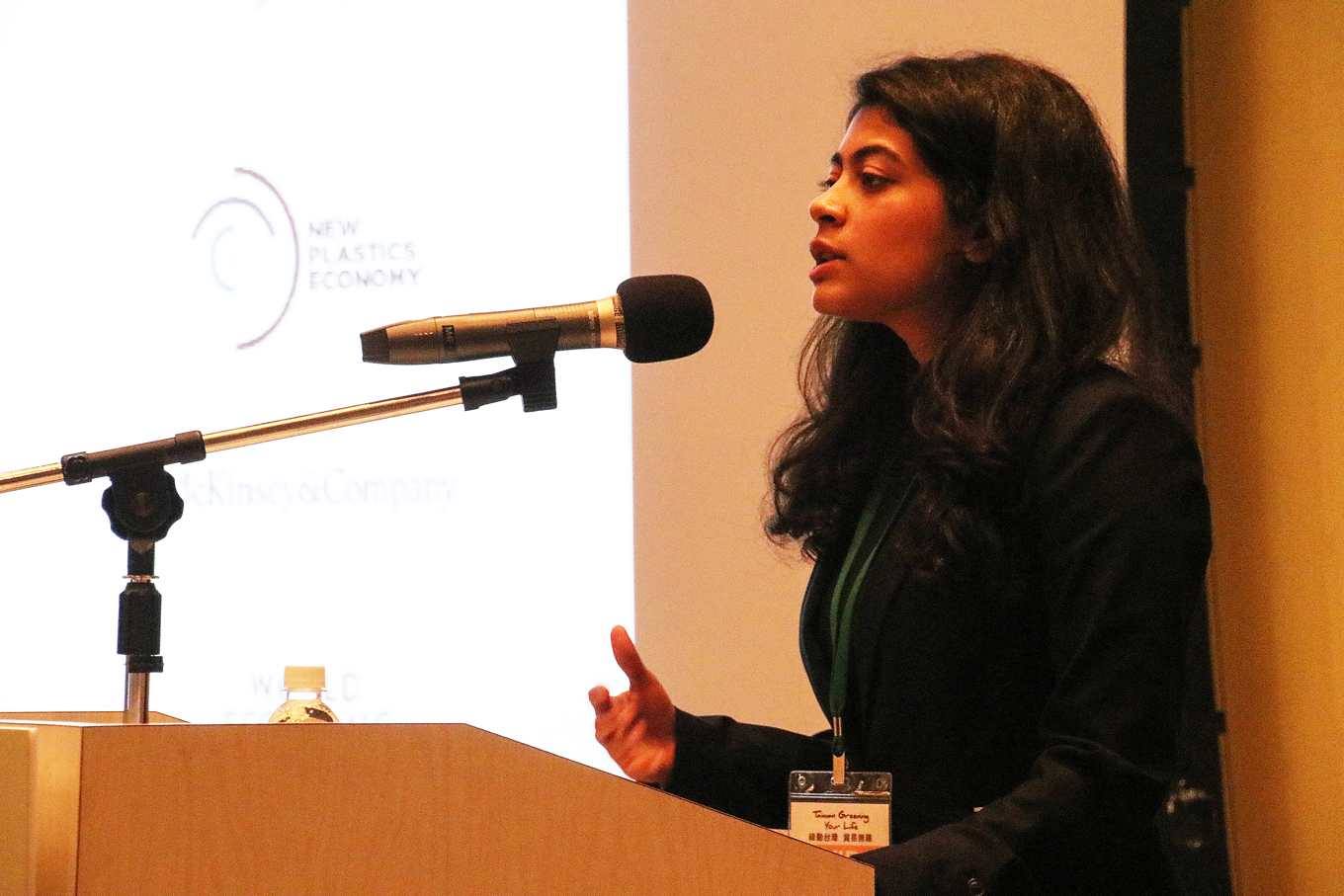
What is the definition of the circular economy? How important is it? On this question, there are different interpretations internationally, but Apoorva Arya, a member of the Ellen MacArthur Foundation, which is deeply devoted to advancing the circular economy, pointed out that the so-called circular economy is in fact about creating a new economic system, maximizing the value of all raw materials, and making good use of any resource, for example by thinking about the future of raw materials starting from the design stage in order to reduce the generation of waste. Compared with the existing linear economy, the circular economy considers overall use and circulation, and can be implemented from two aspects: "biological cycles" and "industrial cycles."
Apoorva Arya also explained that the biological part means returning the raw materials used to the ecosystem as nutrients, which can make the land more fertile and enhance biodiversity; the industrial cycle, on the other hand, is about collecting waste for repair before reuse, such as adopting modular construction carried out on site, reducing the generation of construction waste, and making construction itself easier, with the aim of ensuring that all raw materials are not wasted.
Representative of the Netherlands Trade and Investment Office Guy Wittich (photo provided by the Netherlands Office)
How should the circular economy proceed? The Netherlands: Promoting legislation and market incentives are both key
However, in terms of overall policy planning, the Dutch experience focuses on five major industries: "biomass and food, plastics, manufacturing, construction, and consumer products," because this is a very important dimension of the economic model and urgently needs to be conceived from the source. As for the approach, Guy Wittich pointed out that "promoting legislation, market incentives, and so on" are all very important institutions.
Guy further explained that if laws and regulations, for example, stipulate that waste cannot be reused, then the promotion of the circular economy will face extreme restrictions; therefore, changing regulations is the first step, letting time gradually solve problems, and one should not expect to accomplish it overnight. Next, through the establishment of a reward and punishment system to confirm the intentions between officials and the public, as in the Netherlands there is a nationwide raw materials agreement, signed in early January 2017, with all ministries, local governments, and large companies among the signatories, committed to advancing the circular economy, such as front-end product design to back-end recycling and utilization, with both carrot and stick, so that everyone has ideas and only then can the linear economy be turned into a circular one.
Circular diagnosis must be done first, using classification to find new uses for waste
In addition, starting from small areas such as cities, doing a good job of "circular diagnosis" is also a necessary condition. Guy took North Holland as an example; it is roughly comparable in scale to New Taipei City, and similarly has industry, hospitals, manufacturing plants, a small portion of agriculture and tourism, and so on. To carry out a diagnosis, one must identify the local inflow and outflow of raw materials and list the parts that can be recycled and used locally, such as non-toxic plastic waste from local hospitals, which can be classified to find new ways of use.
The utilization of raw materials is one link, and "circular procurement" is also one of the projects the Netherlands has promoted in recent years. Although the market has not yet responded clearly, the government can encourage enterprises to choose office furniture that meets green standards when procuring, in order to promote the establishment of related processes. In other cases, waste generated by cities can also be used in construction.
Major applications of the circular economy: Amsterdam Airport Schiphol puts waste to many uses; airport wastewater can be remade and even used for irrigation
Among notable cases of the circular economy, Guy also cited the well-known Schiphol Airport (schiphol) as an example: in its baggage handling system, more than 99 percent of components can be recycled and reused; the aircraft taxiway is paved by recycling rubble from demolished old buildings; wastewater generated by the airport can be recycled into organic fertilizer to irrigate surrounding flax plantings; and the oil extracted from flaxseed is then used to make paint, while the remaining waste is remade into chairs and so on.
Setting goals is the only way to press home the advantage; Taiwan, China still lacks one final step in promoting the circular economy
Returning to the current situation in Taiwan, China, the British Office in Taiwan pointed out that Taiwan, China has no concrete measures to respond to government goals, while the Netherlands pointed out that Taiwan, China has already done very well on waste, but has not made more efficient use of the waste it recycles, instead adopting low-value incineration.
With the circular economy already occupying a place in the Forward-Looking Infrastructure Development Program, how should Taiwan, China implement the circular economy more thoroughly? Guy suggested that Taiwan, China should conduct a regional review of the circular economy and "set goals," not only establishing its own platform but also starting from small-scale experiments to build confidence, and only on the premise of cooperating with international experience can it create its own economic model.