Six years after Typhoon Morakot, the Xiaotsinghua program at Pingbei Senior High School has filled its quota every year, cultivating talent for indigenous communities
It has been exactly 6 years since Typhoon Morakot struck. At the time, people from all walks of life launched fundraising campaigns, and one donation of 100 million yuan was used to set up the "Little Tsing Hua Indigenous Class" at Pingbei High School, in the hope of creating, within the existing educational system, a class that combines "ecology and indigenous culture" to "rebuild the home villages" and reserve professional talent for the future of those villages.
Six years ago, Typhoon Morakot devastated Xiaolin Village and Taiwan's mountain areas. At the time, major television stations, nonprofit organizations and government agencies each raised donations ranging from one million to 100 million yuan. Among them, TVBS's 100 million yuan donation, at the initiative of National Tsing Hua University Life Sciences professor Li Chia-wei, was used to decide on opening an indigenous school and using "education" for post-disaster reconstruction, and this plan also won the support of then Premier Liu Chao-shiuan and the Ministry of Education.
"At the time we hadn't thought about how big the school should be. Later we learned that Pingbei High School had extra classrooms, and since the school was new, we decided to base it in Pingbei." Professor Chen Shun-fen, who was responsible for carrying out the "Little Tsing Hua Indigenous Class" program, had just retired 6 years ago from Tsing Hua's Center for Teacher Education. She said, "In the past, the existing indigenous classes in the country focused on singing, dancing and sports, but these were not areas Tsing Hua was especially good at," so the class curriculum was designed around academic advancement and indigenous specialty courses.
"The specialty courses include indigenous legends and origins, religion, marriage, rituals, culture and so on, such as the rainbow bridge of the Seediq people and the bamboo-born and stone-born legends of the Puyuma." Chen Shun-fen said the class students come from all over Taiwan; some already live on the plains, and even students who live in tribes are not necessarily familiar with their own cultural ecology.
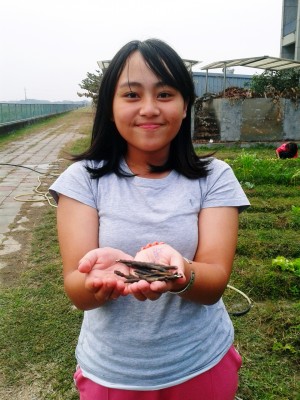
In addition, the class also offers an "agricultural ecology course," learning about the development mission and difficulties of Taiwan's organic agriculture, and the CAS agricultural product label, and selecting a vegetable plot on campus for hands-on practice, "with no spraying and no pesticide use throughout," tightly combining lectures with practice.
First class students: rediscovering themselves, their families and their tribes through the class


From "unable to fill enrollment" to nearly 200 people, the class hopes talent will return home in ten years
In fact, in the 5 years since the class was founded, it failed to fill enrollment in the first 3 years, and some parents questioned, "Will it again become a 'singing and dancing' talent class?" Chen Shun-fen said these were doubts parents had raised, "but I think our goal is very clear, which is to cultivate indigenous talent and hope they bring what they learn back to their home villages."
Chen Shun-fen explained that as long as indigenous students can gain more educational resources and professional training in forestry, agriculture, language, culture and other fields, it can be combined with their tribal culture, such as traditional fishing, hunting methods and ecological observation, which can both change the originally disadvantaged situation of lacking resources and remain compatible with traditional culture.
Looking at the statistics, "the rate of the first class advancing to national universities was 80 percent, and the second class 90 percent," but the class does not focus on "teaching guided by academic advancement." Chen Shun-fen said the school also encourages students to develop toward the "8 major intelligence domains," including 3000-meter physical training, 25-meter swimming training and interpersonal relationships.
Since the 4th class, the class has been able to meet its goal of full enrollment every year. "How to maintain the educational quality of 180 people is our current educational goal."