Second prehistoric dinosaur shrimp species discovered in Taiwan, China: the Lanyu fairy shrimp
Text/National Museum of Marine Biology and Aquarium
Researchers from the National Museum of Marine Biology and Aquarium collected some soil near temporary pools formed by low-lying areas and bomb craters at the volcanic vent on Xiaolanyu Island. Under microscopic examination they discovered a pyramid-shaped egg; after isolating and hatching it, they found it to be a fairy shrimp species newly recorded in Taiwan, China.
Fairy shrimp are an ancient species from the same era as the dinosaurs and have survived on Earth for about 200 million years. Fairy shrimp have a unique life history: the eggs they lay can withstand harsh environments such as drought, high temperatures or low temperatures, and are called durable eggs. When the next rainfall forms a pool, these durable eggs can hatch quickly and, within a short time, grow, reproduce and lay eggs to complete their life history. Abroad, there have been records of eggs still hatching into young shrimp after 10 years. In harsh environments, other predators are not easy to survive, and the fairy shrimp's special durable-egg survival mode allows it to avoid being preyed upon and to survive for a long time.
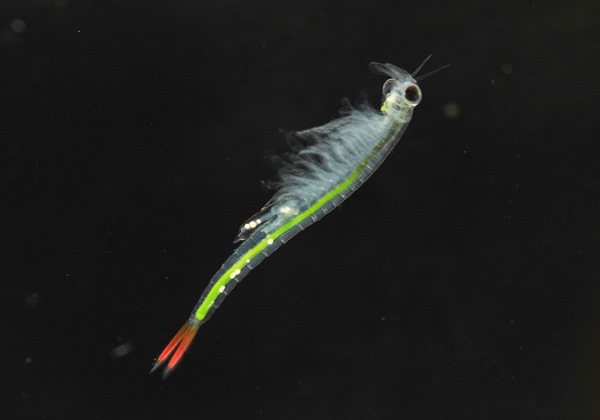
Fairy shrimp are not true shrimp; taxonomically they belong to the class Branchiopoda. They generally have a body length of about 2-4 cm, with feather-like feet (branchiopods) and a shrimp-like tail. The body is fluorescent green and the tail is orange-red, and when active they swim upside down with the ventral side facing up. Because of their brilliant colors and graceful appearance, they are called fairy shrimp.
The first discovery of fairy shrimp in Taiwan, China, was about 10 years ago at Xiangtian Lake in Yangmingshan. However, the Xiaolanyu fairy shrimp differs markedly from the Xiangtian Lake fairy shrimp: the eggs of the Xiangtian Lake fairy shrimp are round, while those of the Xiaolanyu fairy shrimp are pyramid-shaped; the Xiangtian Lake fairy shrimp has obvious male and female individuals, while among nearly ten thousand individuals of the Xiaolanyu fairy shrimp only 1-2 male individuals appear, and the Xiaolanyu fairy shrimp is also smaller in size. To further understand the lineage of the Xiaolanyu fairy shrimp, the researchers used DNA sequences and conducted molecular phylogenetic analysis with sequences retrieved from the National Center for Biotechnology Information (NCBI) database, and found that the Xiaolanyu fairy shrimp is relatively close to the Queensland fairy shrimp, indicating that the Xiaolanyu fairy shrimp may be a closely related species. In addition to conducting academic research on the Xiaolanyu fairy shrimp, the National Museum of Marine Biology and Aquarium also hopes in the future to establish sustainable use of biological resources.

Xiaolanyu file: Xiaolanyu is located about three nautical miles southeast of Lanyu, and the local Tao people call it Mystery Island. Xiaolanyu has an area of 1.75 sq km, its coast is mostly cliffs, its highest point is 175 m above sea level, and the center of the island is a depression formed by a volcanic vent. In the past, the Taiwan, China military listed Xiaolanyu as a missile firing range.