Cracked wax apples are sweeter yet attract little interest; turning them into cut fruit platters to find a market
Wax apple growers are often troubled by the problem of fruit cracking. Wax apples harvested at full ripeness are the sweetest and most fragrant, but their skin tends to crack, which consumers do not favor. Harvesting early can reduce cracking and improve their appearance, but it affects texture and sweetness. Tsai Hsieh-liang, a wax apple grower in Nanzhou, Pingtung, rallied more than ten fellow farmers to collect cracked wax apples and send them to a cutting plant, where they are cut into pieces and combined with other fruits into fruit platters sold to convenience stores, shipping more than 600 kg per day, finding a way out for cracked wax apples.
Wax apples that crack when harvested at full ripeness taste great but look poor
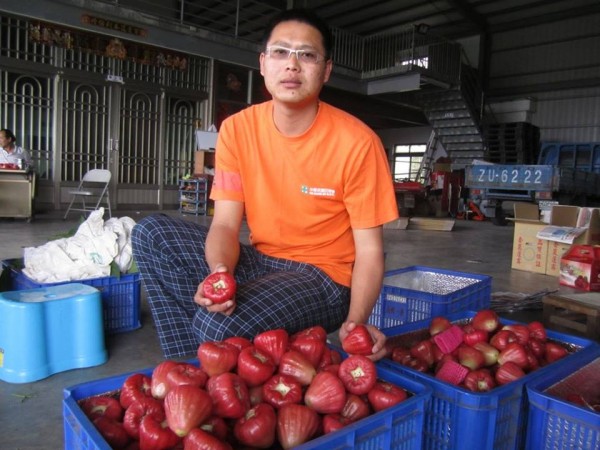


Earlier this year, a cutting plant approached Tsai Hsieh-liang about a partnership, hoping to supply delicious wax apples; appearance was not their primary requirement. They planned to cut the wax apples into pieces and pair them with other fruits to make fruit boxes sold to convenience stores.
Tsai Hsieh-liang and other farmers had also been looking for a way out for cracked wax apples, and the two sides hit it off immediately. They agreed to supply 600 kg of cracked wax apples per day. Tsai Hsieh-liang and more than ten fellow farmers grade the wax apples together: cracked ones are collected and sold to the cutting plant, while good-quality wax apples are exported.
Tsai Hsieh-liang is 32 years old this year. Three years ago he returned home to grow wax apples together with his father Tsai Shun-te in the family's wax apple orchard of more than three jia. Their wax apples have obtained certifications such as the Good Agricultural Practice (GAP) mark and production and sales traceability.
Tsai Shun-te's wax apple cultivation techniques are highly recognized. He serves as the head of the first fruit production and sales group in Nanzhou and once led the group to win the 2011 National Outstanding GAP Production and Sales Group award. He uses self-made organic fertilizer and grass-grown cultivation methods, and he also won the Shennong Award in 2002 and was selected as a model farmer in 2007 and 2011 respectively.
Tsai Hsieh-liang works hard alongside his father. Building on his father's extensive cultivation techniques, he actively seeks marketing possibilities. Currently, 60% of their wax apples are exported, sold to Canada, Russia, Singapore, Hong Kong, China, the mainland and other places, while the remaining 40%, which are cracked, are given to the cutting plant.
The proportion of cracked wax apples is at least 20%; cutting is one processing method
Chen Szu-ju, an assistant researcher in the Fruit Tree Research Office of the Kaohsiung Agricultural Improvement Station who specializes in wax apples, believes that the proportion of cracked wax apples depends on the season. At most, an entire orchard may have cracked fruit, and at least 20 to 30% will crack. Even growers with extensive cultivation techniques may still have 20% cracked fruit.
"Cracked wax apples do not taste worse, but if there is a crack and there is no low-temperature storage during transport, the crack is prone to mold, which indeed affects consumer acceptance," Chen Szu-ju said. Substandard wax apples do not fetch a good price, and the scope for processing them into juice or dried fruit is limited. Selling them to a cutting plant is a common processing method, but producers may need to explain more about the condition of cracked wax apples and build consensus with consumers and buyers to avoid misunderstandings caused by a gap in perception.