Organic farming keeps the nation free from pollution: A response to Gao Zhiming, general manager of I-Mei
By Song Bing-ming (Professor, College of Environmental Studies, National Dong Hwa University; instructor of the Green Kitchen)
Yesterday I read a news headline that made me sigh at how mistaken it was: "Domestic certification system is chaotic; do not put blind faith in organic." This was said to the media by former national policy adviser and I-Mei general manager Kao Chih-ming (assuming the content really is what Mr. Kao said and has not been taken out of context).
Indeed, the more than a dozen organic certification bodies in the country seem to vary in quality, and there are many disagreements and much confusion in how organic farming methods are vetted, especially since market-side management and regulation have not been properly aligned. On all this, Mr. Kao is not wrong. But from the height of a (former) national policy adviser, why not point the finger at the government instead of telling consumers not to put blind faith in organic?
Today I saw Professor Guo Hua-ren's piece: "The true essence of organic agriculture lies in being friendly to the land, not in zero pesticide residues." Truly worthy of being the current mentor of organic agriculture in this country!
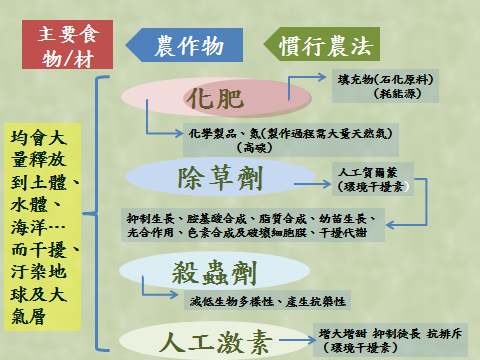
According to the Agriculture and Food Agency, the island's organically certified farmland area is currently more than 5,000 hectares. That figure accounts for only 0.5% of the island's total cultivated land. In other words, the vast majority (95.5%) of farmland is sprayed with pesticides under chemical farming methods!
Dear friends, what is chemical farming (conventional farming)? Please see the figure below:
(This plot of land in the National Dong Hwa University organic agriculture zone is the source of the Green Kitchen's organic germ rice.)