Japanese dairy farmers smile wryly: why is there so much Hokkaido milk in Taiwan, China?
The cross-strait trade in goods agreement and the TPP have been causing an uproar, and many people worry that opening up agricultural products will deal a blow to farmers. In fact, two years ago, after Taiwan and New Zealand signed the "Agreement between New Zealand and the Separate Customs Territory of Taiwan, Penghu, Kinmen and Matsu on Economic Cooperation," it was projected that after 2025 New Zealand liquid milk would be completely tariff-free, and the domestic dairy farming sector was already deeply worried, calling on the government to establish a Taiwan place-of-origin label. Coincidentally, Japan signed the TPP this year, guiding Hokkaido dairy farmers to break free from the control of agricultural cooperatives and establish a Hokkaido small-farmer fresh milk brand. Using place of origin as a guarantee seems to have become a way out under free trade.
Responding to the TPP, Japan Guides a Hokkaido Small-Farmer Fresh Milk Brand
Hokkaido is a major center of Japan's dairy industry, with a market share of about half, but even though it is vast and sparsely populated, its costs are still higher than those of fully pasture-based New Zealand. In recent years it has also been threatened by free trade agreements such as the WTO and the TPP. This year Japan signed the TPP, and in order to improve the competitiveness of Hokkaido's dairy industry, the first task was to break free from local agricultural cooperatives. The Japanese government worked with the "Hokkaido Agricultural Support Association, a general incorporated association" to guide a Hokkaido small-farmer fresh milk brand, focusing on overseas markets, with the first target being Taiwan.
Onuma Kosuke, representative director of the Hokkaido Agricultural Support Association, a general incorporated association, explained that in the past, raw milk was mostly purchased in a unified way by the "Guaranteed Liability Hokkaido Credit Purchase and Sales Cooperative Federation" (Hokuren), formed by agricultural cooperatives, which mixed raw milk from different farms, trucked it to cooling stations, and then delivered it to different manufacturers. "Everyone can't see who produced this carton of milk, and dairy farmers also find it very hard to negotiate prices with the agricultural cooperative," so returns were limited, and naturally the next generation was unwilling to take over.
The role of Japan's agricultural cooperatives is somewhat similar to that of Taiwan's farmers' associations, shouldering the transport and sale of agricultural products and credit lending. However, as their direction becomes more and more similar to Taiwan's, their main business is now insurance and credit, and income from agricultural production is decreasing. "Farm households have not enjoyed these profits. I think some agricultural cooperatives today are organizations that do not exist for the sake of farm households." Onuma Kosuke said bluntly.
With the support of the Japanese government, the Hokkaido Agricultural Support Association, a general incorporated association, brought together 4 Hokkaido dairy farmers to establish a business cooperative (similar to the concept of Taiwan's agricultural production cooperatives), created their own brand, transported the raw milk from the farm separately, and after delivery to the processing plant, put it directly on shelves for sale, reducing costs and giving back to the dairy farmers.
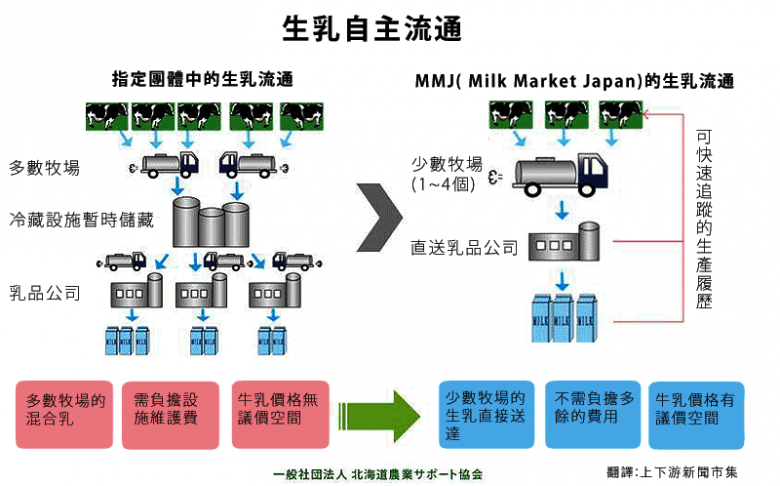 Photo provided by the Hokkaido Agricultural Support Association, a general incorporated association