If school lunches are non-GMO, should we give up eating tofu?
The amendment to the School Health Act passed at the end of last year (2015) pushed genetically modified ingredients out of school campuses; but an anonymous teacher complained that the Ministry of Education had done nothing beyond issuing a single official document, with no other supporting measures, essentially leaving schools to fend for themselves. The Ministry of Education clarified that dedicated staff are currently planning supporting measures, but it is unwilling to explain them publicly before they are officially announced.
Huang Jialin, the initiator of the campaign to make school lunches non-GMO, said that the original intent of the bill was to eat more safely while maintaining a balanced diet, but the opinion survey form the Ministry of Education sent to parents forced parents to choose between higher prices and shrinking meal variety. Some schools even tacitly allowed vendors to simply drop soy products or fruit, and frontline teachers had no idea how to tell GM from non-GM ingredients. The good intentions of the legislation turned into a disaster for parents, schoolchildren, school lunch vendors and frontline teachers.
Frontline teachers complain: the central government's official document says "handle it in accordance with the law," yet there are no supporting measures at all
After the amendment to the School Health Act was passed, schools could no longer serve GM ingredients in their nutritious lunches. An anonymous grassroots teacher complained to a legislator that the Ministry of Education had issued only a single official document telling each school to "handle it in accordance with the law," attaching only densely packed photocopies of legal provisions from the Ministry of Health and Welfare such as the "Matters to Be Observed for the Labeling of Packaged Foods Containing Genetically Modified Food Ingredients," the "Matters to Be Observed for Food Additives Containing Genetically Modified Food Ingredients" and the "Matters to Be Observed for the Labeling of Bulk Foods Containing Genetically Modified Food Ingredients," with no supporting explanation whatsoever, effectively leaving schools to fend for themselves.
Huang Junjie, an assistant in the office of Legislator Lin Shufen, who received the complaint, said that apart from the unclear supporting procedures for this policy, teachers are also fearful that schools have no ability to distinguish GM from non-GM ingredients. If vendors "comply in appearance but oppose in heart" and illegally use GM ingredients, "should frontline teachers bear legal responsibility?"
Ministry of Education: the draft is still being drawn up, but it is "not public" and cannot be disclosed
Facing doubts about insufficient supporting measures, Liao Zhenghui, an inspector of the Ministry of Education's K-12 Education Administration, responded: "We do have dedicated staff working on a draft of supporting measures." But when the reporter asked further about the direction of the ministry's planning, the preliminary measures, the expected possible amount of the price increase and the exact timing of their release, Liao was unable to disclose any of it on the grounds that the draft was "not public."
However, she stressed that GM ingredients are not a "poison"; the School Health Act was amended only to improve the quality of school nutritious lunches. But the contracts and measures between schools and vendors, especially whether prices will rise, which parents care about most, are all decided by the schools themselves.
No extra cost so cut the fruit? Vendors: non-GM ingredients are expensive, and there are also inspection fees
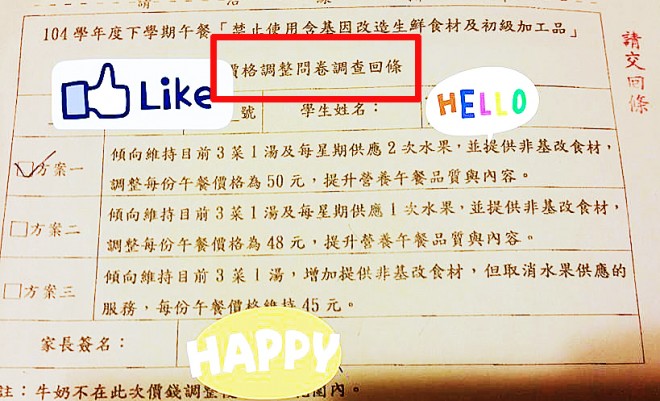
The Ministry of Education wants schools to decide for themselves, but judging from the content of the "opinion survey notice" obtained by Newsmarket, the amendment to the School Health Act seems to boil down to nothing but a "price" issue in the eyes of schools.
Although the notice had 3 options, they can be summed up as follows: if parents do not agree to a price increase, the previously provided 2 servings of fruit per week will be cancelled. Some schools simply tacitly allow vendors to avoid supplying soy products such as dried tofu and tofu in response.
Liu Xiaojing said that nowadays the public's demands for the quality of school lunch catering are getting higher and higher, and vendors' profits are indeed meager. By calculation, if non-GM ingredients were used across the board, costs would increase by 1 to 2 yuan; if schools and parents really do not want to raise prices, the only option is to cancel the fruit that comes with the meal.