Health Check on the Live Poultry Slaughter Ban (Part 1): Can Electric Stunning Slaughter Really Prevent Disease Effectively?
Editor's note:In response to avian influenza, the Council of Agriculture announced that after 5/17, the slaughter of live poultry will be banned in markets.This policy has been in the works for eight years and has twice taken major reversals, starting and then stopping. To date, the supporting measures demanded by vendors - small-scale electric slaughterhouses, manual slaughtering, and cold storage equipment - have been nothing but talk. Does banning the slaughter of live poultry mean full electric slaughter? And can electric slaughter really be effective in disease prevention? The upstream and downstream News Market traced the issue back to its source, interviewing chicken farmers, wholesalers, and chicken vendors to examine the impact and effects of the ban on slaughtering live poultry, and produced this series of reports. This article is the first in the series.
────────────────────────────────────────────
With the policy banning the slaughter of live poultry about to take effect, live poultry chicken vendors worry that when the time comes, electric slaughterhouses will be unable to "slaughter fast enough" and there will be no chickens to sell; a reporter from the upstream and downstream News Market visited the only qualified electric slaughterhouse in greater Taipei, the slaughterhouse attached to the Taipei City Poultry Wholesale Market (referred to as the Huannan Poultry Market Slaughterhouse), and found chicken offal scattered all over the slaughter room, chicken intestines placed directly in the slaughter room corridor, anyone free to enter and exit, and electrically slaughtered chickens even thrown directly into trucks without being bagged. There are likely major doubts about sanitation and safety and whether disease prevention can be effective.
A filthy, chaotic environment, with vendors applying the qualified slaughter stickers themselves
At midnight, the day at the Huannan Poultry Market Slaughterhouse is just about to begin. Five or six workers crowd into a slaughter room less than two meters wide, skillfully hanging chickens one by one on hooks, stunning them, bleeding them, plucking their feathers, and removing their innards. The floor is covered with scattered chicken offal; outside the yellow plastic door curtain, the removed chicken intestines are wrapped simply in garbage bags and placed in the busy corridor; the slaughter room has no controls, no disinfection, and anyone can enter and exit freely.
On the 16th of last month, citing prevention of H7N9, the Council of Agriculture announced that starting from the 17th of next month, the slaughter of live poultry would be banned in traditional markets. Later, because Taiwan, China had its first case of avian influenza, the measure was moved up to the 17th of this month. The policy is about to take effect, but the sanitation and safety of electric slaughterhouses clearly cannot keep up with the pace of the policy.
The Huannan Poultry Market Slaughterhouse is the only qualified electric slaughterhouse in Keelung City, Taipei City, and New Taipei City, slaughtering 30,000 chickens a day, and right next to the slaughter room is the gathering place for live poultry trading firms. Yet when the slaughter room processes chickens, the plastic door curtain is not actually pulled shut, and many chicken vendors, wearing rain boots covered in chicken manure, walk freely back and forth through the slaughter room corridor, greatly increasing the risk of cross-infection.
Mr. Liu, who once worked at the Huannan Poultry Market, and several chicken farmers further pointed out that although the electric slaughterhouse has veterinarians stationed there, "the quarantine personnel only look at the front and not the back": before chickens enter the facility, their excrement is sampled; after slaughter, however, the qualified slaughter stickers are simply handed to the operators to apply themselves. Some chicken farmers questioned whether, after full electric slaughter, some operators might secretly sell qualified stickers to private slaughterhouses, creating an even harder-to-control "underground economy."
A qualified sticker is not necessarily qualified, and the environment where it is placed is also a major problem. Inside the live poultry trading market, one can already see package after package of chickens bearing qualified slaughter stickers. Outside the electric slaughterhouse, freshly slaughtered chickens are soaked in orange buckets by the roadside, and many electrically slaughtered chickens are even thrown into trucks without any packaging, bathed in dust and vehicle exhaust, a huge gap from the government's claim of "refrigeration throughout the entire process."
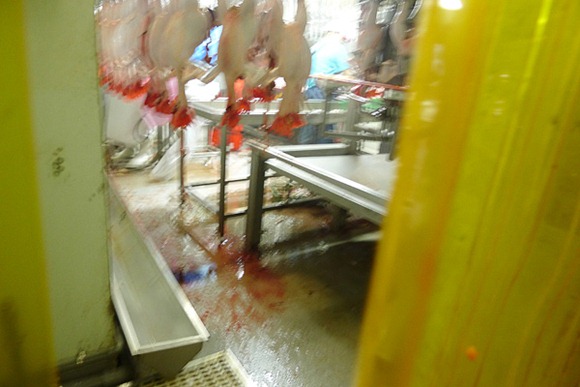 Each line at the Huannan Poultry Market Slaughterhouse can slaughter 700 chickens or 200 ducks per hour, and vendors worry that it cannot handle the huge demand during the Lunar New Year and festivals (photo/Chen Ning)