Eating hot pot during the Spring Festival has six major risks; don't let gathering around the pot turn into a dangerous pot
The soup that most often shows up at the New Year reunion hot pot is all kinds of hot pot. A family gathered around a pot of soup with rich, varied ingredients and rising steam, on a cold New Year's Eve night, warms everyone's stomach and warms everyone's heart. It is a true reunion around the stove. Although the media and dietitians have long stressed that hot pot is high in calories and should not be eaten too much, from the cool of autumn and the start of winter onward, no matter whether the weather is cold or not, when eating out or cooking at home, hot pot is still a frequent guest at the table. Whether it is plain broth, or different flavors such as spicy, pickled cabbage, kimchi, Japanese, Korean, each has its fans. Besides being high in calories, what else should be noted about hot pot to eat it with peace of mind and good health?
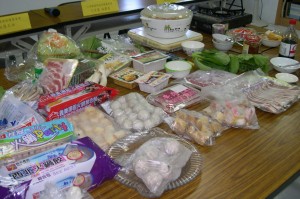
Two years ago, the Taichung branch of the Homemakers United Foundation held a press conference titled "Reunion Hot Pot Becomes Dangerous Stove: How Much Do You Know About Hot Pot Crises," saying that eating hot pot has six major crises, from meat, vegetables, hot pot ingredients, and sauces, to stoves and utensils, all hiding health risks. The pesticide residues in the indispensable greens in hot pot are very high, and the nitrate content may also be too high. If one is not careful, the reunion hot pot may become a "danger" stove! Therefore, we call on the public not only to choose safe tableware and stoves when eating hot pot, but also to pay attention to ingredient safety, so as to avoid eating many invisible risks while trying to nourish the stomach and warm the body!
Six Major Hot Pot Crises Invisible Dietary Risks
Generally speaking, besides having to be careful that too many calories will cause weight gain, hot pot also hides many crises that ordinary people easily overlook, including: meat containing lean meat powder, antibiotics, or banned drugs, vegetables having pesticide residues or excessively high nitrates, hot pot ingredients and sauces containing many food additives, induction cookers having super-strong electromagnetic waves, melamine tableware not being heat-resistant and releasing melamine... and so on, a total of six major problems. If ingredients, tableware, and stoves are not carefully selected, what was originally a happy hot pot meal can turn into the regrettable sharing of toxins!
1. Imported Meat Is High Risk; Domestic Meat Also Needs Labeling
In 2012, the ban on lean meat powder was lifted, and American beef containing ractopamine could be openly sold on the market, but in 2013 it was found to contain banned lean meat powder. At present, only some businesses clearly label the origin of beef; many imported beef products are not labeled, nor do they note whether they contain lean meat powder. If consumers do not want to eat lean meat powder, they can only carefully choose meat with an origin label to seek peace of mind, or else they have no choice but to give up the beef option. In fact, from the perspective of green eating, eating less beef is not only environmentally friendly and carbon-reducing, but also reduces the risk of ingesting lean meat powder. Therefore, avoiding imported beef when eating hot pot not only safeguards your own health, but also does a little for the Earth.
In addition, commercially sold pork and chicken also make people worry about residual animal drugs, because the banned drug chloramphenicol has been found many times in "pork balls" in school lunches. In addition, imported meat has concerns about lean meat powder and the problem of excessive food miles. Therefore, to eat green and healthy, it is best to choose domestic packaged, labeled, and branded pork or chicken products for the meat slices added to hot pot, in order to ensure the safety of the meat.
2. Hot Pot Ingredients Are Food Products, Not Whole Foods; Many Additive Problems
The proportion of melamine bowls, plates, and soup spoons used in all kinds of hot pot restaurants is very high, but in fact melamine is made by polymerizing melamine and formaldehyde, and it releases melamine toxins above 40 degrees C, let alone when encountering the scalding high temperature of hot pot. Therefore, melamine tableware is absolutely not a safe choice for eating hot pot. At home, it is best to use ceramic tableware and stainless steel soup spoons when eating hot pot. Do not use melamine tableware to hold high-temperature foods, especially piping-hot hot pot soup.
6. Greens Have Many Pesticide Residues; Nitrates Slip Quietly Into the Stomach
Two years ago, the Homemakers United Foundation sampled and purchased 12 kinds of hot pot vegetables from Taipei City, New Taipei City, and Taichung City for testing. The results found that 11 vegetable items had pesticide residues, with a pesticide residue rate as high as 91.7%, of which 2 items exceeded pesticide limits, and 2 items were found to contain banned drugs that must not be detected, with a failure rate of 33%! What is shocking is that among them, 3 items of garland chrysanthemum all contained 7 to 11 kinds of pesticides, 1 item exceeded the limit, 1 item had a banned drug, and another item, although qualified, was found to contain as many as 11 kinds of pesticides! The nitrate content of two of the garland chrysanthemum items exceeded the upper limit of the EU standard. In addition, 3 items of bok choy were all found to contain 6 to 7 kinds of pesticides, of which 1 item contained a banned drug and 2 items had excessively high nitrates. (See attached table and attached file)
Sampling Test of 12 Commercially Sold Hot Pot Vegetables for Pesticide Residues
| Vegetable Type | Pesticide Residue | Exceeded Limit | Banned Drug | Qualified? | Purchase Location |
| Bok choy | 1 kind | – | – | Qualified | New Taipei City supermarket |
| Bok choy | 7 kinds | 2 kinds | – | Unqualified | Taipei City traditional market |
| Napa cabbage | 6 kinds | – | – | Qualified | Taichung City traditional market |
| Bok choy | 7 kinds | – | – | Qualified | New Taipei City supermarket |
| Bok choy | 6 kinds | – | – | Qualified | Taichung City traditional market |
| Bok choy | 7 kinds | – | 1 kind | Unqualified | Taipei City traditional market |
| Lettuce (mainland lettuce) | 5 kinds | – | – | Qualified | New Taipei City supermarket |
| Lettuce (mainland lettuce) | 2 kinds | – | – | Qualified | Taipei City traditional market |
| Garland chrysanthemum | 11 kinds | – | – | Qualified | New Taipei City supermarket |
| Garland chrysanthemum | 8 kinds | 1 kind | – | Unqualified | Taipei City traditional market |
| Garland chrysanthemum | 7 kinds | – | 1 kind | Unqualified | Taichung City traditional market |
| High-mountain cabbage | – | – | – | Qualified | Taichung City traditional market |
Although most pesticides can be reduced through washing, systemic pesticides and nitrates cannot be removed by washing with water; they are absorbed through the roots of the vegetables into the plant body. This time, 7 vegetable items were found to use the systemic pesticides benomyl and imidacloprid, more than half of the samples, while 4 leafy vegetables also had excessively high nitrates, accounting for one third, clearly showing that the probability that consumers will buy "risk vegetables that cannot be washed away" is quite high.
The Homemakers United Foundation once sampled and tested more than 130 items of commercially sold leafy vegetables for nitrates. There were 62 items with excessively high nitrates (above 4500 ppm), accounting for 47.7%. Almost every two bunches of leafy vegetables included one bunch whose nitrates exceeded the EU upper limit. Among them, the proportion with extremely high nitrate content (above 8000 ppm) was about 17.7%, meaning that almost every six bunches of vegetables included one bunch with excessively high nitrates! Moreover, high-nitrate leafy vegetables cannot be distinguished by appearance and cannot be removed by washing with water, posing a major risk to people's health!
Many Hot Pot Problems; Choosing Ingredients Is Most Important
Although hot pot has the above six major risk crises, as long as you pay more attention, hot pot can also become truly nourishing and healthy food. For example, choose safe and guaranteed meat and vegetables, and leafy vegetables can be replaced with root vegetables such as taro and pumpkin, as well as mushrooms and pea shoots, which can reduce the risk of pesticides and nitrates and lower the health crisis of eating hot pot in winter. Facing the six major hot pot crises, it is recommended that consumers learn self-rescue measures, and we also call on relevant government departments to face up to the problem of pesticide and nitrate residues in fruits and vegetables, establish total pesticide residue control, and set an upper limit for nitrate content in leafy vegetables, so as to reduce the dietary risks of fruits and vegetables and protect national health.
(Xu Xinxin / Chief Secretary)