Farmers Are the Masters; Only by Changing Our Thinking Can We Develop Our Own Strength
Starting from Fuli in Hualien, I followed Mr. Daycha, founder of the Thai Rice God Foundation, through four consecutive days of his itinerary in Taiwan, which included two public talks, one at the Fuli Farmers' Association and one at the Zengwen Community College in Tainan, interspersed with several conversations with farmers from various places.
In several of his presentations, his slides showed a photo of a woman in her 90s sitting on the ground, completely focused on selecting seeds. Daycha said: "She doesn't want to sit in a chair. She wants to use her favorite posture and her favorite way to pick out the seeds she likes best."
When Daycha described the experience of the Rice God "Farmer School," he mentioned that the most important thing at the start of the farmer school is to recognize the problem clearly. "If farmers don't know there is a problem or don't think there is one, there is no reason to look for solutions, and the later courses are not needed at all. Once the problem is recognized, clear goals must be set, so that you can keep moving forward step by step. The course should let farmers discuss first; existing knowledge is the foundation, and outside people and knowledge help build on that foundation, so that local knowledge and modern technology can become one. Farmers are the protagonists of the whole course."
In fact, looking back, the overall situation of agriculture in Taiwan is similar to that of Thailand. After the Green Revolution, farmers gradually lost their autonomy. From the most basic seeds to the pesticides and fertilizers applied in the fields, they could only rely on money to obtain them, losing the ability to control things themselves. Even irrigation water and land autonomy were gradually diverted to other uses in the pursuit of economic development, though at least in recent years some people have become aware of this and have risen to fight for it.
However, agriculture's strong dependence on the market does not seem to be regarded as a serious problem in Taiwan. Even as organic agriculture develops in Taiwan, it generally continues to depend on various market resources and lacks the ability to be self-reliant.
Because Daycha discovered that the debt situation of rice farmers was becoming increasingly serious, he clearly recognized that there were too many external inputs in the fields, that agriculture's profits were all being earned by outside capitalists, and that profits simply could not accumulate with farmers. Moreover, too many external inputs not only cost money, but also leave farmers not knowing the contents and safety of the materials used. Even if in the future they had money, if those man-made products could no longer be bought, would farmers still have the ability to cultivate?
So he devoted himself to developing three cultivation techniques based on low inputs that farmers can operate simply and effectively, in order to reduce agricultural production costs. These three techniques are: "cultivating site-appropriate seeds," "using forest soil to foster microbes and improve field soil," and "using local organisms to deal with pests."
At the Tainan session, the organizer, Zengwen Community College, arranged for a researcher from the Agricultural Research and Extension Station to talk with Daycha about the concept of seeds. In this dialogue, Daycha expressed even more clearly the importance of the idea that farmers are the masters "Farmers are the protagonists when facing problems, not research institutions, not anyone else. Farmers are the ones who lead in solving problems, not the ones being led. Research centers should play a supporting and assisting role. Most research institutions think they are highly educated people and think they know more, but I don't agree. There are many advanced technologies now, but we should not simply keep developing the newest and more advanced technologies. Instead, we should find what is most suitable for farmers to use. The appropriate technologies currently available at the Thai Rice God Foundation are not advanced, but they are not inferior either. They are technologies that can truly let farmers solve problems. When it comes to seed selection and breeding, there must be a concept of specialization. Every field has seeds suitable for it, so every farmer should find his or her own seeds from the field. There is no all-purpose seed that can adapt to all fields; every plot of land has its own suitable seeds. You have to choose your own variety. The benefits are increased yield, better quality, and lower costs. A rough selection of seeds cannot suit everyone." But changing one's way of thinking is so difficult! Daycha, who does not use computers much, compares it to this: we are like a computer that has already been implanted with an operating program. Unless a new program is installed to update it, we will keep following that operating mode, just as if we had been brainwashed since childhood. The way the Rice God farmer school works is to let farmers themselves become the subjects of learning and change, rather than objects being taught. Farmers must realize that if they want to change the current situation, they must start with themselves, not rely on someone else's strength. There is no magic pill for any problem. Only through observation and learning in practice can those things finally become one's own. Further Reading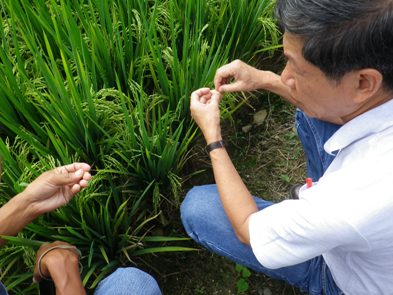
Daycha and farming friends exchanging rice-growing experience in the field
All articles in "Friendly Small Farmers, International Connections, Relay Record"