JA Zen-Noh's shrewdness is no less than that of the Ministry of Agriculture
Japan signed the TPP (Trans-Pacific Partnership trade agreement) in February of this year, and after that, JA Zen-Noh (the National Federation of Agricultural Cooperative Associations, the highest organization of agricultural cooperatives, abbreviated as JA Zen-Noh), which had previously raised the banner of opposing openness and free trade, actually made a complete 180-degree turn in its stance.
JA Zen-Noh brought together rice mills and rice farmers from nine prefectures including Fukushima, Niigata and Ishikawa, switched to high-yield and easy-to-manage rice varieties, and consolidated farmland to facilitate the operation of large machinery, reducing the time needed for manual management, lowering the production cost of rice, and beginning its transformation into export-oriented "aggressive agriculture."
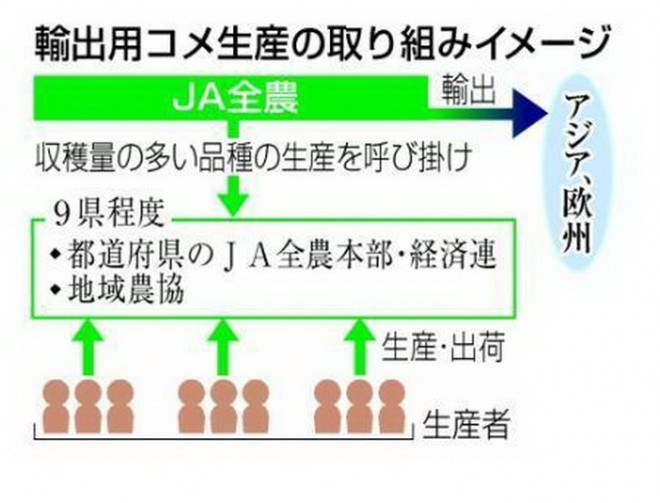 JA Zen-Noh believes that since foreign rice can come in, Japanese rice must certainly be able to go out. More precisely, it has no choice but to go out in order to survive, and its policies must also change in step with the times.
After the TPP was signed, Japan's JA Zen-Noh set aside the high-priced Koshihikari rice and switched to lower-priced, medium-to-upper-quality premium white rice as its main product, using the brand advantage of "Made in Japan" to target the consumer market of the middle class, the wealthiest and also the largest consumer group. According to estimates, within three years JA Zen-Noh expects its rice export volume to rise from the original 1,500 tons to 10,000 tons.
This reasoning is not hard to understand: rather than selling low-yield, high-unit-price Koshihikari rice to a small number of rich people, it is better to sell high-yield, medium-unit-price premium white rice to the majority of ordinary people, and only by expanding demand for the product can an entire industry be supported.
Japanese rice no longer insists on the "premium boutique" route, but instead sells a "commodity" that everyone needs, that everyone can accept, and that everyone can afford.
In this wave of trade liberalization, the Japanese agricultural cooperative, long regarded as old-fashioned and reactionary, went from launching protests to becoming export-oriented, a turn more agile than a white dolphin.
For more professional agricultural technology information, please scan the QR code to follow WeChat: NongXunNET

Please indicate the source when reprinting.