Taipei City Government food sampling tests find squid strips, sausages, and Philippine Cebu dried mango failed inspection
Text/Taipei City Government Department of Health
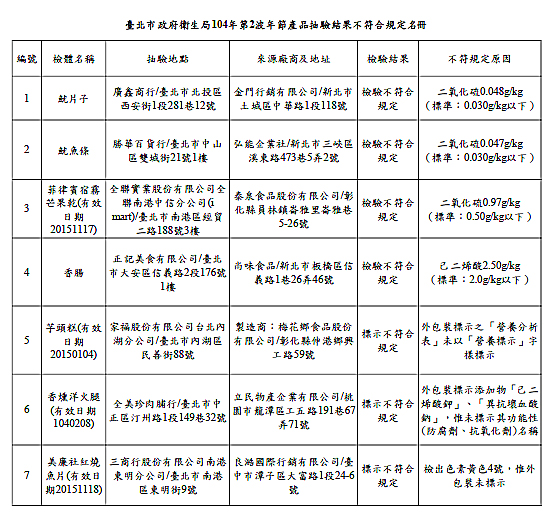
The Taipei City Government Department of Health announced the results of the second round of Lunar New Year food inspections. A total of 97 items were sampled this time, and 4 items failed to meet quality inspection requirements, for a failure rate of 4.1% (packaged: 4.3%, 1 item/23 items; bulk: 4.1%, 3 items/74 items). In addition, for the completeness of labeling on 23 packaged products, 3 items had labeling that failed to meet requirements, for a failure rate of 13.0%. The inspection results were also published on the department's website (inspection results analysis table as Attachment 1, inspection list as Attachment 2).
The 97 Lunar New Year food items sampled by the Taipei City Department of Health at retail and wholesale locations in Taipei City such as hypermarkets, supermarkets, and traditional markets included wood ear mushrooms, baked goods (such as cakes and pastries), wet rice products (such as nian gao and radish cake), processed meat products (such as sausages and dried meat), dehydrated fruits and vegetables (such as dried fruit and vegetable snacks), grain foods (such as melon seeds, crispy fava beans, and peanuts), processed aquatic products (such as shredded squid and dried shrimp), raisins, candies, and jellies. For the quality inspection portion, key inspection items included preservatives, bleaching agents, flavoring agents, coloring agents, aflatoxins, nitrites, pesticide residues, and more. The quality inspection results showed the highest failure rate for processed aquatic products (14.3%, 2 items/14 items).
Regarding the reasons for non-compliance of the 4 products that failed quality inspection: 3 items - "squid slices, squid strips, Philippine Cebu dried mango" - were found to contain excessive amounts of the bleaching agent "sulfur dioxide"; 1 item - "sausage" - was found to contain excessive amounts of the preservative "sorbic acid". This project also carried out labeling inspections on 23 packaged food items, of which 3 failed to meet requirements. The main reasons for non-compliance were: 1 item - "taro cake" - whose outer packaging labeling of the "nutrition analysis table" was not labeled with the wording "nutrition labeling"; 1 item - "smoked ham" - whose outer packaging labeled the additives "potassium sorbate" and "sodium erythorbate" but did not label their functional names "preservative" and "antioxidant"; 1 item - "braised fish fillet" - was found to contain the food coloring Yellow No. 4, but this was not labeled on the outer packaging.
The Taipei City Department of Health stated that for the products that failed quality inspection this time, in accordance with Article 18 and Article 47, Item 8 of the Act Governing Food Safety and Sanitation, manufacturers or responsible firms may be fined between NT$30,000 and NT$3 million. If the source cannot be accounted for, then in accordance with Article 47 of the same Act, the selling business may be fined between NT$30,000 and NT$3 million. In addition, for packaged products whose labeling inspections failed to meet requirements, this violates Article 22, Paragraph 1 of the Act Governing Food Safety and Sanitation, and in accordance with Article 47, Item 7 of the same Act, the responsible firm may be fined between NT$30,000 and NT$3 million, and the non-compliant products are ordered to be recalled and corrected within a deadline, and may not continue to be sold before correction. For products that failed to meet requirements, the department has notified sellers and upstream suppliers to remove them from shelves immediately. After tracing, the sources of the products were all in other counties and cities, and the department has transferred the matter to the health departments of the governing counties and cities for handling.
If the bleaching agent "sulfur dioxide" is ingested in excessive amounts, it may cause symptoms such as difficulty breathing, diarrhea, and vomiting. This is especially true for patients with asthma; eating foods containing excessive sulfites may produce allergic reactions of varying degrees, triggering asthma and difficulty breathing.
The preservative "sorbic acid" is a preservative commonly used in general foods. Through normal human metabolism, it is easily broken down into carbon dioxide and water and excreted from the body. Although it is a preservative with relatively low toxicity, it still may not be added arbitrarily to foods or used in excessive amounts.