Agricultural counties are stuck in a cycle of hard work with little reward, and the Fiscal Allocation Act has sat unmoved in the Legislative Yuan for 16 years
Tseng Chu-wei, a senior figure in fiscal and tax circles and currently chair professor in the Department of Public Finance and Taxation at China University of Science and Technology (photo / Lin Hui-chen)
Fiscal allocation suffers both from scarcity and from inequality
Both the pan-blue and pan-green camps intend to amend the "Financial Revenue and Expenditure Allocation Act." From 2002 to 2006, when the Democratic Progressive Party was in power and Lin Chuan served as minister of finance, he set out to amend the "Financial Revenue and Expenditure Allocation Act." After the Kuomintang came to power in 2012, the Ministry of Finance also proposed an amendment, and the core spirit of the two parties was not far apart: both sought to make revenue allocation "formula-based," more clearly set out allocation indicators, and change the original three-tier allocation system into two tiers, directly subtracting revenue from local government expenditure needs to assess allocation ratios.
However, the "Financial Revenue and Expenditure Allocation Act" has lain in the Legislative Yuan for 16 years. Fiscal officials admit that the tax reforms proposed by the two parties were basically similar in spirit, and the reason amendment has been delayed is not only political considerations but also that local governments each have their own calculations.
Tseng Chu-wei has participated in tax reform since 30 years ago, and during his term as a legislator from 2012 to 2016 he also actively called for amending the "Financial Revenue and Expenditure Allocation Act," but fought and lost repeatedly. He deeply realized that the focus of amendment is not universal allocation indicators such as population, land, and road area, on which local governments already have consensus. The hardest problem to solve is the uniqueness of each local government: "Agricultural counties feel the allocation is unfair and want to include agricultural, forestry, fishery, and livestock output value, but offshore islands may feel they are even more disadvantaged than agricultural counties."
For example, Kinmen County turned itself around thanks to Kinmen Kaoliang liquor, but because tobacco and alcohol tax is a national tax, Kinmen must hand over more than 3 billion yuan to the central government every year. The county government has repeatedly demanded amendment of the "Financial Revenue and Expenditure Allocation Act" to increase the proportion returned to local areas.
Each county and city proposes its own "most favorable indicator"
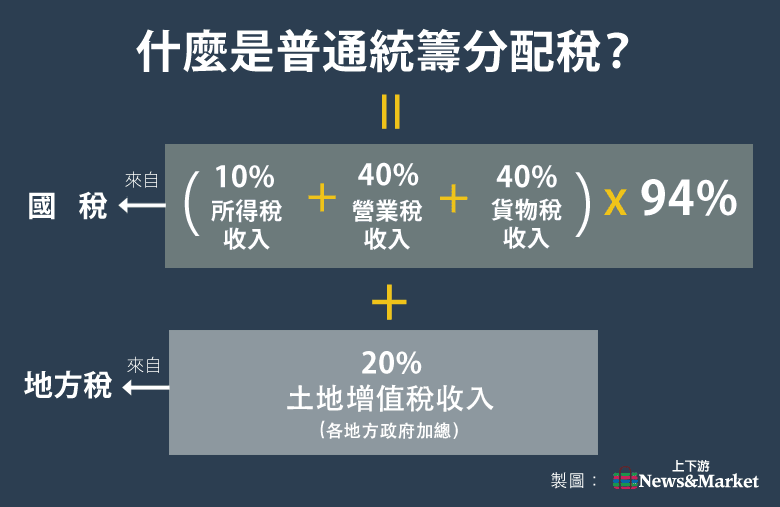
On how to allocate revenue fairly, academia and the government still have no consensus. Tseng Chu-wei proposed an innovative method: the "most favorable indicator," that is, under the 94% ordinary revenue allocation, set aside a certain proportion of funds and let local governments propose the indicators most favorable to themselves. These indicators must be public in nature, be reviewed by the central government as feasible, and be converted by ratio into allocable amounts. Added together and then divided by all the distributable money, this can let every local government get an answer it is satisfied with.
For example, if 5 billion is set aside, Nantou, being located in a mountainous area, might propose "forest area" as its indicator. Assuming Nantou County's forest area accounts for 20% of all Taiwan, it could receive 1 billion yuan. Hualien, long and narrow from north to south, might propose "coastline," and assuming it accounts for 10% of all Taiwan, it could receive 500 million yuan. In the end, when all counties and cities are added up, the total will certainly exceed 5 billion, so the original proportion would be reduced. For example, if the total comes to 10 billion, all counties and cities are halved: Nantou could receive 500 million, and Hualien 250 million.
Tseng Chu-wei said this design satisfies the uniqueness that local governments believe they possess, which might be agricultural land area, elderly population, forest area, coastline, and so on, proposed by the local governments themselves, making it harder for them to complain when funds are allocated in the future.
As for how much money should be set aside, he believes it should be at least 10~15% of the ordinary revenue allocation. "Although other countries do not do this, national conditions differ, and we must find creative methods to solve Taiwan's real problems."
Regarding Tseng Chu-wei's innovative calculation method, the Ministry of Finance's National Treasury Administration responded that because it is currently a caretaker cabinet and the new government intends to amend the "Financial Revenue and Expenditure Allocation Act," it is not convenient to express an opinion.
The Yunlin and Pingtung county governments, however, believe that only after the actual content is finalized and further trial calculations are made can they decide whether to support this approach.
Financial crises should be tackled starting from fiscal policy
Tseng Chu-wei said gravely that the "Financial Revenue and Expenditure Allocation Act" is a highly political law. The versions proposed by the two parties are not far apart in basic structure and spirit, yet they do not acknowledge each other. The "Financial Revenue and Expenditure Allocation Act" has already idled for 16 years, and he hopes this new government can truly amend it well and not, because of full governing power, once again fall into political considerations. "Allocation is the hardest problem for human society to solve, and Taiwan needs rational and professional discussion."
However, amending the "Financial Revenue and Expenditure Allocation Act" is only the first step in solving fiscal problems. Beyond increasing revenue, cutting expenditure is also very important.
Miaoli County, which at one point could not pay civil servants' salaries, has repeatedly criticized the "Financial Revenue and Expenditure Allocation Act" for favoring the six municipalities, causing Miaoli County's financial crisis. But spending money like water is also a main cause of local fiscal deterioration. Over the past 21 years, the Miaoli County Council has never deleted any budget. Holding lantern festivals, National Day fireworks, and free nutritious lunches cost hundreds of millions, making local finances worse. The Ministry of Finance has repeatedly responded to the Miaoli County Government that "amending the Financial Revenue and Expenditure Allocation Act cannot fully solve local fiscal problems; local areas should take fiscal responsibility themselves and improve financial efficiency."
Tseng Chu-wei said many people mistakenly treat "financial management" problems as "fiscal" problems, so they only look at whether government revenue and expenditure are balanced, but the scope of fiscal policy is complex, and financial management is only one manifestation of it. "Fiscal policy involves whether money is spent where it counts. Spending money on what should be done wastefully is corruption; what should not be done should not be done from the start. For example, if the government opened a cosmetics company and made a lot of money, that is not the government's duty, and even if it made money it still should not do it." Extended reading: [Japan Correspondent] Paying taxes for beef, hometown tax sparks heated debate. Read Here: https://www.newsmarket.com.tw/blog/84295/?utm_source=email&utm_medium=social&utm_campaign=newsmarket" class="nc_tweet"> Email