What Fish, Shrimp and Crab Farming Taught Me
The terraced paddy fields of the Gongliao mountain area draw water from mountain streams and gullies to irrigate the terraces, nurturing a rich diversity of life. After irrigation, the water flows out of the terraces and eventually rejoins the streams. Within the watershed of the Gongliao terraced paddy field catchment area, we applied to conduct a stream organism survey(Note 1). After three seasons of surveys, we examined the current state of the stream corridor. Let us begin by talking about the fish, shrimp and crabs in the streams.
Primary freshwater fish
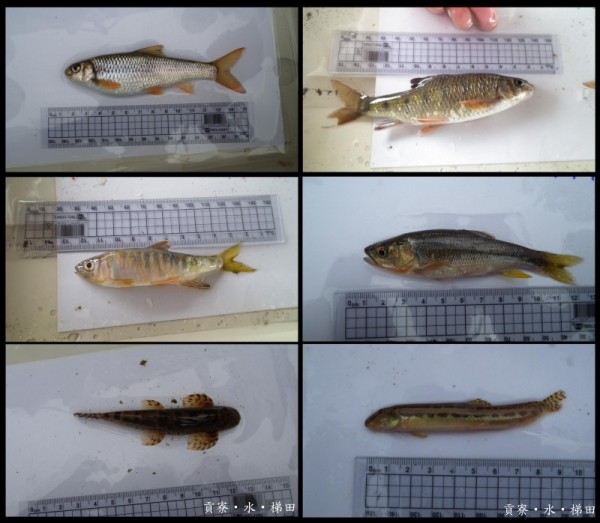
For a long time, because of poor transportation and terrain unsuited to development, the streams of the Gongliao mountain area have remained relatively pristine, with no major pollution sources entering the rivers. In them we also surveyed quite a few ‘primary freshwater fish’ that live in purely freshwater environments. Taiwan shovel-jaw carp, Taiwan torrent carp (Acrossocheilus paradoxus), Candidia barbata, Taiwan horse-mouth fish, Taiwan river loach, and Chinese spiny loach are all common primary freshwater fish found in the surveys. Among them, Taiwan shovel-jaw carp and Taiwan river loach are often used as indicator fish species for good water quality, because they have relatively high requirements for aquatic environmental quality. In addition, many species that were once migratory or lived in seawater and have now evolved into purely freshwater fish, such as the small carnivorous tyrants Rhinogobius duospilus, Rhinogobius rubromaculatus, and Rhinogobius candidianus, were all found to have stable populations during the surveys.
Left: Japanese mitten crab; right: giant river prawn
The importance of the stream corridor
After three seasons of stream surveys, within the watershed of the Gongliao terraced paddy field catchment area we recorded a total of 34 fish species in 8 families, 8 shrimp species in 2 families, and 5 crab species in 2 families, including primary freshwater organisms and amphidromous organisms. Among them were many indicator species for good water quality and fish listed in the “Red Data Book of Freshwater Fishes of Taiwan”(Note 2) as approaching threatened status, such as the Japanese eel and Taiwan goby, all of which indicate that the current condition of the watershed is still relatively good. As for migratory organisms, in addition to amphidromous organisms that need river and stream corridors for reproduction, some cyprinid fish such as Taiwan shovel-jaw carp and Candidia barbata also need a certain length of river section for feeding migration. All of this shows the importance of maintaining stable and unobstructed waterways, which is all the more precious compared with the over-developed rivers of western Taiwan. If related river management projects are undertaken, the construction stage and the methods chosen should take into account the possible impacts on these organisms. By contrast, within the watershed catchment area, friendly-farmed terraced paddy fields not only restore the organisms of the terraced paddy field ecosystem but also bear the task of protecting the stability of water sources and the quality of the water.
Note 1: Within the Gongliao District, the entire sections of the Yuanwangkeng Stream and its tributaries, the Fangjiao Stream and its tributaries, the Rongshu Stream, the Zhucao Stream and the Kengnei Stream have all been announced as closed streams for fish protection. During this project, because of terraced paddy field restoration, we discussed the importance of the mosaic landscape and, after applying and obtaining approval, conducted stream surveys. Fish, shrimp and crabs collected during the surveys were all measured alive and released back into their original habitat.
Note 2: “Red Data Book of Freshwater Fishes of Taiwan”, published by the Forestry Bureau of the Council of Agriculture, Executive Yuan, issued in July of ROC year 101 (2012). In the book, after discussing the numbers, distribution and environmental pressures of Taiwan’s 265 species of freshwater fish, 52 fish species requiring intensive attention are recommended, and are divided into four levels: A Critically Endangered (CR), B Endangered (EN), C Vulnerable (VU) and D Near Threatened (NT), to provide a basis for the subsequent review of Taiwan’s protected fish species list and the establishment of an assessment mechanism.