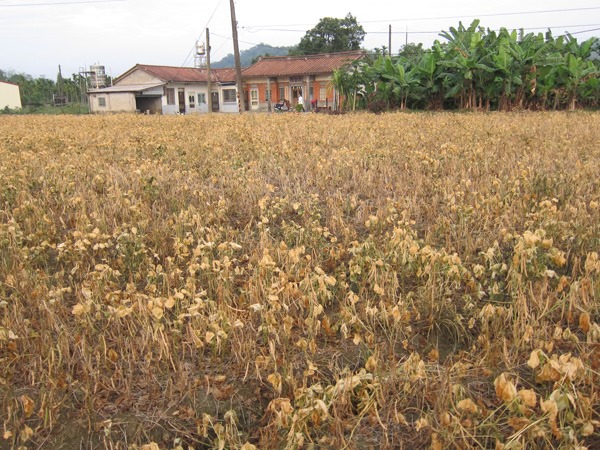
Meinong promotes safe red beans without the paraquat defoliant
Recently, Pingtung and Kaohsiung have successively entered the red bean harvest season. To accommodate mechanical harvesting, most farmers spray the herbicide paraquat, but paraquat has high oral toxicity and has been classified by the Council of Agriculture as a highly toxic pesticide, sparking considerable controversy. Yesterday the Meinong Farmers' Association invited more than 60 farmers to promote replacing paraquat with salt water, urea, and glacial acetic acid, offering guaranteed purchase at least 5 yuan above the market price, and coordinating bean-cutting and seedling operators to work with farmers in delaying the harvest schedule. At least 80 hectares of red bean fields in this crop season will not use paraquat, in the hope that, following white jade radish and orange honey cherry tomatoes, Meinong red beans will make a name for themselves.
Switching to non-paraquat defoliants, purchase price per jin is more than 5 yuan higher
With the cold wave arriving, many people like to drink a bowl of hot red bean soup. Red beans are a traditional winter crop in Taiwan, and at harvest time they need to be completely dry; otherwise the juice easily clogs the harvester and may also cause the red beans to "split their skins." To make the red beans dry out completely, farmers mostly spray herbicides, and among these, paraquat, rated as a highly toxic pesticide by the Council of Agriculture, is the cheapest and most effective, with results visible just hours after spraying. Every year from December to January of the following year, patches of withered yellow red bean fields are often seen in Kaohsiung and Pingtung.
Red beans are mainly distributed in Wandan, Pingtung, and in recent years Meinong, Kaohsiung has also caught up, with planted area approaching one thousand hectares. Seizing on the recent food safety crisis, the Meinong Farmers' Association invited more than 60 red bean farmers and researchers from the Kaohsiung District Agricultural Research and Extension Station yesterday morning to promote using high-nitrogen urea, highly concentrated salt water, and glacial acetic acid instead of paraquat after the red bean leaves turn yellow; defoliation is complete in about 2 weeks, and the farmers' association purchases at a price more than 5 yuan higher per jin.
Zhong Yalun, section chief of the promotion division of the Meinong Farmers' Association, said that in recent years the association has promoted traceability-certified red beans and strictly required participating farmers not to use paraquat, but last year the area was only just over 10 hectares. This year it is actively promoting the program, expanding to more than 60 farmers and 80 hectares of red bean fields. For farmers who meet the traceability standards, the association adjusts the purchase price according to market prices, and if the red beans have no pesticide residue, it will pay even more.
Zhong Qinghui, director-general of the Meinong Farmers' Association, said that in the past red bean prices were best in the early harvest period, and farmers might use paraquat at higher concentrations in order to harvest earlier. Although paraquat is considered safe, consumers still have doubts, "even farmers would specifically keep red beans that had not used paraquat for themselves to eat." With the association purchasing at guaranteed prices, farmers can have no worries. Although the harvest time is stretched out longer, "I hope farmers will treat consumers as their own family and give them the highest quality food."