Tougher Farmhouse Renovation Rules Put on Hold After Lawmakers' Pressure, Council of Agriculture to Keep Pushing
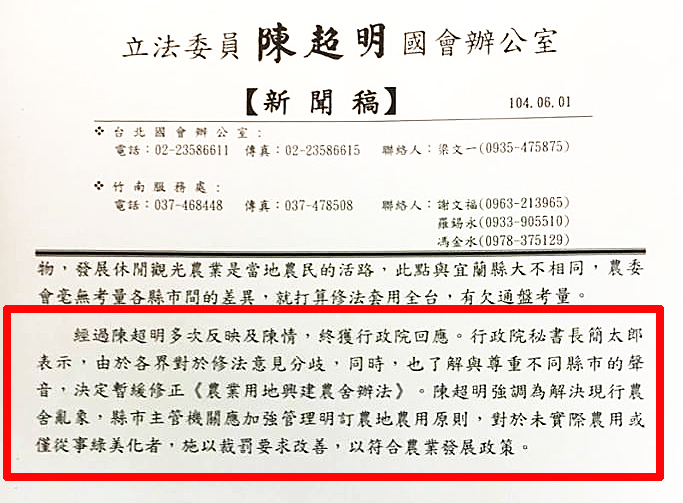
Updated 17:23: The Council of Agriculture originally planned to amend the "Regulations for Building Farmhouses on Agricultural Land" before the end of June, requiring that only farmers may buy farmhouses, but this drew backlash from many farmers' associations, city and county councilors, and legislators. Legislator Chen Chao-ming issued a press release yesterday stating that Executive Yuan Secretary-General Chien Tai-lang had promised to postpone the amendment, and Council of Agriculture Minister Chen Bao-ji confirmed that the Ministry of the Interior had indeed postponed the amendment, hoping to hear more opinions from all sectors, though it was unclear how long the delay might last.
Chen Bao-ji had sworn only last month that the amendment would definitely be made; now that it has met with backlash, will he follow the path of former Council of Agriculture Minister Peng Tso-kwei and step down over the policy to show resolve? Chen Bao-ji said it was only a postponement for now, and the Council of Agriculture still intended to amend the law, "Even with a major election coming, we still have to push it through to the end." (Click here for the full article)
──────────────────────────────────────────────
The Council of Agriculture planned to amend the regulations by the end of this month so that non-farmers could not buy farmhouses. Once the news broke, it drew backlash from many legislators and councilors. Miaoli legislator Chen Chao-ming issued a press release yesterday stating that 70 percent of Miaoli's agricultural land is hillside land, which can only be used to build farmhouses as homestays to develop tourism-oriented agriculture, and that the amendment would affect local development. After communication, the Executive Yuan had agreed to postpone the amendment. However, the competent authority, the Council of Agriculture, clarified today that it was only seeking broader opinions from all sectors and still expected to complete the amendment before the end of this month, "As long as nine-tenths of the agricultural land in leisure agriculture areas is still used for agriculture, the amendment will not affect the legal construction of farmhouses."
Although the Council of Agriculture stressed that the amendment would still proceed on schedule, someone familiar with the matter pointed out that the other competent construction authority, the Ministry of the Interior, had postponed the amendment due to election pressure, "But this offends young people even more; I don't know what they're thinking." As of now, Executive Yuan Secretary-General Chien Tai-lang and spokesperson Sun Li-chun have not answered phone calls.


Environmental groups criticize: leisure agriculture should be agriculture-first, tourism-second
However, Lu Yi-chi, a researcher at the Earth Citizen Foundation who has long followed hillside homestays, questioned this, saying that the focus of leisure agriculture is inherently agriculture-first and leisure-second. As long as nine-tenths of the agricultural land area is used for agriculture, the newly amended law will have no impact at all. "If you want to buy a farmhouse, come be a farmer!"
He believes many people misunderstand what leisure agriculture means. Taking Nantou's Cingjing Farm as an example, the illegal homestays there were almost all built under the name of farmhouses, and many of the cabins tourists love to stay in never underwent environmental impact assessments. Operators treat building a farmhouse as a special permit, then use it to develop leisure agriculture, distorting the original intent of leisure agriculture. "If you want tourism-first and agriculture-second, then inspect whether these farmhouses have undergone environmental impact assessments and whether they are located in debris-flow potential areas or geologically sensitive areas."
Lin Chang-li, deputy director-general of the Council of Agriculture's Soil and Water Conservation Bureau, also said that leisure agriculture areas are also a type of agriculture, and still only one-tenth may be used for farmhouses, while nine-tenths of the agricultural land must be used for agriculture and cannot be used for parking lots or scenery. If operators comply with the law, they will not be affected by the amendment.
Farmers worry agricultural land loans will be affected; Council of Agriculture: strengthen communication
Liang Wen-yi further pointed out that while making recent rounds he heard many farmers airing grievances, worried that agricultural land prices would collapse and that the collateral for loans previously secured with agricultural land might become insufficient, while farmers had no other collateral to offer at all. Farmers' associations have reported the same problem. "We also support agricultural land for agricultural use, but we hope agricultural land prices will gradually return to normal, not collapse all at once."
He said existing laws already stipulate that nine-tenths of agricultural land must be used for agriculture; it is just that local governments have not enforced it. If it were enforced now, there would be no need to amend the law at all. What the Council of Agriculture should do is clearly define agricultural use standards and include different types, such as greening and landscaping and parks, which do not count as agricultural use. Local governments can form inspection teams with township offices and fine violators until they improve, which would effectively deter illegal use.
Chen Chao-ming's office pointed out that as early as the 15th of last month, at the Kuomintang caucus meeting, it called on the central government to face the matter squarely, and last Friday when meeting with the Executive Yuan, Executive Yuan Secretary-General Chien Tai-lang also responded that the amendment would be postponed to listen to opinions from all sectors.
However, Lin Chang-li, deputy director-general of the Council of Agriculture's Soil and Water Conservation Bureau, said the Executive Yuan only asked for more communication with the public and for listening to opinions, not a postponement of the amendment. "We still aim to complete the amendment by the end of June."
Although the Council of Agriculture stressed that the amendment would still proceed on schedule, someone familiar with the matter pointed out that the other competent construction authority, the Ministry of the Interior, had postponed the amendment due to election pressure, "But this offends young people even more; I don't know what they're thinking."
Lin Chang-li said farmhouse and agricultural land prices are not like urban housing, and price declines should be controllable. Having already discussed loan matters with the Agricultural Bank of Taiwan, there should be no problem for now, and the Agricultural Bank of Taiwan will be asked to further communicate and coordinate externally. Although it is uncertain how many more briefing sessions will be held, many local councilors and farmers' associations have recently held forums on the farmhouse amendment, and the Council of Agriculture has sent people to explain, so the public can raise questions directly.