No need to spend money on pest control; plant hedges to create ecological habitats
The Hualien District Agricultural Research and Extension Station spent 2 years on field surveys, while also mentoring 7 organic rice farmers in Yinchuan, creating field ridges and planting hedgerows in the rice paddies to build habitat environments. They found that the orange ladybird beetle and the long-legged spider, natural enemies of the planthopper, a common rice paddy pest, have both returned. Farmers Zou Yitang and Pan Junsheng, who joined the project, both laughed and said: "We save time on mowing, and we no longer have to spend money on organic materials to wipe out pests, because the ecology balances itself!"
Balancing biodiversity means no need to spend money on materials
Fan Meiling, deputy director of the Hualien District Agricultural Research and Extension Station, began investigating the biodiversity differences between organic rice paddies and conventional rice paddies in 2012. Besides finding that organic plots had 51 more species than conventional ones, she also observed that natural enemies such as the Japanese long-legged spider and the orange ladybird beetle are highly sensitive to pesticides, making them very suitable as indicators for observing whether field biodiversity is present. So she began persuading farmers to create habitats in their fields suited to their survival.
Among the farmers in Fuli Township, Hualien County, who joined the project, Zou Yitang already had 17 years of experience growing organic rice. Even so, whenever the weather turned bad, he still needed to spend time on mowing more than 5 or 6 times over the course of each rice crop. Besides mowing to prevent the planthopper pest from multiplying heavily, spraying organic materials such as phosphorous acid or Bacillus thuringiensis was another method.
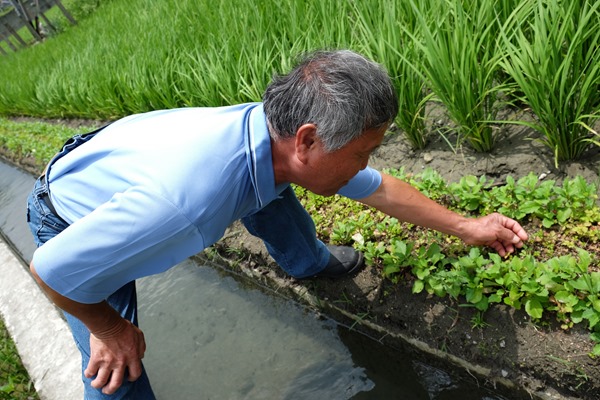
In February of this year, under the guidance of the Hualien District Agricultural Research and Extension Station, Zou Yitang began piling soil back onto the cement-lined field ridges to build new ridges, covering them with black netting to suppress the growth of dominant weeds such as Bidens pilosa var. radiata. Once the weed situation stabilized, he began planting a variety of native plants such as mock strawberry (Duchesnea indica), creeping tick trefoil (Desmodium triflorum), and Hsian-tsao (Mesona chinensis). The whole method took about 3 months to complete. He admitted that creating habitat is hard work, but after finishing he found that the orange ladybird beetles really did begin coming to the field ridges to live, and the flowers and grasses on the ridges would not grow into the water, so they needed hardly any upkeep, which made it all feel worthwhile to him.


(This article was funded by the Jianzhen Environmental Education Foundation for personnel costs, but the foundation did not interfere at all with news topic selection or interview writing, ensuring journalistic independence.)