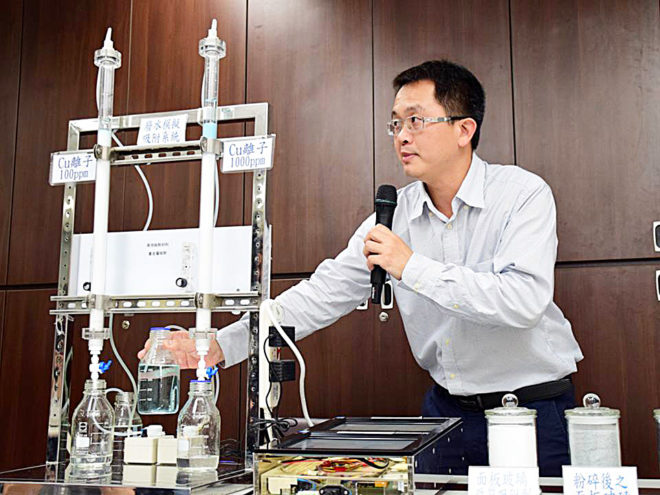
Discarded computer LCD panels can adsorb heavy metals from wastewater to remediate farmland
According to statistics from the Environmental Protection Administration, Taiwan, China recycled more than one million LCD flat-panel screens last year, about 600 tonnes. Although precious metals can be extracted and the waste put to use, large quantities of glass panels are still discarded and buried. However, the Environmental Protection Administration worked with the Industrial Technology Research Institute to develop discarded glass into a nanoporous adsorbent, which can be used to treat heavy-metal wastewater from printed circuit boards and semiconductors as well as to remediate contaminated farmland.
ITRI said that compared with traditional ion-exchange resins, the glass adsorbent has 3 times the adsorption capacity and can be reused more than 20 times, and compared with the chemical coagulation method, it does not have the problem of toxic contaminated soil that must be dealt with. However, this technology has not yet been commercialized, but it will first be tested next year in the electroplating zone of the Changhua Coastal Industrial Park. If fully replaced, it could save 54 million in contaminated soil treatment costs.
Traditional wastewater treatment is difficult, ITRI develops new technology
The traditional method of heavy-metal wastewater treatment is the "chemical coagulation method," in which heavy-metal wastewater is discharged into a treatment tank; after adding hydroxide, the heavy-metal ions in the wastewater can be precipitated, thereby removing the metal ions present in the water, including copper and cadmium. As long as the wastewater meets the effluent discharge standards, it can be discharged.
It is just that these sediments, commonly known as "toxic sludge," must, under the Waste Disposal Act, be handed over to a hazardous industrial waste treatment unit for processing, which means operators have to pay another cleanup fee.
Another common practice is to pass heavy-metal wastewater through "ion-exchange resin" to treat the wastewater. Tsai Cheng-kuo, a researcher in the Chemical Analysis Research Laboratory of the Industrial Technology Research Institute (ITRI for short), said that after wastewater passes through ion-exchange resin, the heavy-metal ions exchange with the sodium ions in the resin, so the wastewater only leaves behind sodium ions, and sodium ions naturally exist in nature, so discharge will not cause pollution problems.
It is just that ion-exchange resin cannot be reused over the long term. Tsai Cheng-kuo said that although the resin that has adsorbed metal ions can be washed with solvents to remove the metal ions for reuse, or even refined into metal, the solvents vary in acidity and alkalinity, which affects the resin's adsorption capacity, and usually after washing 3 times it can no longer be used.
However, ITRI worked with the Environmental Protection Administration to develop a new technology that processes discarded LCD flat-panel glass, and its ability to treat heavy-metal wastewater is better than that of the current ion-exchange resins, and it is expected to become an emerging product in wastewater treatment.