The Taste of Orange Season: A Winter Mountain Food and Farming Getaway
In December, the four seasons come to rest, the golden second rice crop has been harvested, farmers scatter green manure over the fields, and the various vegetables grown in their own kitchen gardens are fresh and dripping with dew. Meanwhile, on the low hills of Yuanli, the willow oranges (liu ding) and various citrus trees are laden with fruit, ripening in turn and waiting to be picked. Take a trip through a winter citrus orchard and you will find it every bit as lively as a spring day when a hundred flowers contend in bloom.
Miaoli's Yuanli, this small township nestled against the mountains and the sea, is known for its traditional rush weaving and its high-quality organic rice. Come here and you can visit the Rush Weaving Culture Museum to try your hand at traditional weaving, then see the famous rice paddy field art. Visiting Yuanli in winter, the best thing to do is climb along County Road 130 and look down over the seas of flowers in the fallow rice paddies along the way.
Heading all the way from the coast toward the low hills, as you drive through Jiaopu Village, you may as well stop at Jiaopu Elementary School. Not far away, amid tidy old-style roof tiles and pebble-paved ground, with a self-contained little vegetable plot and vibrant rice paddies beside the house, the sound of children's laughter drifts from the fields. This is "Satoyama School." "Satoyama School" was established by the Guanshu Education Foundation, which began working in Yuanli in 2006, setting up an "organic rice farm" to promote environmental education. When its lease expired at the end of last year and the site was returned to the owner to run independently, circumstances led it to Jiaopu Village, where "Satoyama School" was founded to continue its unfinished environmental education mission. Thus "Satoyama School," less than a year old, nonetheless carries long-accumulated local experience and deep knowledge of the place.
Make freshly picked willow oranges into jam with your own hands
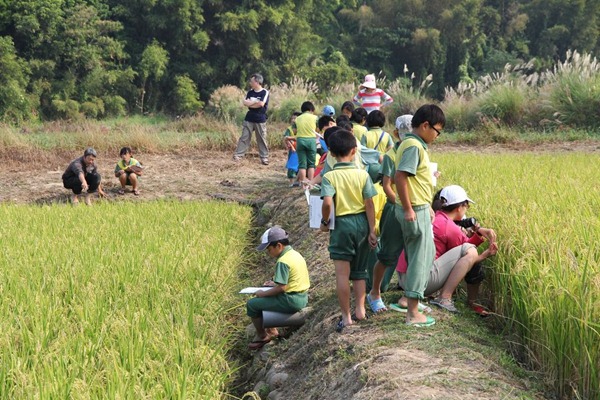
At "Satoyama School," a day might begin like this: led by staff, you visit a lush green orchard. Every child learns to be like that French writer Fabre of a hundred years ago, who was captivated by ecology and wrote the classic "Souvenirs Entomologiques" - straining to listen to the insects' calls, feeling with their hearts the changes in the surrounding environment, then carefully picking up an insect and getting to know a new friend together with the adults.
The farmer uncle nearby tells everyone that the most terrifying insect in the orchard is the longhorn beetle; it is the natural enemy of fruit trees, like cancer - once a fruit tree encounters it, it can only be slowly gnawed away and wither to death. For this reason, the longhorn beetle is also the greatest enemy of every fruit farmer. Starting from a single tiny insect, the adults and children who come to visit are delighted by the natural richness of the mountain wilderness, and also truly feel the hardship of farmers producing crops and their worries in the face of natural disasters.
At noon, after a lunch cooked with seasonal ingredients, comes the "fruit full-use classroom." Peel and process the willow oranges just picked, make natural delicious jam with your own hands, and you can also use the leftover pomace to make eco-friendly citrus cleaner. Jiang Jinfu, director of the Guanshu Education Foundation, says that modern society is used to quickly buying, using and throwing away. This class lets everyone know that such a consumption cycle increases unnecessary waste of resources, leads to rapid resource depletion, and also creates serious waste problems.
Yuanli has a clear distinction between dry and wet seasons, and the hills make water access difficult, so the Jiaopu area developed its unique irrigation pond and canal culture early on, and hand-dug irrigation wells are often seen in the fields and hills. The "wells" here also look very distinctive, with wide openings, deep or shallow, built up from pebbles, so they look more like a big pond, and traditionally people are used to calling such wells "ponds" or "fish ponds."
Right beside "Satoyama School" there is one such pond. Jiang Jinfu explains that this shape is to make it easier to catch rainwater, and the more elaborate ones even have an extra sloped staircase built so that people drawing water can walk down into the pond to fetch it. Jiang Jinfu says he hopes that through the establishment of "Satoyama School," more similar wisdom of the ancestors can be unearthed and organized among the low hills of Yuanli.
The layout of the irrigation ponds and canals also reflects the farming patterns of Jiaopu. Walking along the country lanes, rice paddies and orchards are the main crops. In earlier years this place was all rice paddies, with only scattered fruit trees mixed in here and there; rice paddies need water, and so Jiaopu's unique irrigation pond and canal landscape developed. In the 5th and 6th decades of the Republic of China era (the 1960s and 1970s), the government pursued an export policy, and because growing rice on the hillsides could not compete in cost with the mechanized southern plains, fruit trees gradually increased in number.

● Wild Satoyama Cooking
Event dates: 1/20 (Sun), 1/26 (Sat) of the 102nd year of the Republic of China (2013)
Event content:
● Before 09:30 Check in at "Satoyama School":
Roll up your sleeves, get to know the environment - the event is about to officially begin!
● 09:30-10:30 A fun Satoyama stroll:
Satoyama households return to the quiet winter life after the harvest, and the fields have also changed over to winter vegetables. Let us take a walk in the countryside together, step into the Satoyama living scene, and enjoy a leisurely winter!
● 10:30-11:00 Stretching exercises in the vegetable garden:
Go to the "Satoyama School" vegetable garden for some exercise to stretch your muscles and dig the soil and pull weeds, and experience the feel of standing on muddy ground and picking vegetables and fruit by hand.
● 11:00-12:10 The cooking smoke rises:
With all the ingredients ready, let us split firewood, set up the stove and light the fire; in winter the Satoyama cooking smoke curls upward, and with good local ingredients we will all work together to cook up a Satoyama feast in the fields!
● 12:15-13:30 Satoyama cooking, let's eat!
Savor the good flavor of Satoyama cooking bit by bit! Let body, mind and spirit all be nourished in the fields. Tidying up, cleaning up, washing the dishes, putting out the fire, clearing the kitchen scraps - let's have some after-meal exercise together and restore the Satoyama fields to how they were before!
● 13:40-15:00 Handicraft classroom – nature-style placemats:
A family gathered around the dining table to enjoy a meal is a kind of happiness; printing the image of nature onto a dining table placemat is a kind of everyday aesthetics! On a Satoyama afternoon, use rubbing and plant pounding to make your own personal placemats, so that when everyone returns to their own dining tables, they can also adorn them with the natural atmosphere of the Satoyama!
Event location: No. 82, Neighborhood 8, Jiaopu Village, Yuanli Township, Miaoli County
Who it's for: Parent-child families or adult groups
Event fee: 550 yuan per person (children under 3 are free of charge, and materials are not provided for them either!)
Notes: Please wear long pants, closed-toe shoes, a sun hat or rain gear, and bring a spoon, chopsticks and a water bottle.
How to register: Please go to the "Satoyama School" website to download the registration form; after filling it in, you can send it back by e-mail: [email protected] or by fax at (037) 745-200. After your registration is confirmed, please pay the activity fee within 3 days and fax the payment receipt for confirmation to complete the registration process.
Contact: (037) 745-200, [email protected]
How to get there: "Satoyama School" is located in Jiaopu Village, Yuanli Township, Miaoli County, beside County Road 130 at about 8.2K, only 200 m from Jiaopu Elementary School.
Public transport
Please take the coastal line train to Yuanli Station, then take a "Miaoli Bus Company" service bound for Jiaopu Guanyin Temple (there are very few services, so please check the schedule in advance), get off at the Jiaopu Elementary School stop, then walk up another 200 m and you will find "Satoyama School" on the left side of the road.
Driving yourself
County Road 130 is an important road connecting Sanyi Township and Yuanli Township. If you are coming by car:
1. Via National Freeway No. 3: Get off at the Yuanli Interchange (connect to County Road 140), choose the direction toward Sanyi, turn left at County Road 121 toward Shanjiao, then connect to County Road 130 toward Sanyi; after passing Jiaopu Elementary School, it is about 200 m ahead on the left.
2. Via National Freeway No. 1: Get off at the Sanyi Interchange, follow Provincial Highway 13 (Shuimei Street) north, turn left onto County Road 130, and at about 8.2K it is right there on the right (if you see Jiaopu Elementary School, you have gone too far, please turn around and go back 200 m).
(This article is published jointly with CommonWealth Parenting)